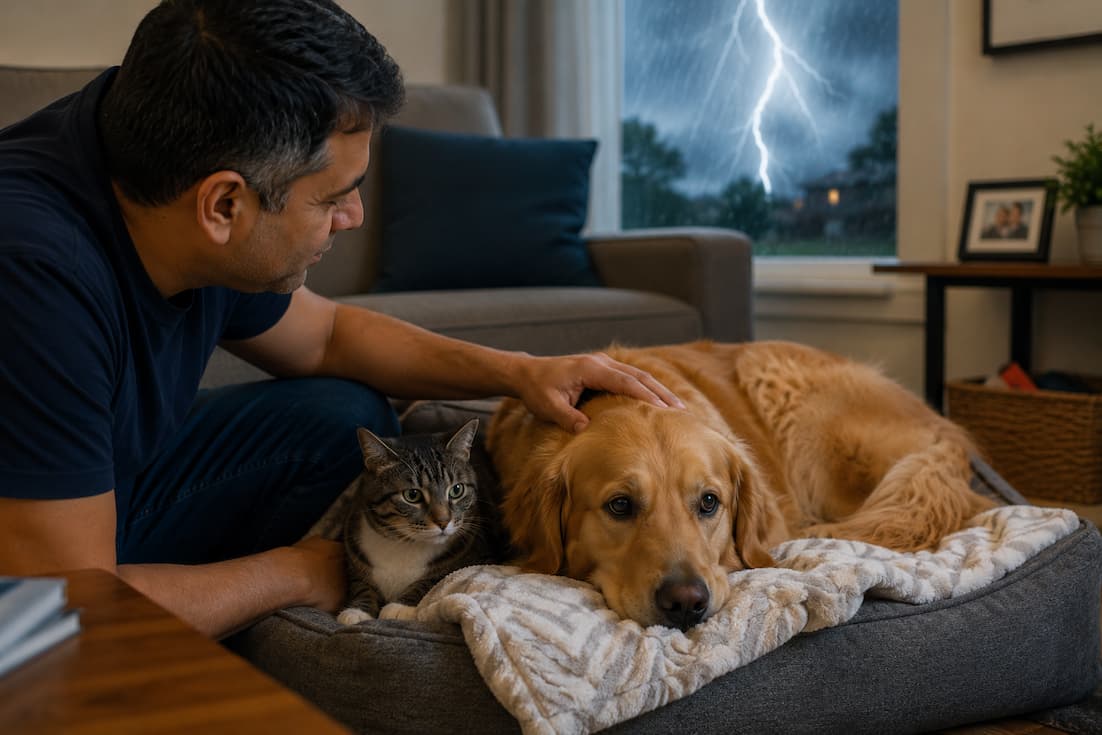
July 4th, 2024. I’m in my kitchen in Austin, making potato salad for a barbecue I no longer wanted to attend. Cooper, my Labrador, was under the table. Not just under it — pressed against the wall, trembling so hard I could see it from across the room. The first firework went off at 9:15 PM, three blocks over. By 9:20, Cooper had stopped responding to his name. By 9:30, he’d knocked over a chair trying to get into the bathroom, the only room in the house without windows. I spent the next three hours sitting on the tile floor with him, wondering why I’d ever thought the holiday was something to celebrate.
That night changed how I handle noise stress. Not because I learned some magic technique — I didn’t. But because I stopped treating Cooper’s fear as a behavior problem and started treating it as a medical one. What follows isn’t a list of tips I read online. It’s what I tried, what failed, what worked, and what I’m still figuring out two years later.
What I know now that I didn’t then: Noise phobia isn’t about the noise itself. It’s about the inability to escape it. A dog’s hearing range is roughly 40 Hz to 60,000 Hz — fireworks produce frequencies and pressure changes humans can’t perceive. The panic response is physiological, not psychological. You can’t talk a dog out of it any more than you can talk yourself out of a panic attack.
The Thundershirt Experiment: Six Months of Data
After that July 4th, I bought a Thundershirt Classic Dog Anxiety Jacket — size large, $39.95 on Chewy. The theory is simple: gentle, constant pressure on the torso triggers a calming response, similar to swaddling an infant. I was skeptical. Cooper is seventy-two pounds of solid muscle and stubbornness. A snug vest seemed like a band-aid on a broken leg.
I started testing it on non-firework days first. Thunderstorms in Texas are frequent enough that I had opportunities. The first storm, Cooper wore the Thundershirt for an hour before the rain started. He still paced. Still panted. But he didn’t try to break down the bathroom door. That was something.
By the third storm, I noticed a pattern. The Thundershirt didn’t eliminate his anxiety — it lowered the peak. Without it, Cooper’s stress level hit a ten and stayed there for hours. With it, he peaked at a seven, then gradually dropped to a four as the storm passed. The difference was enough that I stopped seeing it as optional.
But here’s what the packaging doesn’t tell you: the fit has to be precise. Too loose and it does nothing. Too tight and you restrict breathing, which makes anxiety worse. I spent twenty minutes adjusting the Velcro the first time. Now I can get it right in thirty seconds, but only because I marked the exact strap positions with a Sharpie. Cooper’s chest measurement is 31 inches. The large Thundershirt fits chests 24-32 inches. At the upper end of the range, I had to use the smallest Velcro setting. If your dog is between sizes, size down.
Limitations: the Thundershirt does nothing for the initial startle response. The first crack of thunder or firework still triggers panic. What it seems to do is prevent the panic from escalating into full breakdown. For Cooper, that’s the difference between manageable and unmanageable. For a dog with severe phobia — the kind that injures themselves trying to escape — it’s probably not enough on its own.
What I Learned About Pheromones
Three months after the Thundershirt, I added an Adaptil diffuser — $25 for the starter kit, $20 for refills that last about four weeks. The active ingredient is a synthetic version of the appeasing pheromone mother dogs produce 3-5 days after giving birth. The idea is that this chemical signal triggers a primal sense of safety.
I plugged it into the living room outlet in late September, before storm season ended and before I knew fireworks season was approaching. The instructions say to run it continuously for at least a month before assessing effectiveness. I gave it six weeks.
Did it work? Honestly, I’m not sure. Cooper’s behavior during that period was variable — some storms he seemed calmer, others not. The problem with pheromones is that you can’t run a controlled trial on your own dog. There’s no placebo group, no blinding. You observe, you guess, you attribute changes to whatever you most want to believe.
What I do know: the Adaptil diffuser didn’t hurt. It didn’t make Cooper drowsy or change his appetite. The veterinary literature supports its use as an adjunct therapy — something that may help when combined with other interventions, but isn’t a standalone solution. According to CEVA, the manufacturer, clinical studies have demonstrated efficacy for reducing stress-related behaviors in puppies and adult dogs, particularly when combined with behavioral therapy.citeweb_search:6#4
I keep the diffuser running now from June through August, covering fireworks season. Whether it’s doing anything or just making me feel better, I can’t say definitively. But at $20 a month, it’s cheaper than the vet bills from a dog that breaks through a screen door.
Sound Masking: White Noise vs. Music vs. Nothing
The first thing everyone suggests is turning on the TV or playing music. I tried everything. Classical playlists. Reggae — apparently there’s a study about dogs preferring reggae. White noise machines. Fans on high. Heavy metal, just to see.
Here’s what actually mattered: consistency and volume. Not the genre. Cooper doesn’t care about Bob Marley. What he cares about is whether the ambient sound is steady enough to mask the sudden, unpredictable cracks of fireworks. A TV show with variable volume — quiet dialogue followed by loud explosions — is worse than nothing. It creates false alarms.
What worked best was a combination: a LectroFan white noise machine ($45) set to “brown noise” — deeper and less harsh than standard white noise — plus a Bluetooth speaker playing a single, long ambient track from YouTube. Something without lyrics, without dynamic range, without surprises. I found a ten-hour “rain on roof” track that loops seamlessly. The brown noise handles the low frequencies. The rain track adds texture that seems to confuse the directional hearing that makes fireworks so startling.
I tested this setup during a thunderstorm in May. Cooper still reacted to the first thunderclap — ears back, brief freeze. But he recovered in about thirty seconds instead of ten minutes. By the third clap, he was lying down, head on paws, watching me. Not relaxed, exactly. But not in crisis.
The mistake I made for too long: I thought sound masking meant drowning out the noise. I cranked the volume until I couldn’t hear fireworks either. That level of sound is itself stressful — to Cooper, to me, to my neighbors. What works is masking, not overwhelming. The goal is to make the firework sound like it’s coming from inside the ambient noise, not like an intrusion. Lower volume, consistent texture, no surprises. It took me a year to understand the difference.
The Safe Space That Actually Worked
Cooper’s first safe space was the bathroom — no windows, tile floor, cool and dark. He chose it himself, breaking through a baby gate to get there. I leaned into it for a while: covered the door with a blanket, added his bed, left water. It helped, but it had problems. The bathroom has a fan that turns on with the light. The vent connects to the outside, so he could still hear fireworks, just muffled. And the tile was hard on his joints when he trembled for hours.
Last spring, I built something different. I took a corner of my bedroom closet — interior wall, no windows, carpeted floor — and converted it. Removed the shoes. Added a Frisco orthopedic dog bed ($35), a fleece blanket I’d slept with for a week so it smelled like me, and a small battery-powered LED light that stays on dimly. The closet door stays open — Cooper won’t enter if he feels trapped. But the darkness and enclosure seem to help.
The key discovery was the floor. Carpet absorbs vibration. Fireworks produce low-frequency pressure waves that travel through structure. Cooper could feel them in the bathroom, even when he couldn’t hear them clearly. In the closet, on carpet over a slab foundation, that vibration is significantly reduced. It’s not eliminated — nothing short of a bunker would do that — but it’s reduced enough that his startle response is blunted.
I tested this during New Year’s Eve 2025. Austin allows fireworks until 1 AM on January 1st. Cooper spent six hours in that closet. He wasn’t happy — he panted, he paced in small circles, he pressed against my leg when I sat with him. But he didn’t try to escape. He didn’t injure himself. He didn’t break anything. For a dog who once knocked over a bookshelf trying to get away from thunder, that’s progress I can measure in dollars of property damage.
When Medication Became Necessary
All of the above — Thundershirt, Adaptil, sound masking, safe space — works for moderate anxiety. It doesn’t work for severe phobia. In October 2024, a construction crew started using a jackhammer two blocks from my house. Cooper’s reaction was immediate and catastrophic: he broke through a screen door, ran into the street, and was nearly hit by a car. I caught him three houses down, shaking, bleeding from cuts on his paws, and completely unresponsive to commands.
That was the day I called my vet and asked about medication.
We started with trazodone — 100mg, given two hours before anticipated noise events. It’s an antidepressant with sedative properties, commonly prescribed for situational anxiety in dogs. The first dose, I gave Cooper 50mg to test tolerance. He was groggy but functional. At 100mg, he was calm enough to lie down during a thunderstorm but still responsive to his name and able to walk without stumbling.
What trazodone doesn’t do is eliminate fear. Cooper still heard the thunder. He still reacted — ears back, brief tension. But the medication prevented the reaction from escalating into panic. He could process the sound as unpleasant but not life-threatening. That’s the difference between management and cure.
In May 2026, the FDA approved Tessie (tasipimidine oral solution) — the first drug specifically indicated for both noise aversion and separation anxiety in dogs. I haven’t used it yet — trazodone works for Cooper, and switching medications involves risk. But the approval matters because it validates noise phobia as a legitimate medical condition deserving targeted treatment, not just off-label use of human drugs.citeweb_search:6#1
Another option is Sileo (dexmedetomidine oromucosal gel), FDA-approved since 2016 specifically for noise aversion in dogs. It’s applied to the gums and takes effect in about thirty minutes. The advantage over trazodone is speed — you don’t need to plan hours ahead. The disadvantage is duration: it lasts two to three hours, which may not cover an entire fireworks display. For unpredictable noise events, Sileo is more practical. For planned events like July 4th, trazodone’s longer duration is better.citeweb_search:6#1
What I learned about medication: it’s not failure. I resisted it for a year, thinking I should be able to manage Cooper’s anxiety with environmental changes alone. That resistance nearly got him killed. Medication is a tool, like the Thundershirt or the safe space. Use it when the situation demands it. Don’t use it when it doesn’t. The goal is Cooper’s welfare, not my pride in avoiding drugs.
Busy Days: When the Stress Isn’t Noise
Not all stress comes from fireworks and thunder. Last Thanksgiving, I hosted fourteen people. Cooper spent the day under my bed, emerging only after the last guest left at 11 PM. The stress wasn’t noise — it was chaos. Too many people, too much movement, too many unfamiliar smells.
I’ve learned to manage this differently. For planned busy days — holidays, parties, renovations — I now have a protocol:
Three hours before: Long walk, thirty minutes minimum. Physical exhaustion reduces anxiety baseline.
Two hours before: Thundershirt on, even though there’s no noise. The pressure seems to help with general stress, not just noise phobia. Or maybe it’s just familiar — a signal that something unusual is happening and he should prepare.
One hour before: Adaptil spray on his bed and the safe space blanket. The spray is more concentrated than the diffuser and works faster for short-term events.
During: Cooper stays in the bedroom with the door closed, white noise running, bed and water available. I check on him every thirty minutes. If he seems particularly stressed — panting, pacing, refusing treats — I offer a low dose of trazodone.
After: Quiet time, just me and him, no guests, no TV. He needs decompression as much as I do.
This protocol doesn’t make busy days enjoyable for Cooper. It makes them survivable. That’s the realistic goal. Anyone who tells you their dog loves parties is either lying or owns a Golden Retriever with no survival instincts.
The hardest lesson: I can’t fix Cooper’s noise phobia. I can manage it. I can reduce its impact. I can prevent it from getting worse. But the underlying sensitivity is part of who he is — genetics, early experiences, whatever combination made him this way. Desensitization training, the gold standard for noise phobia, requires starting two months before the trigger season with controlled sound exposure at very low volumes. I’ve tried it. Cooper’s threshold is so low that finding a starting volume he doesn’t react to is nearly impossible. For some dogs, it works. For Cooper, management is the realistic path. That acceptance took longer than any technique.
What I’d Do Differently If I Started Over
Looking back at two years of trial and error, here’s what actually mattered, ranked by impact:
| Intervention | Cost | What It Actually Did | Would I Recommend? |
|---|---|---|---|
| Trazodone (prescription) | ~$15/month | Prevented panic escalation during severe events. Did not eliminate fear but made it manageable. | Yes, for severe cases. Consult vet first, test dose before event day. |
| Thundershirt | $40 | Lowered peak anxiety by roughly 30%. Required precise fit. Useless without it. | Yes, for moderate anxiety. Size down if between sizes. Mark strap positions. |
| Safe space (closet) | ~$50 (bed, light, blanket) | Reduced vibration transmission. Gave Cooper a place to be instead of running. | Yes. Choose interior room, carpeted floor, open door. Let dog choose entry. |
| Sound masking | $45 (LectroFan) | Reduced startle recovery time from ~10 min to ~30 sec. Consistency mattered more than volume. | Yes. Use brown noise + steady ambient track. Avoid variable-volume sources. |
| Adaptil diffuser | $25 + $20/refill | Possibly helpful. Impossible to measure definitively. No side effects observed. | Maybe. Low risk, moderate cost. Use as adjunct, not primary intervention. |
| Desensitization training | Time-intensive | Ineffective for Cooper due to extremely low threshold. May work for milder cases. | Try it. Start 2+ months before season. If threshold is too low, pivot to management. |
Related Articles
- How to Recognize Signs of Pet Stress — The body language cues I missed for months before understanding Cooper’s anxiety was medical, not behavioral
- How I Correct Small Bad Habits in Pets Without Stress — Why punishment during anxiety episodes backfires and what redirection actually looks like under pressure
- Building Positive Behavior in Pets Through Daily Reinforcement — How consistent daily calmness training lowered Cooper’s baseline anxiety over six months
- How to Keep Your Pet Hydrated Daily — Why anxious dogs pant more and need water access even when they refuse food during stress events
- Creating a Safe Indoor Environment for Senior Pets at Home — How the safe space principles I used for Cooper’s anxiety overlap with senior pet comfort needs
- How I Monitor Pet Energy Levels for Early Health Signs — How stress-related sleep disruption showed up in Cooper’s activity data before I noticed it behaviorally
Sources and References
- Cornell University College of Veterinary Medicine. (2026). Fear of Fireworks and Thunderstorms. Riney Canine Health Center. vet.cornell.edu
- Coherent Market Insights. (2026, May 28). Pet Noise Anxiety Market Size, Trends & Forecast, 2026-2033. coherentmarketinsights.com
- CVS Vets. (2026, April 23). Noise Phobia In Pets. cvsvets.com
- CVS Vets. (2026, January 29). Keeping Your Pet Safe during Firework Season. cvsvets.com
- Drugs.com Veterinary. (2026, March 1). Adaptil Diffuser for Dogs. drugs.com
- DVM360. (2026, May 23). Noise Reactivities and Phobias in Dogs: Implementing Effective Drug Therapy. By Karen L. Overall, MA, VMD, PhD, DACVB. dvm360.com
- Blue Cross UK. (2025, November 26). Dogs and Fireworks. Reviewed by Claire Stallard, Animal Behaviourist ABTC-CAB. bluecross.org.uk
- Petgevity. (2025, November 17). How to Calm Dogs During Fireworks: Pet Anxiety Tips & Advice. petgevity.co.uk
Daniel Maxfield is a pet care writer focused on practical guidance for modern pet owners. He covers pet wellness, grooming, behavior, travel routines, and everyday care habits for dogs and cats. Through reader-focused educational content, Daniel shares simple and accessible tips designed to support healthier, safer, and more organized daily life with pets.