
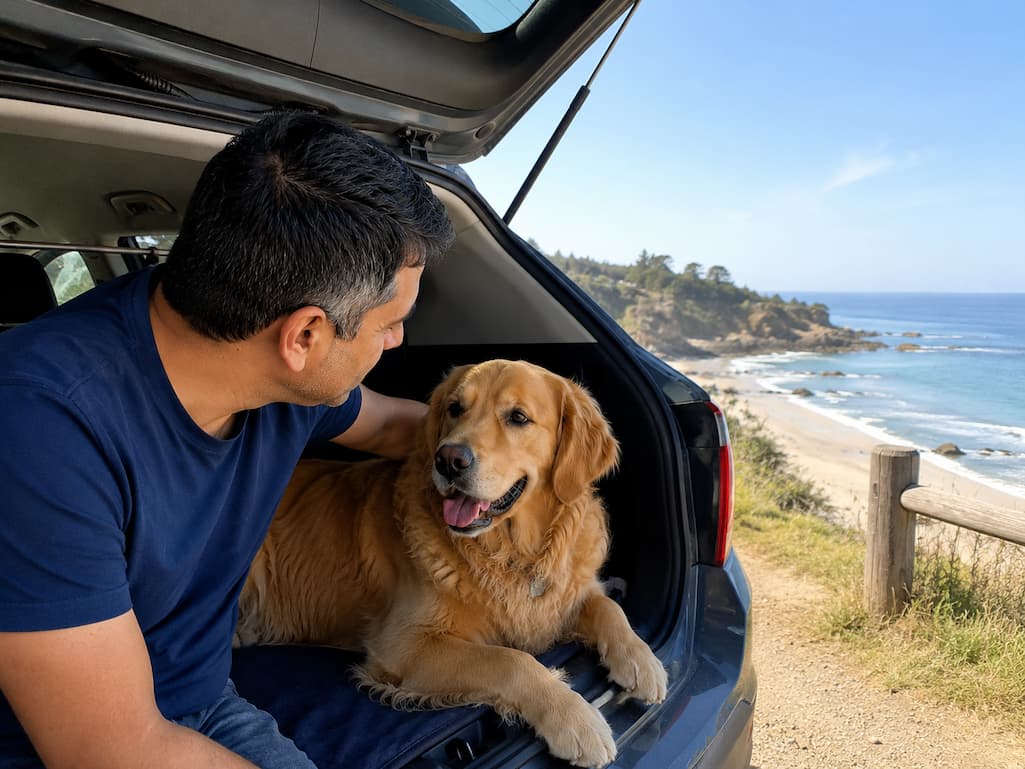
My first attempt at a pet-friendly vacation was a disaster I still pay for emotionally. Memorial Day weekend, 2023. I booked a “pet-friendly” cabin in the Texas Hill Country based on three photos and a website that used the phrase “fur babies” four times. The cabin was pet-friendly in the same way a parking lot is car-friendly — technically true, functionally useless. No fence. Neighbors with aggressive off-leash dogs. A “pet bed” that was a stained towel folded in a corner. Cooper spent the entire weekend on high alert, barking at every sound, refusing to eat. I spent $847 for three nights of stress and came home more exhausted than when I left.
That failure taught me something the travel blogs don’t: “pet-friendly” is a marketing term, not a standard. Anyone can claim it. Very few properties earn it. What follows is how I now plan vacations with Cooper — not aspirational advice, but the actual checklist I run through, the questions I ask, the red flags that make me close a browser tab immediately.
The single most important question: Does this property want pets, or merely tolerate them? You can tell by what they offer unprompted. A property that wants pets mentions specific amenities before you ask. A property that tolerates them buries pet policies in fine print and charges punitive fees. I’ve learned to read the difference like a language.
What “Pet-Friendly” Actually Means (And What It Doesn’t)
After that Hill Country disaster, I started keeping a spreadsheet. Every property I considered, I logged: stated policy, actual amenities, fees, reviews mentioning pets, and my final decision. After two years and forty-seven entries, patterns emerged.
Properties fall into three categories:
Category 1: Marketing Pet-Friendly
These places allow pets because they don’t want to lose bookings. The policy is usually “dogs under 25 lbs, $150 non-refundable fee, no leaving dog unattended in room.” Translation: we don’t actually want your dog here, but we’ll take your money. I’ve stayed at two of these. Both times, staff treated Cooper like a liability. One front desk employee asked me three times if he was “going to be a problem.” He was a six-year-old Labrador who had never been a problem in his life. I checked out early and ate the cancellation cost.
Category 2: Functionally Pet-Friendly
These properties have thought about pets enough to offer basics: designated relief areas, waste stations, maybe a bowl in the room. They’re fine. Not memorable, not terrible. Cooper gets through the stay without incident. I get through without joy. Most chain hotels fall here. Best Western is the standout — over 1,880 properties worldwide accept two pets up to 80 lbs, and some have dedicated dog-walking areas. La Quinta (Wyndham) is reliable too, though weight limits vary by location.citeweb_search:7#0 These are my backups when I can’t find anything better.
Category 3: Actually Loves Pets
These are rare and worth seeking out. Kimpton Hotels — all 50+ locations — accept pets of any size or breed with no fee. They provide beds, bowls, blankets, and door hangers. Some have a Director of Pet Relations. Their concierge will find you dog parks, pet-friendly restaurants, local vets.citeweb_search:7#0 I’ve stayed at the Kimpton in Chicago. Cooper got a welcome treat at check-in. The housekeeper left a handwritten note saying she hoped he enjoyed the extra blanket. That’s the difference.
Staypineapple is another Category 3, though smaller — ten locations in major cities, $25/night fee, treats and beds provided, dogs encouraged in communal spaces.citeweb_search:7#0 Aloft Hotels (Marriott’s ARF program) goes further — $50 fee gets you a bed, bowl, toy, door hanger, poop bags, dispenser, and floor mat. Around 130 properties worldwide participate.citeweb_search:7#0
I now refuse Category 1 entirely. I’ll take Category 2 for one-night stops on road trips. I plan entire vacations around Category 3.
My Pre-Booking Investigation Process
I don’t book pet-friendly properties through standard travel sites anymore. Those filters are too broad. “Pet-friendly” on Booking.com or Expedia means the property checked a box. It doesn’t mean they know what they’re doing.
Here’s my actual process, step by step:
Step 1: Find the property’s direct website
Third-party sites strip nuance. I need the property’s own words about pets. I search “[property name] pet policy” and read the actual page. What I’m looking for: specific amenities mentioned, weight limits stated clearly, fees explained, any mention of staff training or pet services. Vague language (“we welcome your furry friends”) is a red flag. Specific language (“we provide orthopedic dog beds, fresh water stations on each floor, and a concierge-curated map of local off-leash parks”) is a green flag.
Step 2: Read recent reviews filtering for “pet” or “dog”
I don’t trust the overall rating. I trust what people with pets actually experienced. I look for: mentions of staff attitude toward pets, cleanliness of pet-designated areas, whether other guests complained about pets being present, any incidents with aggressive animals. One review mentioning a loose aggressive dog in a “fenced” area is enough for me to eliminate a property.
Step 3: Call and ask specific questions
I have a script. I don’t deviate. The answers tell me everything:
- “What’s the exact pet fee, and is it per night or per stay?” — Some properties charge $50/night. For a week, that’s $350. Others charge $150 flat. The difference matters.
- “Is there a fenced area on the property, and how is it secured?” — “We have a grassy area” is not “we have a fenced area.” I’ve learned to press.
- “Can my dog be left alone in the room, and for how long?” — Some properties require crating. Some prohibit leaving pets entirely. I need to know before I book dinner reservations.
- “What happens if my dog barks while I’m out?” — The answer reveals their actual tolerance. “We understand dogs bark sometimes” is different from “we’ll ask you to return immediately.”
- “Are there other pets currently staying?” — I avoid properties with high pet turnover during peak season. Too many unfamiliar dogs in confined spaces creates stress for everyone.
Step 4: Verify the surrounding area
The property is only half the equation. I use Google Maps satellite view to check: Is there green space within walking distance? Are there busy roads immediately adjacent? Is the neighborhood walkable at night? I once booked a seemingly perfect cabin that turned out to be on a highway with no shoulder and no sidewalk. Cooper and I spent the weekend driving to a park twenty minutes away.
The call that saved me $1,200: Last fall, I found a gorgeous lakeside rental in Maine. Photos were perfect. Reviews were glowing. I called and asked my standard questions. The owner hesitated on the fenced area question, then admitted the “fence” was a three-foot decorative border around the deck — Cooper could step over it. The property backed onto a state highway with a 55 mph speed limit. No sidewalk. No streetlights. I would have been trapped in that cabin for a week, unable to let Cooper out safely without driving somewhere. The owner was honest when pressed. I’m grateful. I booked a Kimpton in Portland instead, drove to the lake for day trips, and both of us had a better time.
Documentation and Preparation: The Boring Part That Matters
I keep a travel folder — physical, not digital, because phone batteries die and cloud accounts lock — with Cooper’s complete records. What’s in it:
| Document | Why I Carry It | Format |
|---|---|---|
| Rabies certificate | Required by most hotels, some states, all international borders. Never assume your home state requirements transfer. | Original + photocopy in folder |
| Vaccination records (full) | Bordetella, distemper, leptospirosis — some boarding facilities or emergency vets require complete history. | Vet printout, updated annually |
| Health certificate | Required for some interstate travel and all international. Must be issued within 10 days of travel by an accredited vet.citeweb_search:7#1web_search:7#2 | USDA-accredited vet form |
| Microchip registration | If Cooper gets lost in an unfamiliar place, the chip is useless if the registration isn’t current with my travel contact info. | Registry printout + phone app backup |
| Recent photo | For lost pet flyers, social media posts, showing to people in the area. A current photo saves critical time. | Printed 4×6 + digital on phone |
| Emergency vet list | I research 24-hour emergency clinics within 30 minutes of every destination before I leave home. | Printed list with addresses, phone, hours |
For international travel, the requirements multiply. The UK and EU now require an Animal Health Certificate (AHC) for pets from Great Britain, replacing EU pet passports issued to UK residents. The AHC must be issued within 10 days of travel by an Official Veterinarian (OV), is valid for EU entry for 10 days from issue, allows 4 months of EU travel, and covers return to the UK. Costs range from £99 to over £200 depending on provider.citeweb_search:7#1web_search:7#4
China is the most extreme example I’ve researched: ISO microchip, two documented rabies doses, RNATT blood test from a GACC-accredited lab, 14-day health certificate validity, entry only through Beijing, Shanghai, or Guangzhou. Any documentation gap triggers mandatory 30-day quarantine at official facilities, entirely at your expense. No exceptions, no negotiation.citeweb_search:7#3 I mention this not because I’m planning a China trip with Cooper, but because it illustrates how dramatically requirements vary. Never assume what works for one country works for another.
What I Pack (And What I Stopped Packing)
My packing list has shrunk over time. Early trips, I brought everything — collapsible crate, extra leash, backup collar, three toys, grooming supplies, first aid kit, booties, cooling vest, warming vest, life jacket. I was prepared for scenarios that never happened and weighed down by the preparation.
Now I bring:
Non-negotiables: Food for the trip plus two extra days (same brand, never switch on vacation), portable water bottle and bowl, one leash, one collar with ID tag, waste bags, his regular bed (not a travel substitute — the familiar smell matters), one toy, medications if any, and the documentation folder.
Situational: Booties if we’re hiking rough terrain, cooling vest if summer in the south, anxiety medication if fireworks season. Everything else I can buy or do without.
What I stopped bringing: The crate (most Category 3 properties don’t require it, and Cooper sleeps fine on his bed), extra toys (he ignores them in unfamiliar environments anyway), grooming supplies (I can find a local groomer if needed, or just wait until home), the “just in case” first aid kit (I know where the emergency vet is, and I’m not performing field surgery).
The principle: familiarity over preparation. Cooper doesn’t need variety. He needs consistency. His bed smells like home. His food tastes like home. His routine — walk, eat, rest, walk — stays the same. The location changes. The structure doesn’t.
Managing the Vacation Itself
The planning is done. You’re there. Now what?
I structure vacation days around Cooper’s needs, not mine. Morning walk before any activity — thirty minutes minimum, off-leash if possible, letting him sniff everything. Sniffing is how dogs process new environments. Depriving them of it is like taking a tourist to a new city and blindfolding them.
Midday is for low-key activities. Cooper stays in the room (if the property allows — I confirmed this in Step 3) or comes with me to pet-friendly spots. I never leave him alone in a new place for more than three hours. The unfamiliarity amplifies anxiety. Three hours in a strange room feels like six.
Evening is another long walk, dinner at a pet-friendly restaurant or takeout eaten on a bench, early bedtime. I’m on vacation, but Cooper isn’t. His routine matters more than my nightlife.
The hardest part is other people. Other guests who don’t like dogs. Other dogs who aren’t well-managed. I once had a man yell at me because Cooper sniffed his shoe in a hotel lobby. Cooper was leashed. The man wasn’t injured, offended, or even inconvenienced — he just didn’t like dogs near him in a dog-friendly hotel. I apologized and moved away. Some battles aren’t worth fighting. The goal is Cooper’s comfort, not my pride.
The metric I use to judge a vacation: Does Cooper eat normally? Does he sleep through the night? Does he wag his tail when we head out for a walk? If yes to all three, the vacation succeeded, regardless of what tourist attractions I missed or restaurants I didn’t try. His baseline behavior is my report card. Everything else is bonus.
Related Articles
- How I Handle Feeding Schedules While Traveling With Pets — The exact timing and portions I use to keep Cooper’s digestion stable when his environment changes
- How I Pack a Lightweight Travel Kit for Pet Comfort — What made the cut and what got eliminated after too many overpacked trips
- Simple Hacks for Stress-Free Pet Travel — Carrier choices, calming aids, and the small adjustments that reduce travel anxiety
- How to Recognize Signs of Pet Stress — How I spot when vacation excitement is tipping into vacation overwhelm for Cooper
- How I Explore Cities Safely With My Pet Step-by-Step — My urban walking protocol for unfamiliar downtowns, crowds, and traffic
- Managing Pet Stress During Loud Noises and Busy Days — Why I avoid certain destinations during fireworks season and how I handle unavoidable noise events on the road
Sources and References
- Booking.com. (2026, March 5). The Best Pet-Friendly Hotel Chains in the World. booking.com
- Roundwood Vets. (2026, April 18). UK Pet Travel Requirements for the EU: New 2026 Rules Explained for Dog and Cat Owners. roundwoodvets.co.uk
- Paws Abroad. (2026, April 5). International Pet Travel Requirements 2026: The Complete Checklist. pawsabroad.co
- Zoovet Travel. (2026, February 24). 2026 Guide: China Pet Travel Requirements – Dogs & Cats. zoovettravel.com
- APHA (Animal and Plant Health Agency). (2026, April). Briefing Note 14/26 — Change to Pet Travel Rules. improve-ov.com

Daniel Maxfield is a pet care writer focused on practical guidance for modern pet owners. He covers pet wellness, grooming, behavior, travel routines, and everyday care habits for dogs and cats. Through reader-focused educational content, Daniel shares simple and accessible tips designed to support healthier, safer, and more organized daily life with pets.