
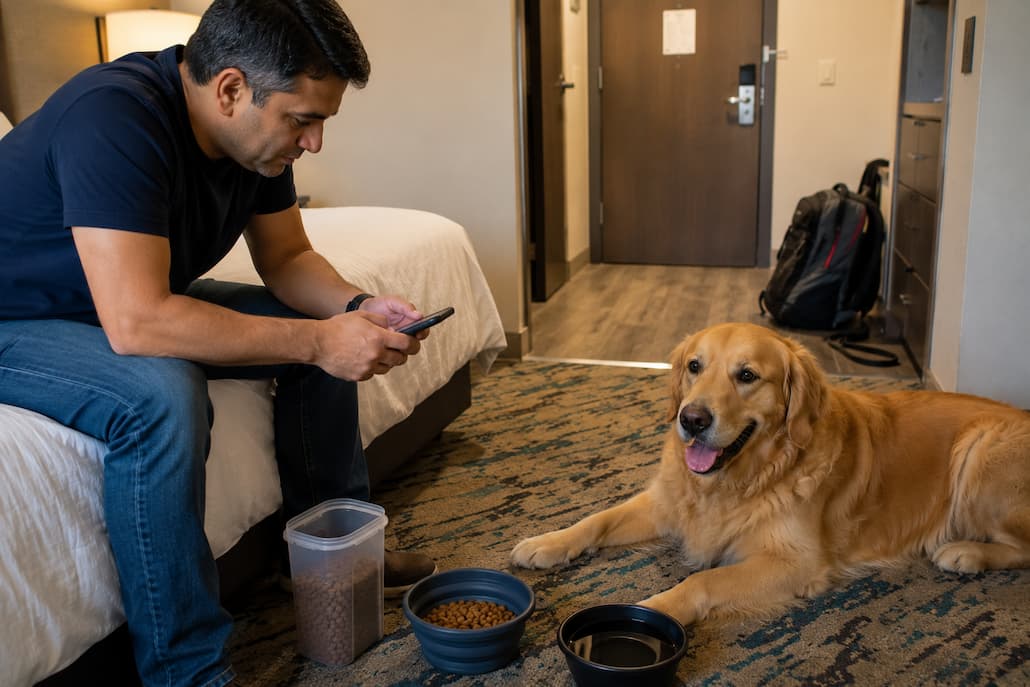
The first time I drove from Austin to Santa Fe with Cooper, my 7-year-old Labrador, I made every mistake possible. Fed him his usual 7 AM breakfast right before we left at 8. By the time we hit Amarillo, he’d thrown up twice in the back seat. I pulled over at a gas station, cleaned the mess with napkins and bottled water, and sat on the curb wondering how I’d survive eleven more hours. A trucker walked by with his German Shepherd, perfectly calm, and told me he’d learned the hard way too — never feed a dog within four hours of a long drive. That piece of advice, delivered between cigarette puffs outside a Buc-ee’s, changed how I approach every trip since.
Feeding schedules aren’t glamorous. They’re not the part of pet travel people photograph for Instagram. But get them wrong and your entire trip unravels. Get them right and your pet settles into travel like it’s just another Tuesday. After dozens of road trips, three flights, and one spectacular failure with a cross-country move, here’s what actually works.
The rule I live by now: Light meal, four hours before departure. Nothing in the two hours before. Water available until thirty minutes before we leave. This isn’t arbitrary — it’s based on how long kibble actually takes to clear a dog’s stomach, which is roughly three to four hours for most breeds. Feed too close to travel and you’re gambling with motion sickness.
Why Timing Matters More Than the Food Itself
Cooper isn’t a nervous traveler. He actually likes the car — head out the window, ears flapping, the whole cliché. But his stomach doesn’t share his enthusiasm. The issue isn’t anxiety; it’s physics. A moving vehicle disrupts the inner ear’s balance signals, and a full stomach makes that disruption much harder to handle. According to the ASPCA, pets should start with a light meal three to four hours before departure, and you should avoid feeding them in a moving vehicle entirely.citeweb_search:5#0
What “light meal” means depends on your dog. For Cooper, that’s about two-thirds of his normal breakfast portion — roughly one and a half cups of his usual dry food instead of two. For smaller dogs, it might be half. The goal is enough food to prevent low blood sugar and irritability, but not so much that there’s significant volume sitting in the stomach when motion starts.
Cats are a different story. My neighbor’s cat, Luna, won’t eat in unfamiliar environments at all. She fasted for fourteen hours during their move from Dallas to Denver and was fine. The general guideline from veterinary sources is similar to dogs — withhold food for four to six hours before travel — but cats are more prone to stress-induced appetite loss, so pushing too hard on fasting can backfire.citeweb_search:5#2
What I Pack and How I Organize It
I’ve refined my travel food kit over enough trips that I can now pack it in under five minutes. Everything lives in a single IRIS Airtight Food Storage Container — the 10-pound size, which holds about four days of Cooper’s food plus treats. The airtight seal matters more than you’d think. I once used a cheap snap-lid container on a humid July trip to New Orleans. By day two, the kibble had absorbed enough moisture to smell slightly off. Cooper ate it anyway — he’s a Labrador — but I won’t make that mistake again.
Here’s my actual packing list, which I keep on my phone’s notes app and check off before every trip:
| Item | What I Actually Use | Why It Matters |
|---|---|---|
| Food container | IRIS 10-lb airtight container ($18 on Amazon) | Humidity protection, stackable, doesn’t crack in heat |
| Measuring cup | Stainless steel 1-cup scoop from his home set | Consistency in portions — I don’t guess on the road |
| Collapsible bowls | Ruffwear Bivy Bowl ($25) for food, generic silicone for water | Food bowl needs to be stable; water bowl just needs to not tip |
| Wet food backup | Two cans of Purina Pro Plan Sensitive Skin & Stomach | If he refuses dry food due to stress, this usually works |
| Treats | Small bag of Zuke’s Mini Naturals | Low-calorie, don’t fill him up, good for rest stop rewards |
| Water | Bottled water — same brand he drinks at home | Water chemistry varies by city; sudden changes can cause stomach upset |
The bottled water point is worth expanding on. During a trip to Phoenix two years ago, I let Cooper drink from a campground spigot. He had loose stools for the next thirty-six hours. Not full diarrhea, but enough that I was cleaning the hotel bathtub at midnight. Now I bring at least two gallons of his usual bottled water for any trip longer than a weekend. The ASPCA specifically recommends opting for bottled water when traveling, since unfamiliar local water can cause stomach discomfort.citeweb_search:5#0
My Actual Road Trip Feeding Schedule
People ask for templates, so here’s what a typical driving day looks like for us. This assumes an 8 AM departure and a ten-hour drive with two planned stops.
5:30 AM — Light breakfast
One and a half cups of dry food, same brand as always. No treats, no extras. Cooper gets this in his usual bowl at home, not in the car. I want him to associate the meal with normalcy, not travel.
6:30 AM — Final bathroom break
Long walk, at least fifteen minutes. Not a quick backyard trip — I want his digestive system fully engaged and his bowels emptied before we’re confined in the car.
7:30 AM — Water cutoff
I remove his water bowl. He’ll get more at the first stop, but I don’t want a full bladder pressing against his stomach during the initial drive.
8:00 AM — Departure
No food, no water in the car. I keep a small towel within reach in case of drooling or unexpected nausea, though that’s rare now that I’ve got the timing down.
11:00 AM — First rest stop (hour 3)
Fifteen-minute walk. Offer water — usually about half a cup. No food. I let him sniff around, reset his equilibrium, then back in the car.
2:00 PM — Second rest stop (hour 6)
Another walk, longer this time — twenty minutes if the location allows. Water again, half a cup. If we’re driving past six hours total, I’ll offer a small handful of kibble or a couple of treats here. Not a meal, just something to stabilize blood sugar.
5:00 PM — Arrival
Full dinner, normal portion, normal timing relative to our destination time zone. I don’t gradually shift his schedule — I switch to the new time zone immediately. Dogs adjust faster than humans in my experience, especially if they’re tired from the drive.
Time zone trick: If you’re crossing zones, feed by the clock at your destination, not your origin. Cooper’s stomach doesn’t know it’s 5 PM in Austin and 6 PM in Nashville — it just knows it’s been a long day. Feeding by arrival time helps him sync faster. I learned this the hard way during a Chicago trip where I kept him on Austin time for two days. He was restless at midnight, hungry at 4 AM, and generally miserable until I gave up and switched him over.
What Flying Changed About My Approach
Road trips let you control everything. Flying strips that control away. The first time I flew with Cooper — Austin to Seattle, three and a half hours — I followed the same four-hour rule but added a complication I hadn’t considered: TSA.
Solid pet food is allowed in carry-on, which is what Cooper eats. But I also packed two cans of wet food as backup, and those fell under the 3-1-1 liquids rule. Each container had to be 3.4 ounces or less, all fitting into a single quart-sized bag. My cans were 5.5 ounces. The TSA officer was patient but firm — they went in the trash, or I went back to check a bag. I trashed them.citeweb_search:5#3web_search:5#6
Now I only pack dry food for flights, pre-measured into individual Ziploc bags — one bag per meal, labeled with a Sharpie. If Cooper refuses to eat due to stress (which happened once during a delayed connection in Denver), I don’t have to open a container and measure in an airport bathroom. I just hand him a bag’s worth in his collapsible bowl and hope for the best.
The other flying-specific issue is the pre-flight meal timing. For a 10 AM flight, that means feeding at 5 or 6 AM — earlier than Cooper prefers, but necessary. I set two alarms and drag myself out of bed. The one time I tried feeding him at 8 AM for a 10 AM flight, he vomited in the carrier during takeoff. The flight attendant was kind about it, but the smell in a pressurized cabin is something you don’t forget.
Veterinary sources generally recommend withholding food for four to six hours before flying, with water restricted to small amounts in the final one to two hours.citeweb_search:5#2 Puppies, seniors, and pets with medical conditions need custom schedules worked out with a vet — never wing it with a diabetic dog or a kitten.citeweb_search:5#2
When Things Don’t Go According to Plan
Delays happen. Traffic, weather, mechanical issues with the car — I’ve hit all of them. Last March, a blown tire outside Flagstaff added four hours to what should have been a straightforward drive to the Grand Canyon. Cooper’s schedule was wrecked. He’d had his light breakfast at 6 AM, expected dinner at 5 PM, and was still in the car at 8 PM.
Here’s what I did, and what I’d do again:
I keep a small emergency ration in the glove compartment — about one cup of kibble in a sealed bag, plus a few treats. Not enough for a full meal, but enough to take the edge off if we’re significantly delayed. I offered Cooper a handful at the 6 PM mark when I realized we weren’t making our target. He ate it. I offered another handful at 7 PM. When we finally arrived at 9:30 PM, I gave him a reduced dinner — about three-quarters of his normal portion — and let him settle before bed. The next morning, we were back on schedule.
The principle is simple: partial feeding beats skipped feeding. A dog with an empty stomach for twelve hours gets irritable, then nauseous, then refuses food when you finally offer it. Small, spaced-out portions keep the digestive system engaged without overwhelming it.
Medications and Special Cases
Cooper doesn’t need motion sickness medication anymore — the timing and portion control solved that. But for pets who do, veterinarians commonly prescribe Cerenia (maropitant) or trazodone for travel anxiety and nausea.citeweb_search:5#1 I’ve never used these, so I won’t pretend to be an expert. What I will say is: get the prescription before you leave, test the medication on a short drive first, and never give a sedated pet unsupervised access to water or food. The combination of drugs and a full stomach is riskier than either alone.
For natural alternatives, some owners use ginger — about half a teaspoon for a dog Cooper’s size, mixed into food thirty minutes before travel.citeweb_search:5#5 I’ve tried it once, on a particularly winding mountain road in Colorado. Cooper seemed slightly less drooly than usual, but the effect was subtle enough that I can’t say for certain it helped. Your mileage may vary.
The one thing I wish I’d known earlier: Your emotional state matters more than the food schedule. Dogs read tension in your shoulders, your voice, your breathing. The trip where Cooper vomited twice? I was stressed about a work deadline, running late, snapping at traffic. The trip where he slept peacefully for six hours? I was relaxed, singing along to podcasts, stopping whenever he seemed restless. The schedule is important, but your calm is the foundation everything else builds on.
Related Articles
- How to Keep Your Pet Hydrated Daily — Why I bring bottled water on every trip and how to spot dehydration before it becomes serious
- How AI Is Transforming Pet Food, Toys, and Health — Smart feeders that adjust portions automatically and how they handle travel disruptions
- Simple Hacks for Stress-Free Pet Travel — Carrier choices, calming aids, and the gear that actually makes a difference on long drives
- How to Plan a Pet-Friendly Vacation — Finding hotels that don’t just allow pets but welcome them, and why that matters for feeding routines
- How to Recognize Signs of Pet Stress — How appetite changes during travel can be your first warning signal
- How I Pack a Lightweight Travel Kit for Pet Comfort — The full packing system that includes food organization, water management, and emergency supplies
Sources and References
- ASPCA. (2026). Travel Safety Tips. aspca.org
- PetMD. (2025, January 16). Dog Motion Sickness: What It Is and How To Help Your Dog. Written by Brittany Kleszynski, DVM. petmd.com
- Travel Ready Pets. (2025, December 23). How to Prepare Your Pet Before a Flight: A Complete Guide. travelreadypets.com
- Canadian Air Transport Security Authority. (2026, February 6). Flying with Animals and Pets. catsa-acsta.gc.ca
- Transportation Security Administration. (2026). Complete List: What Can I Bring? — Pet food guidelines. tsa.gov
- NW Naturals. (2025, April 9). Summer’s Coming: Motion-Sickness Travel Tips. nw-naturals.net
- VCA Hospitals. (2026). Motion Sickness in Dogs. vcahospitals.com
- Animal Cargo. (2025, September 1). Feeding and Care During Air Travel With Your Pet. animalcargo.com

Daniel Maxfield is a pet care writer focused on practical guidance for modern pet owners. He covers pet wellness, grooming, behavior, travel routines, and everyday care habits for dogs and cats. Through reader-focused educational content, Daniel shares simple and accessible tips designed to support healthier, safer, and more organized daily life with pets.