
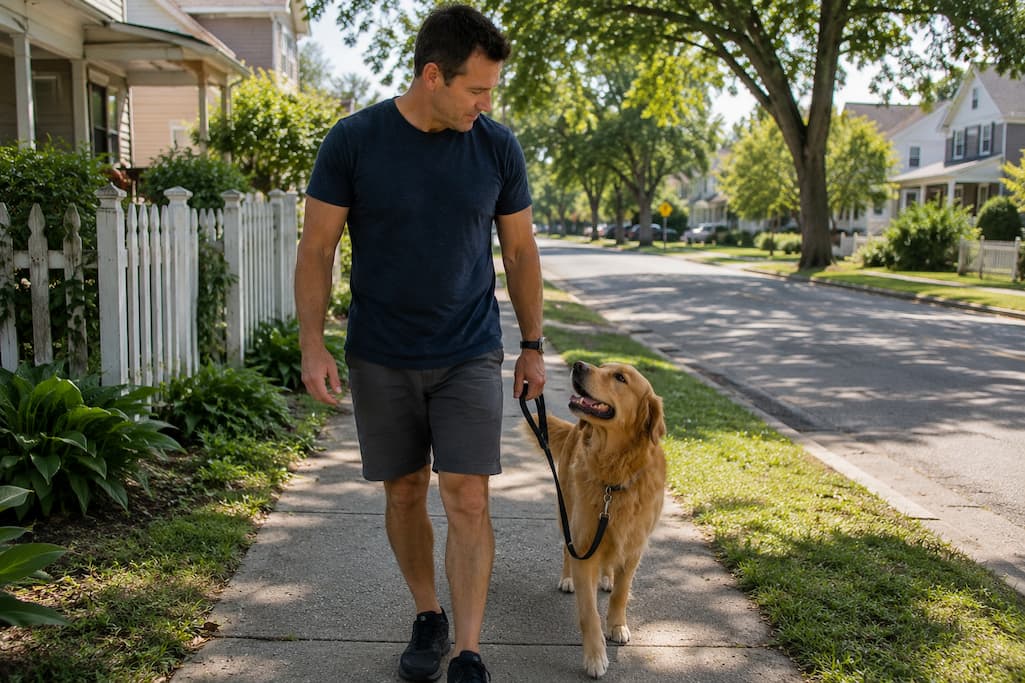
My shoulder still twinges when I think about it. Cooper was two years old, sixty pounds of muscle and enthusiasm, and he had just spotted a squirrel across the street. I was holding the leash with one hand, coffee in the other, completely unprepared. He lunged. The coffee went flying. My shoulder made a sound I did not like. And for the next six months, walks were something I dreaded rather than enjoyed. Leash pulling is one of the most common complaints dog owners have, and it is also one of the most misunderstood. People think the dog is being dominant, or stubborn, or badly behaved.
Cooper was none of those things. He was excited. The world was full of smells and movement and other dogs, and the leash was the only thing stopping him from experiencing all of it at once. My job was not to break his spirit. It was to teach him that walking beside me was more rewarding than charging ahead. I tried several methods before finding one that worked. Some made things worse. Some worked temporarily and then fell apart. The approach I describe here took three weeks of consistent daily practice, and it has held up for over five years. Cooper still gets excited on walks. He still notices squirrels. But the leash stays loose, and my shoulder has been pain-free since 2020.
Why Most Leash Training Fails
Before I get to what worked, I need to explain what did not. I tried the “be a tree” method first. The idea is simple: when the dog pulls, you stop walking and stand still like a tree until the leash loosens. In theory, the dog learns that pulling stops forward motion. In practice, Cooper would pull, I would stop, he would keep pulling, I would keep standing, and we would both get frustrated. He did not make the connection. He just thought walks were boring and unpredictable. I also tried a front-clip harness. The design redirects the dog’s momentum toward you when they pull, which sounds clever. Cooper hated it.
The pressure on his chest made him wheeze, and he spent entire walks trying to twist out of it. I switched back to a standard back-clip harness after three days. The retractable leash was the worst idea. It taught Cooper that tension on the leash was normal. The spring-loaded mechanism meant the leash was always tight, so he never experienced what a loose leash actually felt like. I threw it in the trash after a week. The common thread in all these failures was that I was focused on stopping the pulling rather than teaching an alternative behavior. You cannot erase a behavior by suppressing it. You have to replace it with something the dog wants to do instead.
The Method That Actually Worked
The technique I settled on is a variation of what trainers call the “red light, green light” game combined with direction changes. I did not invent it. I learned it from a professional trainer during one of the five sessions I describe in another article. But I adapted it for Cooper’s specific temperament, and that adaptation made the difference. Here is the basic structure. Walk with your dog on a six-foot leash. The moment the leash goes tight, you stop. Do not yank. Do not say anything. Just stop. Wait for the leash to loosen — even a tiny bit — and the instant it does, say “yes” and take one step forward. If the leash stays loose, keep walking and reward every few steps with praise or a treat. If the leash goes tight again, stop again.
The second component is direction changes. If Cooper pulled and stopping did not get his attention within three seconds, I turned and walked the opposite way. No warning. No cue. Just a smooth pivot. Cooper would be caught off guard, the leash would loosen as he turned to follow, and I would mark the loose leash with “yes” and treat. The unpredictability of the direction changes was key. Cooper could not anticipate where we were going. He had to pay attention to me to know which way to walk. The more random my movements, the more focused he became. I walked in circles, figure-eights, sudden reversals. My neighbors probably thought I was lost. Cooper thought the walk was a game.
Week One: The Setup Phase
I started in my backyard. Not on the street, not at the park. The backyard had minimal distractions — no squirrels, no other dogs, no cars. Just grass, fence, and me. Cooper and I walked laps around the perimeter. When the leash tightened, I stopped. When it loosened, I said “yes” and stepped forward. The first two days were maddening. Cooper would hit the end of the leash, I would stop, and he would stand there pulling against the tension like he was trying to tow a boat. I waited. Sometimes thirty seconds. Sometimes a full minute. Eventually, he would shift his weight, the leash would slacken, and I would reward.
We covered maybe fifty yards in twenty minutes. On day three, something clicked. Cooper started checking in with me voluntarily. He would walk a few steps, glance at my face, and if I was moving, he would match my pace. The leash stayed loose for three steps, then five, then ten. I threw a party every time — treats, praise, the works. Dogs do not understand moderation in celebration. If the behavior is worth doing, it is worth rewarding enthusiastically. By the end of week one, Cooper was walking loose-leash laps around the backyard without me stopping once. We had not left the yard. We had not encountered a single distraction. But the foundation was there. He understood the game: loose leash equals forward motion and rewards. Tight leash equals nothing.
Week Two: Adding Distractions
Once the backyard was solid, I moved to the driveway. Then the sidewalk in front of my house. Then one block down the street. Each new environment added distractions, and each time Cooper’s leash walking degraded slightly. That is normal. Dogs do not generalize well. A behavior learned in the backyard does not automatically transfer to the sidewalk. I managed this by lowering my criteria in new environments. In the backyard, I expected twenty steps of loose leash before a treat. On the sidewalk, I treated every five steps at first. As Cooper adjusted, I gradually increased the distance between rewards. By the end of week two, he was walking a full block with the leash loose, treating every fifteen steps. The direction changes became more important in week two. When Cooper saw another dog across the street, his ears went up, his tail rose, and he started pulling. I did not try to power through it. I turned and walked the other way. The moment the leash loosened as he followed, I marked and treated. We repeated this until Cooper could see the other dog without pulling. Sometimes that meant five direction changes in one block. It looked ridiculous. It worked. I also started using a verbal cue: “with me.” I said it before every direction change, before every stop, before every reward. The goal was to build an association between the cue and the behavior. Eventually, “with me” would become a signal for Cooper to check in and match my pace. But in week two, it was just background noise. The leash mechanics mattered more than the words.
Week Three: Real-World Proof
By week three, I was ready for the test. I took Cooper to the park on a Saturday morning — peak squirrel activity, other dogs everywhere, kids on scooters, the full sensory assault. I was nervous. This was where previous training attempts had collapsed. The first five minutes were shaky. Cooper pulled toward a Labradoodle. I stopped. He pulled harder. I turned. He followed, and I treated. We did this three times before he walked past the Labradoodle with a loose leash. Then a squirrel ran across the path. Cooper lunged. I stopped, waited, turned when he did not respond to the stop, and treated the follow. Two more squirrels, same routine. By the fourth squirrel, Cooper saw it, glanced at me, and kept walking. I almost cried. The breakthrough was not that Cooper stopped noticing distractions. It was that he started choosing me over them. The history of rewards for loose-leash walking had built value in staying near me. The squirrels were still interesting, but they were not more interesting than the treats, praise, and forward motion I provided. By the end of week three, Cooper could walk through the park on a loose leash for thirty minutes with only occasional stops and direction changes. It was not perfect. He still pulled toward particularly enticing smells. But the pulling was brief, correctable, and rare. My shoulder was safe. My coffee stayed in my cup.
The Equipment That Helped
I am not a gear obsessive, but three pieces of equipment made this process easier.
A standard six-foot leash. Not a retractable. Not a chain. A simple nylon or leather leash with a clip on one end and a loop on the other. Six feet is the sweet spot — long enough for the dog to explore slightly, short enough that you can manage the slack effectively. I use a leather leash that has softened over years of use. It feels good in my hand and does not burn if Cooper pulls suddenly.
A back-clip harness. Not a front-clip, not a head halter, not a prong collar. A basic harness that clips on the back. The harness distributes pressure across Cooper’s chest and shoulders, which is safer for his neck than a collar. The back clip does not interfere with his natural gait. I avoid front-clip harnesses because the sideways pressure can cause shoulder strain over time, especially in large breeds.
A treat pouch. This sounds trivial, but it matters. If your treats are in your pocket, you will fumble. If you fumble, you will miss the timing. If you miss the timing, the training degrades. I use a simple pouch that clips to my waistband, with a magnetic closure that opens silently. High-value treats inside — cooked chicken, freeze-dried liver, small cubes of cheese. The good stuff. Walks are training sessions for the first few weeks. Use the best rewards you have.
What I Still Do Five Years Later
The three-week intensive training created the behavior. Maintenance keeps it alive. I still follow a few rules on every walk. I never let Cooper pull me to something he wants. If he pulls toward a fire hydrant, I stop. If he pulls toward a friendly dog, I stop. If he pulls toward a dropped french fry on the sidewalk, I stop. The rule is absolute: pulling never gets you what you want. Walking nicely does. This consistency is what makes the behavior durable. If I let him pull sometimes — “just this once, he really wants to sniff that” — the behavior would erode within days. I still reward intermittently. Not every step. Not even every block. But randomly, unpredictably, I will say “yes” and give Cooper a treat for a particularly nice stretch of loose-leash walking. The unpredictability keeps him engaged. If he knew treats came every ten steps, he would only try for ten steps. Since he never knows when the reward is coming, he tries all the time. I also vary the route. Same walk every day breeds boredom, and boredom breeds pulling. Cooper pays more attention when he does not know what is coming. New smells, new turns, new neighborhoods — these keep his brain engaged and his leash loose.
When Moochi Watched From the Window
My sister’s cat, Moochi, has never been on a leash in her life. She is twelve years old, strictly indoor, and views the outside world with the detached superiority only a senior cat can manage. But during week two of Cooper’s training, my sister was visiting, and Moochi spent three afternoons perched on the windowsill watching Cooper and me walk laps around the backyard. At first, Moochi tracked Cooper’s movements with her eyes, head swiveling like a security camera. By day three, she was asleep. Cooper’s repetitive circles bored her. I found this oddly encouraging. If a cat could not be bothered to watch, the behavior had become predictable enough to be boring. Predictability is the goal in training. The dog should know the rules so well that the behavior becomes automatic. Moochi’s indifference also reminded me that not every pet needs the same level of training. Cooper is a large, strong dog who goes out in public daily. Loose-leash walking is a safety issue for both of us. Moochi is a small cat who sleeps on the couch. Her behavioral needs are different. I do not train her to walk on a leash because she does not need to. Training should match the animal’s lifestyle, not the owner’s ambition.
Related Articles
- What I Learned From a Professional Dog Trainer in 5 Sessions — The professional guidance that gave me the foundation for the leash-walking method described here.
- How I Taught My Dog to Stay Calm When the Doorbell Rings — The same impulse control and redirection principles applied to a different trigger.
- My Experience With Clicker Training: 30-Day Results — The marker-based timing system I used to precisely mark loose-leash moments during Cooper’s training.
- How I Correct Small Bad Habits in Pets Without Stress — The positive reinforcement framework that underpins all of Cooper’s behavior modification, including leash walking.
- Building Positive Behavior in Pets Through Daily Reinforcement — How I maintain Cooper’s loose-leash walking through consistent daily practice and intermittent rewards.
- How to Recognize Signs of Pet Stress — The body language cues that tell me when Cooper is too stressed to learn, and when to end a training session.
- How I Explore Cities Safely With My Pet — Step by Step — Loose-leash walking is the foundation that makes urban exploration with Cooper possible and safe.
Sources and References
- Best Friends Animal Society. “Stop a Dog From Pulling on Leash.” Best Friends Animal Society. https://bestfriends.org/pet-care-resources/how-stop-dog-pulling-leash
- Grisha Stewart. “Stop Pulling! Free Online Dog Training Class for Loose Leash Walking.” Grisha Stewart’s School. https://school.grishastewart.com/courses/pulling
- Bravo Walk. (2026, February 24). “Loose Leash Walking Training: From Pulling to Perfect Walks.” Bravo Walk Blog. https://bravowalk.com
- Chewy. “Training a Reactive Dog to Stay Calm: A Guide.” Chewy Education. https://www.chewy.com
- Dog’s Day Out Seattle. (2019, March 15). “Training Techniques For Leash Reactivity.” Dog’s Day Out Seattle. https://dogsdayoutseattle.com
The leash training described reflects personal experience with Cooper, a 65-pound Golden Retriever adopted from rescue at eight months old, now approximately eight years old. Every dog has different energy levels, distraction thresholds, and physical capabilities. What worked for Cooper in three weeks may take longer for a higher-energy or more reactive dog. If your dog shows aggression on leash, consult a certified professional trainer before attempting these techniques.

Daniel Maxfield is a pet care writer focused on practical guidance for modern pet owners. He covers pet wellness, grooming, behavior, travel routines, and everyday care habits for dogs and cats. Through reader-focused educational content, Daniel shares simple and accessible tips designed to support healthier, safer, and more organized daily life with pets.