
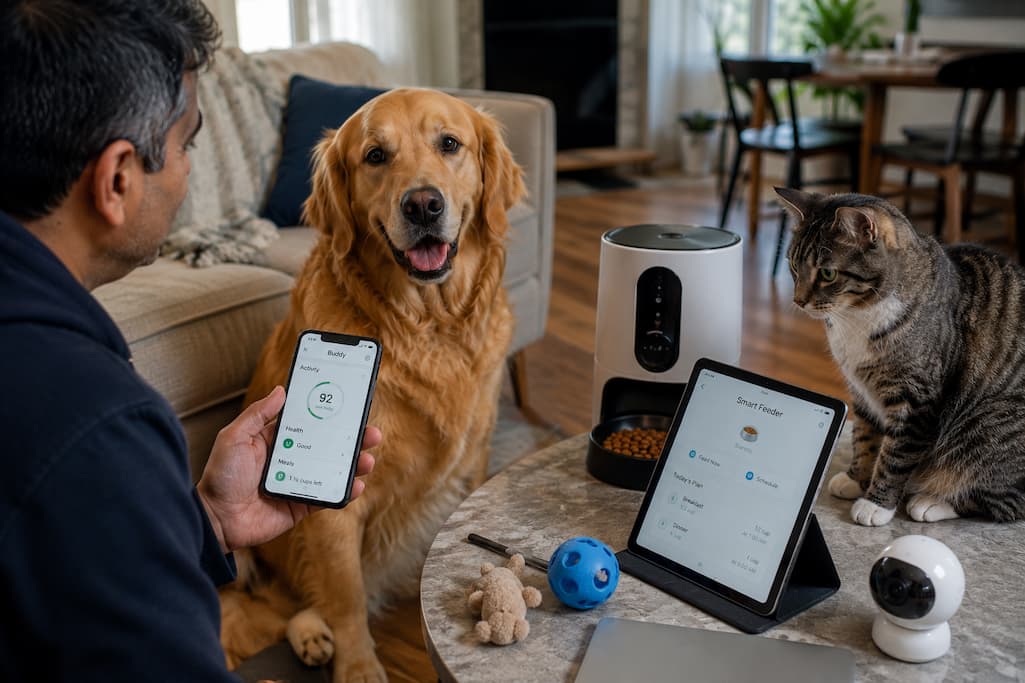
Last spring, my vet called with results I didn’t expect. My 7-year-old Labrador, Cooper, had early-stage kidney issues. Nothing dramatic yet, but the numbers were shifting. What surprised me wasn’t the diagnosis itself — it was what happened next. The clinic had recently partnered with a company called Antech, and their RenalTech tool flagged Cooper’s risk two years before traditional bloodwork would have caught it. That phone call changed how I think about pet care entirely.
Artificial intelligence isn’t a future concept for pet owners anymore. It’s in the food bowls, the toys scattered across my living room floor, and the health alerts buzzing on my phone. What started as a niche tech curiosity has become something I interact with almost daily, whether I realize it or not. This article breaks down where AI is actually making a difference for pets right now — not in theory, but in the products and services you can buy today.
Quick takeaway: AI in pet care falls into three buckets — personalized nutrition algorithms, adaptive interactive toys, and predictive health monitoring. The health side is moving fastest, with several tools already FDA-cleared or in clinical validation for veterinary use.
AI-Driven Pet Food: From Guesswork to Precision
For years, I picked Cooper’s food the same way most people do — by age, weight, and whatever the vet casually recommended at his annual checkup. If he developed itchy skin or loose stools, I’d switch brands and hope. That trial-and-error approach is exactly what AI nutrition platforms are trying to eliminate.
Companies like JustFoodForDogs and Farmer’s Dog now use intake questionnaires that feed into algorithms assessing breed predispositions, activity levels, and health history. The output isn’t just a recipe — it’s a dynamically adjusted feeding plan. Cooper’s current plan from one of these services recalculates his portions based on seasonal activity changes. When we hike more in summer, his calorie target shifts automatically.
What’s more interesting is happening at the manufacturing level. Purina and Hill’s Pet Nutrition have invested in machine learning models that optimize ingredient ratios across production batches. The goal is consistency — making sure bag #10,247 has the same nutrient profile as bag #1. For pets with medical conditions requiring precise nutrition, that consistency matters.
| AI Nutrition Feature | What It Actually Does | Example Platform |
|---|---|---|
| Personalized recipe generation | Builds custom formulas from breed, age, weight, allergies, and health conditions | Farmer’s Dog, JustFoodForDogs |
| Dynamic portion adjustment | Modifies serving sizes based on activity tracking data | Tailored (connected to FitBark) |
| Supply chain optimization | Predicts ingredient quality variations and adjusts formulations | Purina internal systems |
| Allergy pattern detection | Correlates dietary ingredients with symptom reports over time | Petnet SmartFeeder app |
The limitation here is data. These algorithms are only as good as what you feed them — literally. If I underestimate Cooper’s daily treats or forget to log his weekend hikes, the recommendations drift. I’ve learned to treat AI nutrition tools as informed advisors, not autopilot systems.
Smart Toys That Actually Learn Your Pet
Cooper’s toy basket tells a story of abandoned experiments. The automatic ball launcher he ignored after three days. The puzzle feeder he solved in ten minutes and never touched again. The “interactive” toy that did the same motion on repeat until even I was bored watching it.
The new generation of AI toys is different because they adapt. The Wickedbone by Cheerble uses motion sensors and basic pattern recognition to adjust how it moves based on how your dog interacts with it. If Cooper chases aggressively, it speeds up and changes direction unpredictably. If he loses interest, it switches to a slower, more enticing pattern. It’s not sophisticated AI by human standards, but it’s a meaningful step beyond the repetitive motion of older electronic toys.
More advanced is the PupPod, which pairs a physical toy with a smartphone app. The toy dispenses treats when your dog performs specific actions — touching a particular sensor, responding to a sound cue, or waiting for a signal. The difficulty scales automatically as your dog learns. Cooper’s first session lasted four minutes. After two weeks, he was engaged for twenty. The app tracks his progress and flags when he’s plateauing, suggesting new challenge types.
What I learned the hard way: AI toys need supervision, at least initially. Cooper managed to wedge the Wickedbone under a cabinet during his first solo session and spent ten minutes barking at it in frustration. Set boundaries for where these toys operate, and check battery levels — a mid-play dead toy confuses dogs more than no toy at all.
For cats, the landscape is similar but smaller. The Petlibro Pixie and Frolicat Bolt use randomized laser patterns that adjust speed and trajectory based on play duration. My neighbor’s cat, a skittish rescue named Luna, went from hiding under the bed to actively stalking the Pixie within a week. The unpredictability seems to trigger prey drive more effectively than manual play with a static toy.
The companion robot category is where things get genuinely strange. Loona by KEYi Tech, priced around $499, uses ChatGPT-4 integration for conversations, facial recognition for household members, and autonomous navigation. It’s not a dog replacement — Cooper treats it with polite indifference — but for households without pets or with allergies, it fills a companionship gap. The Sony Aibo at $2,899 is the premium tier, with cloud-based learning that supposedly creates unique personality evolution. I’ve never tested one; at that price, I’d rather adopt a second real dog.
Here’s what these toys actually deliver versus what marketing promises:
| Marketing Claim | Reality Check |
|---|---|
| “AI learns your pet’s personality” | Most toys adjust to interaction patterns, not true personality modeling. Think adaptive difficulty, not deep learning. |
| “Reduces separation anxiety” | Some pets engage more with these toys when alone, but clinical anxiety usually needs behavioral intervention, not gadgets. |
| “Never gets boring” | Even adaptive toys plateau. Rotation with traditional toys works better than relying solely on AI devices. |
| “Replaces human interaction” | No. Cooper’s engagement with me versus any toy isn’t close. These are supplements, not substitutes. |
Wearable Health Tech: The Quiet Revolution
This is where AI has genuinely changed my daily routine. Cooper wears a Whistle GPS and health collar. It tracks his activity, sleep patterns, scratching frequency, and drinking behavior. The app flags deviations from his baseline — a spike in scratching might indicate allergies, a drop in activity could signal joint pain or illness.
Last November, the app alerted me that Cooper’s sleep quality had dropped for three consecutive nights. He seemed fine during the day, but the data suggested something was off. A vet visit revealed an ear infection starting in his left ear — subtle enough that I hadn’t noticed, but apparently uncomfortable enough to disrupt his sleep positioning. Caught early, a week of drops cleared it. Without the collar data, I probably wouldn’t have brought him in until he was shaking his head or scratching visibly.
The technology behind this is pattern recognition across biometric data. Whistle’s algorithms compare Cooper’s data against breed-specific baselines and his own historical patterns. Fi collars do similar work with a focus on escape detection and location tracking. Petcube cameras add behavioral analysis — they can distinguish between normal movement and distress signals like excessive pacing or vocalization.
What the data actually shows: A 2023 study published in the Journal of Veterinary Behavior found that continuous activity monitoring detected lameness in dogs an average of 12 days before owners reported visible symptoms. For conditions like osteoarthritis, that early window can significantly impact treatment outcomes.
More advanced systems are entering veterinary clinics. Vetscan Imagyst by Zoetis uses AI to analyze fecal samples and blood smears, reducing the time technicians spend at microscopes and improving consistency in parasite detection. Signal RAY and Signal SMILE analyze radiographs and dental X-rays in real-time, flagging abnormalities for veterinarian review. These aren’t replacing vets — they’re handling the routine screening so professionals can focus on complex cases.
The RenalTech tool that caught Cooper’s kidney issue early uses machine learning trained on over 150,000 cat health records to predict chronic kidney disease up to two years before traditional diagnostics. For a condition that’s manageable when caught early but devastating when advanced, that lead time is genuinely valuable.
The Ethics and Privacy Side Nobody Talks About
Here’s the uncomfortable part. Cooper’s collar collects data on his location, activity, sleep, and behavior. That data sits on company servers. I’ve read the privacy policies — most reserve broad rights to use aggregated data for research and product development. Some share with partners. None of this is unique to pet tech; it’s the same model as human fitness trackers. But it means my dog’s health patterns are, in some sense, a commercial asset.
There’s also the question of over-reliance. When Cooper’s app flags something, I feel a duty to investigate. Sometimes it’s nothing — a sleep disruption because I had guests over, extra scratching because he rolled in grass. The false positive rate matters. If every alert sends me to the vet, I’m burning money and stress. If I ignore alerts and miss something real, I’m failing him. Finding that balance is an ongoing process.
The companion robot raises different questions. Tombot’s Jennie, designed for dementia patients, is being evaluated for medical device status. That makes sense in a therapeutic context. But for general consumers, there’s a risk of substituting robot interaction for real animal relationships. I’ve watched Cooper’s reaction to the Loona — polite disinterest, occasional sniff, then back to his bed. He knows the difference. I’m not sure all humans do.
What’s Actually Worth Buying Right Now
After two years of testing and vet bills, here’s where I land:
Worth it for most pet owners: A health-monitoring collar (Whistle or Fi). The early detection capability alone justifies the cost for me. The activity tracking is a bonus that keeps me honest about Cooper’s exercise.
Worth it for specific situations: Adaptive toys like PupPod for high-energy dogs who destroy standard puzzle toys quickly, or for owners with limited mobility who can’t engage in active play as much as they’d like.
Not worth it yet: Premium companion robots for households that already have pets. The technology is impressive, but the value proposition doesn’t hold when a real animal is available. For allergy sufferers or senior living facilities, the math changes.
Promising but early: AI nutrition services. The personalization is real, but the price premium is significant and the long-term health outcomes aren’t well-studied yet. I’m using one for Cooper now, but I’m tracking his bloodwork more closely than I would with a standard diet.
Bottom line: AI in pet care is most valuable where it extends human capability — detecting patterns we miss, maintaining consistency we can’t, or providing engagement when we’re unavailable. It’s least valuable where it tries to replace the judgment and relationship that define good pet ownership. Use the tools, but don’t outsource the care.
Related Articles
- How I Handle Feeding Schedules While Traveling With Pets — Practical tips for maintaining AI-generated nutrition plans on the road
- How to Keep Your Pet Hydrated Daily — Why hydration data from smart collars matters for overall health
- How I Monitor Pet Energy Levels for Early Health Signs — Combining wearable data with daily observation routines
- How to Maintain Dental Health for Pets — Where AI dental imaging tools like Signal SMILE fit into preventive care
- How to Recognize Signs of Pet Stress — Using behavioral data from smart devices alongside your own observations
- Creating a Safe Indoor Environment for Senior Pets at Home — Why early disease detection matters most for aging animals
Sources and References
- Pandya, K., Mavadiya, S.V., Vagh, A.A., Bilwal, A.K., & Inamdar, S.H. (2026). Application of artificial intelligence in animal disease diagnosis: A new era for veterinary medicine. Veterinary World, 11(4S). DOI: 10.22271/veterinary.2026.v11.i45b.3185
- Reagan, K.L., Reagan, B.A., & Gilor, C. (2020). Machine learning algorithm as a diagnostic tool for hypoadrenocorticism in dogs. Domestic Animal Endocrinology, 72, 106396.
- Bradley, R., et al. (2019). Predicting early risk of chronic kidney disease in cats using routine clinical laboratory tests and machine learning with RenalTech. Journal of Veterinary Internal Medicine.
- Banzato, T., et al. (2018). Methodological approach for deep learning to distinguish between meningiomas and gliomas on canine MR-images. Veterinary Radiology & Ultrasound.
- Zoetis. (2026). VETSCAN IMAGYST — AI-powered diagnostic platform for veterinary practices. zoetisus.com
- SignalPET. (2026). Signal RAY and Signal SMILE — AI radiograph and dental analysis tools. signalpet.com
- Antech Diagnostics. (2026). RenalTech — Machine learning for early detection of feline chronic kidney disease. antechdiagnostics.com
- Indie Hackers. (2026, April 29). Best robotic pet dog toys of 2026. indiehackers.com
- AIToys UK. (2026, March 25). The rise of AI pet robots: Loona, Miko and the best options for UK kids 2026. aitoys.co.uk
- Euronews Next. (2026, January 9). The toys of CES 2026: A smart Rubik’s Cube, robots, and AI companions. euronews.com
- CoVet. (2026). 6 Best AI vet tools for practice efficiency in 2026. co.vet

Daniel Maxfield is a pet care writer focused on practical guidance for modern pet owners. He covers pet wellness, grooming, behavior, travel routines, and everyday care habits for dogs and cats. Through reader-focused educational content, Daniel shares simple and accessible tips designed to support healthier, safer, and more organized daily life with pets.