
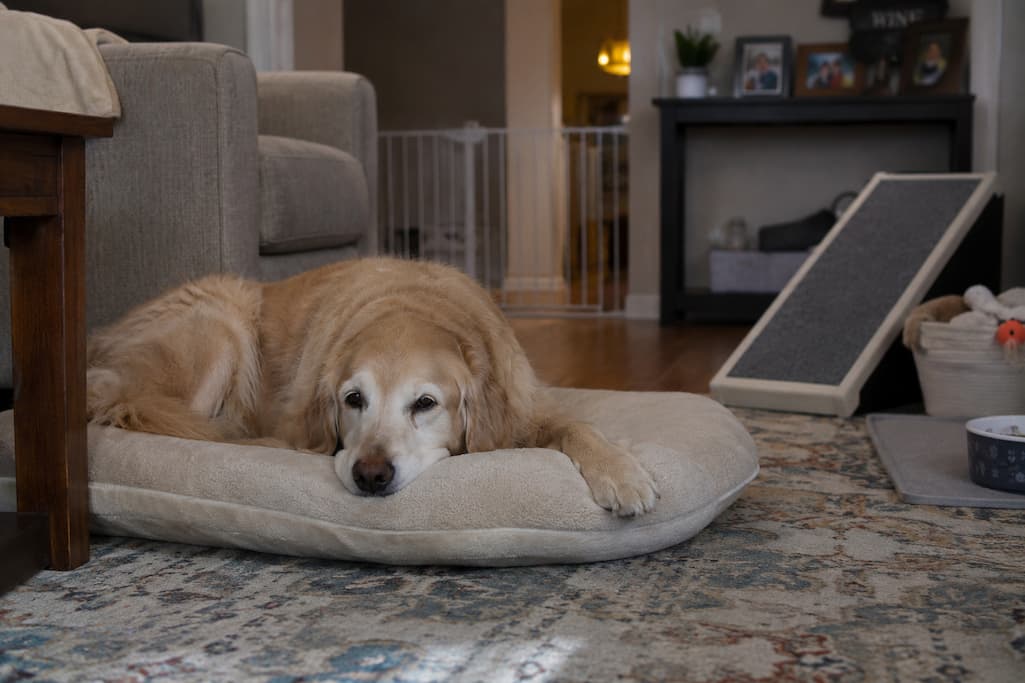
Cooper turned eight last spring. Not ancient for a Golden Retriever, but old enough that I started noticing things I hadn’t before. He hesitated at the top of the stairs, one paw lifted, deciding whether the descent was worth it. He walked around the coffee table instead of squeezing between it and the couch like he used to. His afternoon naps stretched longer, and when he woke, he’d stretch for a full minute before standing, joints creaking audibly in the quiet living room.
My sister’s cat Moochi hit twelve around the same time. Her changes were quieter, easier to miss. She stopped jumping onto the kitchen counter entirely, choosing instead to sit on the floor and stare up at it with what looked like resignation. Her night vision, once sharp enough to navigate the apartment in total darkness, faltered. I watched her misjudge a step she’d taken a thousand times, stumble slightly, then sit down and groom her paw as if nothing had happened.
Neither animal was sick. Both were aging, and aging in pets doesn’t announce itself with dramatic symptoms. It accumulates in small concessions: a skipped jump, a slower pace, a preference for the rug over the hardwood floor. The home they’d lived in for years, the one they’d navigated effortlessly as young animals, had become subtly hostile. My job wasn’t to fix their age. It was to adapt their environment so they could keep living fully within it.
This article is about the modifications I made, the ones I considered and rejected, and the philosophy behind creating a space where senior pets aren’t just safe but genuinely comfortable. Not a hospital room. A home.
Rethinking Floors: The Surface Beneath Their Feet
The first thing I changed was also the cheapest. Cooper had started slipping on our hardwood floors, especially in the hallway where he’d round the corner toward the kitchen with momentum he couldn’t control. His hind legs would splay, he’d catch himself, and he’d continue — but I could see the hesitation building. Each near-slip made him more cautious, which made him move differently, which put strain on joints that were already aging.
I bought three runner rugs with rubber backing and laid them along his primary pathways: hallway to kitchen, living room to back door, bedroom to bathroom. Not decorative rugs that slide around. Proper runners with grip. The transformation was immediate. Cooper moved with confidence again, tail up, gait natural. The rugs cost $45 total. The orthopedic surgery he might have needed from a bad slip would have cost $3,000.
Moochi’s floor issue was different. She didn’t slip; she stopped jumping. The hardwood stairs to my sister’s bedroom, which Moochi had sprinted up as a kitten, became a barrier. My sister tried carrying her, but Moochi hated it. The solution was a carpeted ramp along the side of the stairs, angled gently, with a non-slip surface. It took up space and looked a little odd, but Moochi uses it daily. The independence matters more than aesthetics.
For both animals, I also reconsidered the bathroom. Tile floors are slippery when wet, and senior pets sometimes have accidents or drink messily. A bath mat near the water bowl catches spills and provides traction. A second mat near the litter box (for Moochi) and by the door (for Cooper’s post-walk paw wiping) serves the same purpose. Small changes, outsized impact.
Bedding: Where Rest Becomes Recovery
Cooper’s old bed was a thin pad on the floor, fine for a four-year-old but cruel for an eight-year-old with developing arthritis. I upgraded to an orthopedic memory foam bed with a low entry point — he steps in rather than climbing up. The foam distributes his weight evenly, reducing pressure on his hips and elbows. I placed it in a corner against two walls, which gives him the security of enclosure while he sleeps.
The bed isn’t just for nighttime. Cooper now has three sleep stations around the house: the orthopedic bed in the living room, a thinner but still cushioned pad in my office, and a raised cot on the porch for warm afternoons. The variety lets him choose based on temperature, joint stiffness, and mood. Some days he wants the supportive foam. Other days the cooler cot feels better.
Moochi’s sleep needs changed too. She used to curl up in high places — window sills, the top of the bookshelf, the back of the couch. Now she needs warmth and accessibility. My sister added a heated cat bed near a sunny window at ground level. The heat soothes Moochi’s joints, the low placement eliminates jumping, and the window view satisfies her surveillance instincts. She spends probably 16 hours a day in that bed now.
We also added a second, unheated bed in a quiet closet where Moochi retreats when the apartment is busy. Senior cats need more sleep and deeper rest. Having a sanctuary space, even just a bed in a closet with the door cracked, gives her control over her environment that she didn’t have before.
Lighting: Seeing What They No Longer See
This was the modification I resisted longest. It felt excessive, almost indulgent, to add night lights for a pet. Then I watched Moochi hesitate at a dark hallway at 3 AM, whiskers forward, clearly uncertain. Her night vision had faded enough that shadows were no longer navigable shapes. They were voids.
I installed three plug-in night lights along Cooper’s nighttime path: bedroom to water bowl to back door (for late bathroom needs). They’re motion-activated and dim, not bright enough to disturb human sleep but sufficient for a dog with declining vision to navigate confidently. Cooper stopped bumping into furniture during his 2 AM water breaks. He also stopped waking me up to escort him, which was an unexpected bonus.
For Moochi, my sister took a different approach. She added a strip of LED tape lighting under the kitchen cabinets, on a timer that turns on at dusk and off at dawn. It illuminates the floor-level areas Moochi uses most without creating the harsh overhead light that would disrupt her crepuscular rhythm. The cost was $12. The reduction in nighttime anxiety was immediate and obvious.
Daytime lighting matters too. Senior pets, especially cats, benefit from natural light for circadian regulation. We moved Moochi’s bed closer to a south-facing window. For Cooper, I open the curtains earlier in the morning than I used to, letting natural light signal the start of his day. His internal clock seems to have softened with age, and the external cues help keep him regulated.
Accessibility: Rethinking Vertical Space
Young pets live in three dimensions. They jump, climb, perch, explore. Senior pets increasingly live in two. The vertical world that once brought them joy becomes a source of risk and exclusion.
Cooper’s favorite spot as a younger dog was the window seat in my bedroom, elevated about two feet. He’d leap up to watch the street, bark at passing dogs, nap in the sun. Last year I found him standing with his front paws on the seat, unable to lift his back legs high enough to follow. He tried twice, gave up, and lay on the floor beneath it looking up with an expression I can only describe as mournful.
I built a two-step platform leading to the window seat. It’s carpeted, stable, and wide enough that he doesn’t feel unbalanced. He uses it daily. The view hasn’t changed. His ability to reach it has.
Moochi’s vertical world was more complex. She had favorite perches at three heights: the windowsill (low), the bookshelf (medium), and the top of the wardrobe (high). As her joints stiffened, she abandoned the wardrobe first, then the bookshelf. My sister didn’t want her to lose all elevation, so she added a series of staggered platforms — a sturdy ottoman, a reinforced window perch at mid-height, and a carpeted step leading to the bookshelf. Moochi can now reach her medium perches without the explosive jump that was becoming dangerous. The high perches she gave up on her own, and we didn’t fight it.
The principle is simple: don’t remove vertical space. Bridge it.
| Modification | Cost | Used For | Impact |
|---|---|---|---|
| Rubber-backed runner rugs | $45 | Cooper’s primary pathways | Eliminated slipping, restored confident movement |
| Carpeted stair ramp | $35 (DIY materials) | Moochi’s bedroom access | Restored independence, eliminated carrying |
| Orthopedic memory foam bed | $65 | Cooper’s primary sleep station | Reduced morning stiffness, better rest quality |
| Heated cat bed | $30 | Moochi’s joint comfort and warmth | Increased sleep quality, reduced visible stiffness |
| Motion-activated night lights | $18 | Cooper’s nighttime navigation | Eliminated nighttime collisions, reduced anxiety |
| LED under-cabinet lighting | $12 | Moochi’s evening floor navigation | Reduced hesitation, restored nighttime confidence |
| Two-step platform to window seat | $20 (DIY materials) | Cooper’s favorite elevated spot | Restored access to beloved perch |
| Staggered platform perches | $40 (ottoman + reinforced perch) | Moochi’s medium-height access | Maintained vertical engagement safely |
Temperature, Noise, and the Sensory World
Senior pets experience temperature differently. Their thermoregulation weakens, making them more vulnerable to both heat and cold. Cooper now wears a light fleece jacket on walks below 45 degrees. He never needed one before. At 45, he’d bound through snow without concern. At eight, he shivers on chilly mornings and takes longer to warm up after coming inside.
Inside, I keep the thermostat a few degrees higher than I used to, especially overnight. Cooper’s bed is away from drafty windows and exterior doors. Moochi’s heated bed provides her own warmth source, but my sister also added a draft stopper under the apartment door where cold air used to seep in. The heating bill went up slightly. The comfort difference is substantial.
Noise sensitivity increases with age too. Cooper has always been calm around thunder, but last summer he startled badly at a car backfiring and hid under the bed for an hour. Moochi, never a fan of loud sounds, now flees to her closet sanctuary at the vacuum cleaner’s lowest setting. We’ve adapted by running the vacuum when Moochi is napping in her closet anyway (with the door closed), and by creating a “safe room” for Cooper during fireworks or storms — my bedroom with the blinds drawn, white noise playing, and his orthopedic bed ready.
The safe room isn’t complicated. It’s just a quiet, enclosed space with familiar smells, comfortable bedding, and minimal stimulation. I stay nearby but don’t fuss over him. The goal isn’t to eliminate the stressor (I can’t stop fireworks) but to give him a predictable refuge when the world gets overwhelming.
The Litter Box and Bathroom Situation
This section is mostly for Moochi, though Cooper’s needs changed too. Senior cats need litter boxes that are easier to enter, easier to exit, and placed more thoughtfully than the single hidden box that worked fine for years.
My sister replaced Moochi’s covered litter box with an open, low-sided one. The cover, which provided privacy for a younger cat, became a barrier for a stiff-jointed senior. The high sides that contained litter scatter became a wall she had to climb. The new box has a cutout entry about three inches high — easy to step into, no jumping required.
She also added a second litter box on a different floor. Moochi’s urgency control isn’t what it used to be. Having a box closer to her primary resting area prevents accidents that would stress both her and my sister. The second box is in a quiet corner of the living room, not hidden in a closet. Accessibility beats discretion for senior cats.
For Cooper, the change was simpler. He’d started having occasional nighttime accidents, not because of incontinence but because his sleep was deeper and his bladder capacity reduced. I added a late-evening bathroom break at 10:30 PM, in addition to his usual final walk at 8:00 PM. That single extra trip eliminated the problem entirely. Sometimes the solution isn’t environmental. It’s scheduling.
What I Didn’t Change (And Why)
Not every senior pet modification is necessary or helpful. I considered several changes and rejected them after observation:
Pet stairs for the couch: I bought a set of foam stairs for Cooper to reach the couch more easily. He used them twice, then ignored them. He preferred to stand with his front paws on the couch and wait for me to lift his back end. The stairs became a trip hazard and went to storage. Sometimes the solution isn’t a product. It’s a human willing to help.
Raised food bowls: I’d read that raised bowls reduce neck strain for large senior dogs. I tried one for Cooper. He ate faster, seemed to swallow more air, and had more post-meal gas. I switched back to floor-level bowls and haven’t looked back. The neck strain concern was theoretical. The digestive discomfort was real.
Restricting access to rooms: Some advice suggests blocking off rooms with hazards for senior pets. I tried closing the basement door where Cooper might slip on concrete steps. He stood at the door and whined. The basement was where his toy box lived, where he’d played as a puppy, where the memories were. I opened the door, added a rug to the bottom of the stairs, and let him have his space. Safety matters, but so does the life he’s lived in this house.
Wheelchairs or harnesses: Cooper isn’t there yet, and I hope he never will be. But I’ve seen owners rush to mobility aids before they’re necessary, and the result is often a pet who stops using their own muscles, accelerating the decline. I’ll cross that bridge if and when we come to it. For now, he walks on his own four legs, even if those legs are slower than they used to be.
The Ongoing Conversation
Creating a safe environment for senior pets isn’t a one-time project. It’s an ongoing conversation between you and your animal, conducted through observation and adjustment. Cooper tells me what he needs by where he chooses to lie, which paths he takes, which jumps he attempts and which he avoids. Moochi communicates through her sleep locations, her litter box habits, her willingness to engage.
I reassess every few months. What worked in spring might not work in winter, when joints are stiffer. What was unnecessary at eight might be essential at ten. The environment evolves as the pet evolves, and the willingness to keep adapting is what separates a house where a senior pet survives from one where they genuinely thrive.
Cooper still bounds toward the door when I grab the leash, though the bound is lower and the landing softer. Moochi still watches birds from her window perch, though the perch is lower now and the watching is more contemplative than predatory. They’re not the animals they were at two. But they’re not diminished. They’re adapted. And the home we’ve built around them reflects that adaptation with respect, not pity.
Related Articles
Senior pet care touches every aspect of daily life. These articles from our site explore the areas that connect directly to creating a safe, comfortable home for aging animals:
- How to Recognize Signs of Pet Stress — Environmental changes can stress senior pets. This covers how to distinguish normal aging adjustments from genuine anxiety that needs addressing.
- Managing Pet Stress During Loud Noises and Busy Days — Senior pets are more noise-sensitive. These are the techniques I use to keep Cooper calm during fireworks and thunderstorms in his adapted safe room.
- How to Maintain Dental Health for Pets — Dental disease accelerates with age and affects overall comfort. This covers the senior-specific dental care routines Cooper and Moochi now follow.
- How I Monitor Pet Energy Levels for Early Health Signs — Energy changes in senior pets are often the first indicator that environmental modifications aren’t enough and medical intervention is needed.
- How to Keep Your Pet Hydrated Daily — Senior pets are prone to dehydration. This covers the placement and types of water sources that encourage consistent drinking in aging animals.
- Easy Grooming Tips for Dogs and Cats — Grooming needs change with age. Joint stiffness makes self-grooming harder, and senior pets need more help maintaining coat and skin health.
- How I Manage My Cat’s Weight Without Restrictive Dieting — Weight management becomes critical for senior joint health. This covers how my sister keeps Moochi at a healthy weight that supports her mobility.
- Creating a Safe Indoor Environment for Senior Pets at Home — You’re reading this article right now.
- How I Correct Small Bad Habits in Pets Without Stress — Senior pets sometimes develop new habits as they adapt to physical limitations. These positive approaches help guide behavior without adding stress to an already sensitive animal.
- How to Plan a Pet-Friendly Vacation — Traveling with senior pets requires different planning than traveling with young ones. This covers the accommodations and pacing that work for aging animals.
Sources and References
- American Kennel Club. “Senior Dog Care: Caring for Your Older Dog.” https://www.akc.org/expert-advice/health/senior-dog-care/
- Cornell University College of Veterinary Medicine. “Caring for Your Senior Cat.” https://www.vet.cornell.edu/departments-centers-and-institutes/cornell-feline-health-center/health-information/feline-health-topics/caring-for-your-senior-cat
- American Veterinary Medical Association. “Senior Pet Care FAQ.” https://www.avma.org/resources/pet-owners/petcare/senior-pet-care-faq
- VCA Animal Hospitals. “Arthritis in Dogs.” https://vcahospitals.com/know-your-pet/arthritis-in-dogs
- PetMD. “How to Make Your Home Safe for a Senior Dog.” https://www.petmd.com/dog/slideshows/how-to-make-your-home-safe-for-a-senior-dog
- The Spruce Pets. “How to Care for Senior Cats.” https://www.thesprucepets.com/senior-cat-care-554102
- ASPCA. “End of Life Care FAQ.” https://www.aspca.org/pet-care/general-pet-care/end-life-care-faq
The modifications described in this article are based on personal experience adapting a home for Cooper, an eight-year-old Golden Retriever, and Moochi, a twelve-year-old domestic short-haired cat. Every senior pet has unique needs based on breed, health history, and individual condition. Consult your veterinarian for guidance specific to your pet’s aging process and physical limitations.

Daniel Maxfield is a pet care writer focused on practical guidance for modern pet owners. He covers pet wellness, grooming, behavior, travel routines, and everyday care habits for dogs and cats. Through reader-focused educational content, Daniel shares simple and accessible tips designed to support healthier, safer, and more organized daily life with pets.