
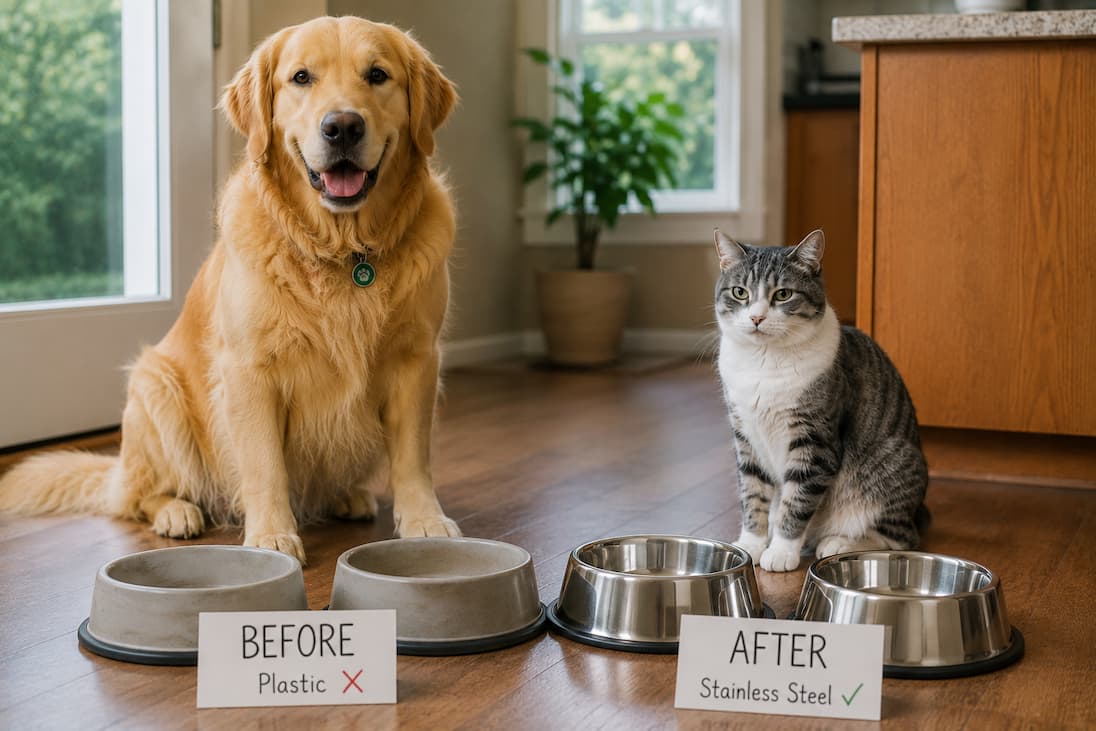
Cooper has eaten from the same set of bowls since I adopted him seven years ago. They were cheap plastic bowls I picked up at a big-box pet store the day I brought him home — bright blue, with a rubber ring on the bottom to keep them from sliding. They cost maybe eight dollars for the pair. For years, they did the job. Cooper ate. Cooper drank. The bowls went in the dishwasher. I never thought about them. Then last fall, something changed. I noticed a faint pink discoloration around Cooper’s lower lip, right where his mouth touched the bowl edge. It looked like acne, small raised bumps in a neat line. I wiped it with a damp cloth. It came back the next day. Then I noticed the same pattern on the other side. I checked Moochi, my sister’s cat, who was staying with me for a month while my sister recovered from surgery. Her ceramic bowl was fine. No discoloration, no bumps. I started researching. What I found made me replace every plastic bowl in my house within a week. This is what changed — not just for Cooper’s skin, but for how I think about the most overlooked object in my pet’s daily life.
Why Plastic Bowls Are Not as Harmless as They Look
Plastic seems safe. It is everywhere. Pet stores stock entire aisles of colorful plastic bowls in every shape and size. But the material has problems that do not show up until they do. Plastic is porous. Over time, microscopic scratches develop from teeth, claws, and scrubbing. Those scratches trap bacteria. Even if you wash the bowl daily in hot water, the bacteria sit inside the plastic itself, protected from soap and heat. A study from Hartpury University in the UK examined plastic, ceramic, and stainless steel bowls over a 14-day period and found that while stainless steel had higher bacteria counts early on, plastic retained the highest bacterial load by day 14. The scratches were the reason. Once plastic is scored, it never fully sanitizes again. Then there is the chemical side. Many plastics contain Bisphenol A, or BPA, a chemical added to make plastic hard and clear. BPA is an endocrine disruptor. It can leach into food and water, especially when the plastic is heated, scratched, or exposed to acidic foods. In dogs, BPA has been shown to alter gut bacteria and cause metabolic changes.
The alternatives to BPA — the “BPA-free” labels — may not be much safer. Replacement bisphenols have shown similar hormone-disrupting effects in animal studies. Some dogs are actually allergic to plastic itself. The contact dermatitis Cooper developed around his mouth is a documented reaction. The plastic particles rub against the skin during eating, causing irritation, redness, and acne-like bumps. The condition is called canine chin acne or plastic dish dermatitis. It is more common than most owners realize, and it is entirely preventable by switching bowl materials. Finally, there is the durability issue. Plastic bowls crack. They warp in the dishwasher. Sharp edges form where pieces break off, and dogs who chew — Cooper is not one, but many are — can ingest plastic fragments. Those fragments can cause intestinal blockages or internal cuts. It is rare, but it happens, and it is not a risk I want to take for a bowl that costs less than a sandwich.
Why I Chose Stainless Steel
I considered ceramic first. Moochi’s bowl was ceramic, and it looked fine. But ceramic has its own risks. Cheap ceramics, especially imported ones, can contain lead in the glaze. Even lead-free glazes can chip, and once a ceramic bowl is chipped, the porous clay underneath becomes a bacteria trap just like plastic. I did not want to research glaze origins every time I bought a bowl. Glass was next on my list. It is non-porous, easy to clean, and chemically inert. But glass breaks. Cooper is not a rough eater, but he is a 65-pound dog who occasionally bumps his water bowl with a paw. One broken glass bowl on a tile floor, and I would have shards in his paws and mine. For a household with a large dog, glass felt like an accident waiting to happen. Silicone bowls are popular for travel. They are lightweight, collapsible, and food-grade silicone does not leach chemicals. But silicone is soft. It scratches. It can retain odors. And for daily home use, it feels temporary, like a camping solution rather than a permanent fixture.
Stainless steel won for three reasons. First, it is completely non-porous and smooth. Bacteria can form on the surface, but they cannot penetrate it. A good scrub with hot soapy water removes everything. Second, it is durable. Cooper cannot chew through it, drop it, or wear it out. A stainless steel bowl lasts years without degradation. Third, it contains no chemicals that can leach into food. No BPA, no phthalates, no coatings that need special cleaning before first use. It is the same material used for surgical instruments because it is safe in contact with living tissue. I bought two stainless steel bowls from a mid-range pet brand — not the cheapest, not the most expensive. Heavy gauge, with a rubber base ring to prevent sliding and noise. They cost $28 for the pair, more than three times what I paid for the plastic set. But I have not replaced them in over a year, and they look the same as the day I bought them.
The Changes I Noticed
The first change was the fastest. Cooper’s chin acne cleared within ten days of switching bowls. The pink bumps faded, the skin returned to normal color, and the slight musty smell that I had attributed to “dog face” disappeared. I had not realized the smell was coming from the bacteria in his plastic bowl until it was gone. The second change was about cleanliness. Plastic bowls develop a film over time — a greasy, slightly sticky layer that does not wash off easily. I used to soak them in vinegar and baking soda monthly to strip it. The stainless steel bowls never develop that film. A quick wash with dish soap and they are spotless. The water bowl, in particular, stays clear. With plastic, I would sometimes see a faint oily sheen on the water surface after a few hours. I do not see that anymore. The third change was unexpected: noise. Plastic bowls slide on tile. Cooper pushes them around while eating, creating a scraping sound that used to drive me nuts. The rubber-ringed stainless steel bowls stay put. Mealtime is quieter. Cooper seems less frantic, too — I think the stable bowl reduces the slight anxiety of a moving target. The fourth change was about temperature. Stainless steel conducts heat and cold. In summer, I can fill the water bowl with ice and the metal keeps it cold longer than plastic ever did. In winter, warm food stays warm slightly longer. It is a small thing, but Cooper drinks more water on hot days now, and I suspect the cold metal edge is part of the reason.
What Did Not Change
Not everything was a revelation. Stainless steel bowls dent if you drop them. I learned this when I knocked one off the counter onto a hard floor. The dent was small, cosmetic, and did not affect function. But it is a reminder that “indestructible” does not mean “immune to physics.” They also show water spots. If you live in an area with hard water, stainless steel will develop a chalky residue that needs occasional polishing with vinegar. It is not a big deal, but it is a maintenance step plastic did not require. And the initial cost is real. Good stainless steel bowls are not cheap. You can find bargain-bin versions for five dollars, but they are thin, lightweight, and prone to sliding or tipping. The heavy-gauge bowls that are worth buying start around twelve dollars each. For someone feeding multiple pets or on a tight budget, that adds up. Cooper did not magically start eating more enthusiastically. He did not gain energy or lose weight. The bowl is a bowl. It holds food and water. The benefits are subtle, long-term, and mostly about what the bowl does not do — leach chemicals, harbor bacteria, or irritate skin — rather than what it actively provides.
How to Choose a Good Stainless Steel Bowl
Not all stainless steel bowls are equal. Here is what I learned to look for after buying one dud and returning it.
- Grade 304 stainless steel: This is the food-grade standard. Some cheaper bowls use lower grades that can rust or corrode over time. The packaging or product description should specify 304 or 18/8 stainless steel. If it does not say, assume it is lower grade.
- Heavy gauge: Thin steel bowls are light, noisy, and easy for a dog to flip. Look for bowls that feel substantial in your hand. Cooper’s bowls weigh about a pound each empty. That heft keeps them stable.
- Non-slip base: A rubber or silicone ring on the bottom prevents sliding and reduces noise. Make sure the ring is securely attached. On one bowl I tried, the ring fell off after two weeks of dishwasher cycles.
- Appropriate depth: Deep bowls work for long-snouted breeds. Shallow, wide bowls are better for flat-faced dogs like bulldogs or pugs. For cats, shallow is almost always better — deep bowls can brush their whiskers, which cats find irritating.
- Dishwasher safe: Most stainless steel bowls are, but check. The rubber base ring is usually the weak point. Some rings are not dishwasher-safe and will degrade or detach. I hand-wash the rings and run the bowls through the dishwasher.
- No decorative coatings: Some stainless steel bowls have painted designs or colored coatings. Those coatings can chip, and the paint may not be food-safe. Stick to plain, uncoated steel.
The Cleaning Routine That Actually Works
Switching to stainless steel is only half the battle. How you clean the bowl matters just as much as what it is made of. I wash Cooper’s food bowl after every meal. Not once a day — after every meal. It takes thirty seconds. Hot water, dish soap, a quick scrub with a dedicated brush, rinse, dry. The water bowl gets the same treatment every morning. If I am running late, I at least rinse and wipe it. The key is not letting food residue sit. Bacteria multiply fast, and even stainless steel can develop biofilm if neglected. Once a week, I do a deeper clean. I fill the bowl with a solution of one part white vinegar to three parts water, let it sit for ten minutes, then scrub and rinse. This removes any mineral buildup from hard water and keeps the surface pristine. I also check the rubber base ring for trapped food or grime. It pops off easily for cleaning. The dishwasher is an option, but I use it sparingly. High heat and harsh detergents can degrade the rubber base over time. When I do run the bowls through, I place them on the top rack and remove the rubber rings first.
Should You Make the Switch?
If your pet is healthy, eating well, and showing no signs of skin irritation, a plastic bowl is not an emergency. It is not going to poison your dog overnight. The risks are cumulative and long-term — years of low-grade chemical exposure, gradual bacterial buildup, slow skin irritation. But if your dog has chin acne, recurrent skin issues around the mouth, or digestive problems that your vet cannot explain, the bowl is worth investigating. It is a cheap, easy variable to eliminate. Switch for two weeks and see what happens. For Cooper, the change was visible in under two weeks. For some dogs, it takes a month. But it costs almost nothing to try, and the potential upside is real. If you are buying bowls for a new pet, skip plastic entirely. Start with stainless steel or high-quality ceramic from a trusted manufacturer. The extra cost upfront is negligible compared to years of use, and you avoid the question of whether plastic was contributing to a problem you did not know you had. For travel or temporary situations, plastic or silicone is fine. I keep a collapsible silicone bowl in my car for hikes and road trips. It is not Cooper’s daily bowl, and he uses it for short periods. The risk profile changes when exposure is occasional rather than twice a day, every day, for years.
Related Articles
- How to Keep Your Pet Hydrated Daily — Why bowl material and cleanliness directly affect how much water your dog or cat actually drinks.
- Easy Grooming Tips for Dogs and Cats — Cooper’s chin acne was a grooming issue before it was a bowl issue. This covers the skin care routine that complemented the switch.
- How I Switched My Dog to a Raw Diet and What Happened — If you are rethinking what goes in the bowl, you might also rethink the food itself. This covers Cooper’s dietary transition and the hygiene demands that come with it.
- How to Maintain Dental Health for Pets — Bacteria in bowls and bacteria in mouths are connected. This covers the full oral hygiene routine that works with clean bowls.
- How I Monitor Pet Energy Levels for Early Health Signs — Small changes in daily habits — like switching bowls — can be early indicators of larger health patterns. This covers what I watch for.
- The Real Cost of Pet Ownership — My First Year Breakdown — Where bowl upgrades fit into the broader budget of responsible pet care.
- How I Handle Seasonal Allergies in My Dog Every Spring — Cooper’s chin acne looked like an allergy at first. This covers how I distinguish between environmental allergies and contact irritants like plastic bowls.
Sources and References
- Wright, Coralie, and Aisling Carroll. (2018). “Microbiological Assessment of Canine Drinking Water: the Impact of Construction Material on the Quantity and Species of Bacteria Present in Water Bowls.” Hartbury Student Research Journal. https://studentjournal.hartpury.ac.uk
- Hemopet. (2025, April 25). “Plastic, Stainless Steel, Stoneware, Silicone or Ceramic Bowls?” Hemopet. https://hemopet.org/food-water-bowls-companion-pets/
- MetLife Pet Insurance. “Could Your Pet’s Food Bowl Be Harmful?” MetLife Pet Insurance Blog. https://www.metlifepetinsurance.com
- Fusco, Alessio, et al. (2023). “Pet feeding habits and the microbiological contamination of dog food bowls: effect of feed type, cleaning method and bowl material.” BMC Veterinary Research, 19, 219. https://pmc.ncbi.nlm.nih.gov/articles/PMC10701922/
- Wooten, Kimberly, and Philip Smith. (2013). “Canine Toys and Training Devices as Sources of Exposure to Phthalates and Bisphenol A: Quantitation of Chemicals in Leachate and in Vitro Screening for Endocrine Activity.” Chemosphere, 93(10), 2245-2253. https://www.sciencedirect.com
- Furchild Pets. “What is the Best Material for Pet Bowls?” Furchild Pets Blog. https://furchildpets.com/blog/best-material-for-pet-bowls
The bowl switch described reflects personal experience with Cooper, a 65-pound Golden Retriever adopted from rescue at eight months old, now approximately eight years old, and Moochi, my sister’s 12-year-old domestic short-haired cat. Every pet has different sensitivities, eating habits, and health conditions. What resolved Cooper’s chin acne may not apply to every dog. Consult your veterinarian if your pet shows signs of skin irritation, digestive issues, or other health concerns that could relate to feeding equipment or diet.

Daniel Maxfield is a pet care writer focused on practical guidance for modern pet owners. He covers pet wellness, grooming, behavior, travel routines, and everyday care habits for dogs and cats. Through reader-focused educational content, Daniel shares simple and accessible tips designed to support healthier, safer, and more organized daily life with pets.