
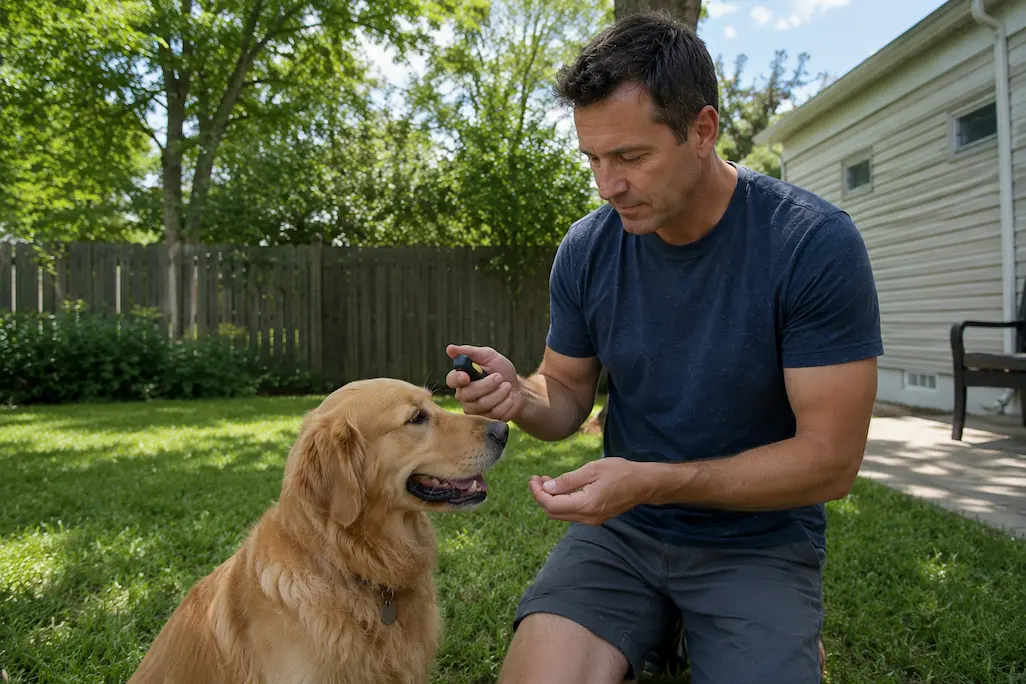
I was skeptical about the clicker. It seemed like one of those training gimmicks that dog trainers push because it makes them look scientific. A small plastic box that makes a clicking noise? I could just say “good boy” and give Cooper a treat. Why complicate it? But Cooper was struggling with leash manners, and my verbal praise was not cutting through his excitement. I would say “good” when he walked nicely, but the word was muddy — I used it when he sat, when he came, when he was just being cute on the couch. It had lost its power. A trainer at the park watched me fumble through a walk and handed me a clicker. “Try it for thirty days,” she said. “If it does not change anything, you are out five dollars.” I tried it for thirty days. Here is exactly what happened — the good, the awkward, and the surprisingly transformative.
Day One Through Seven: Charging the Clicker
The first week is not about teaching behaviors. It is about making the click mean something. This is called “charging” or classical conditioning — the same principle Pavlov used with his dogs and a bell. Click, then treat. Click, then treat. Ten times in a row, three times a day, for seven days. Cooper did not have to do anything. The click simply predicted food. I kept the clicker in my pocket at first because I felt ridiculous holding it. The sound is sharp — a metallic snap that cuts through ambient noise. Cooper startled the first time he heard it. His ears went back, he looked around, and then I tossed a piece of chicken. He ate it, looked at the clicker, and waited. By the third click, he was orienting toward the sound before the treat even left my hand.
By day three, he would hear the click from another room and come running. The timing was harder than I expected. The click has to happen the exact moment the behavior occurs — not a second later, not while the behavior is still happening. If Cooper sat, I had to click the instant his butt touched the ground. If I clicked while he was standing up, I was rewarding standing up. My first few days were a mess of mistimed clicks and confused looks from Cooper. I practiced on my own, clicking a pen while watching TV, trying to nail the timing of a character blinking. It sounds absurd, but it worked. By day five, my clicks were landing within half a second of the behavior. I also learned to load the clicker before every session. Five rapid clicks with treats, no behavior required, just to remind Cooper that the game was starting. This became our ritual — the clicker came out, five warm-up clicks, and then we worked.
Day Eight Through Fourteen: Shaping New Behaviors
Once the clicker was charged, I started using it for actual training. The first behavior I shaped was “touch” — Cooper touching his nose to my palm on cue. I held my hand out, and when Cooper glanced at it, I clicked and treated. Then I only clicked when he moved toward it. Then when his nose got within six inches. Then three inches. Then actual contact. Each step took multiple repetitions, and I had to resist the urge to rush. The clicker made me patient because I could see progress in tiny increments. The breakthrough came on day twelve. Cooper was offering the nose touch without my hand being presented — he would walk up and bump my palm, then look at me expectantly. This is called “offering behavior,” and it is the moment when the dog stops being a passenger and starts being a participant. Cooper was not just following instructions.
He was trying to figure out the game. I also used the clicker to refine Cooper’s leash walking. Instead of rewarding him for general “good walking,” I clicked for specific moments — two steps with a loose leash, then three, then five. The precision was addictive. I could see exactly which criteria Cooper understood and which ones confused him. When I stopped clicking for two steps and started only clicking for three, Cooper noticed immediately. He paused, thought about it, and offered three steps. The clicker turned training into a conversation. By day fourteen, Cooper was responding to the clicker in situations where verbal praise had failed. At the park, when another dog passed, I could click the exact moment Cooper looked at me instead of lunging. The timing was impossible with words — “good” takes too long to say, and by the time I finished the word, Cooper had already looked back at the other dog. The click was instantaneous. It cut through his excitement like a knife.
Day Fifteen Through Twenty-One: The Plateau
Week three was frustrating. Cooper knew the clicker meant treats, and he started offering behaviors randomly — sitting, lying down, pawing, spinning — hoping one of them would earn a click. This is called “extinction burst,” and it is normal. The dog is trying to figure out what works. I had to be disciplined about only clicking the behavior I wanted, even when Cooper’s frantic offerings were adorable. I also hit a wall with my own consistency. The clicker requires you to carry it everywhere. I forgot it on walks. I left it in the car. I clicked at the wrong moment because I was distracted. Cooper’s learning slowed, not because he was struggling, but because I was sloppy. The clicker is unforgiving. Verbal praise is flexible — you can say “good” a little early or late, and the dog still gets the gist.
The clicker is binary. It is either right or wrong. I solved this by attaching the clicker to my house keys with a carabiner. It went everywhere with me. I also started using a verbal marker — “yes” — as a backup for moments when the clicker was not in my hand. The verbal marker was less precise, but it was better than nothing. I kept the clicker for formal training sessions and used “yes” for spontaneous rewards. By day twenty-one, Cooper had learned three new behaviors using the clicker: touch, place (go to his bed), and a loose-leash walking cue. He had also generalized the touch behavior to other objects — I could point at a target stick, and he would nose it. The clicker had turned him into a problem solver.
Day Twenty-Two Through Thirty: Integration and Surprises
The final week was about fading the clicker and adding verbal cues. The clicker is a teaching tool, not a lifelong crutch. Once Cooper understood a behavior, I started pairing it with a word — “touch,” “place,” “with me” — and then clicking only intermittently. The verbal cue became the predictor, and the clicker became occasional confirmation. The biggest surprise was how the clicker affected Cooper’s emotional state. Before the clicker, training sessions felt like work. Cooper would comply, but his tail was low, his ears were back, and he would disengage after ten minutes. With the clicker, his tail was up, his eyes were bright, and he would work for twenty minutes without losing focus.
The difference was clarity. Cooper understood the game. He was not guessing what I wanted. He knew. I also noticed a change in myself. The clicker forced me to think before I acted. I had to decide what I wanted, set criteria, and stick to them. I could not just vaguely hope Cooper would behave. I had to define the behavior, break it into steps, and reward each step. The clicker made me a better trainer because it removed ambiguity. On day thirty, I put the clicker in a drawer and tried a session without it. Cooper responded to verbal cues with the same precision. The clicker had done its job. It had built the behavior. Now the behavior stood on its own.
What Science Says About Clicker Training
My experience was positive, but I wanted to know if the science backed it up. The research is mixed, and that is important to acknowledge. A 2021 study published in Behavioral Processes tested 110 dogs across three experiments, comparing clicker training to verbal markers and food rewards alone. The researchers found no statistically significant difference in learning speed or behavior acquisition between the three methods. Dogs trained with food alone sometimes performed better than those trained with clickers. The study concluded that while clickers work, they are not inherently superior to other positive reinforcement methods. Another study from 2017, published in the Journal of Veterinary Behavior, surveyed 586 dog owners and trainers and found that while most people reported success with clicker training, there was substantial variation in how they used the tool.
The researchers noted that the gap between scientific protocols and real-world practice might explain why some studies fail to show clicker benefits — trainers in the field often use clickers differently than researchers in the lab. However, other research supports the clicker’s unique advantages. A systematic review in Animals found that the clicker’s precision and consistency make it particularly effective for shaping complex behaviors and for dogs with anxiety or focus issues. The sharp, unique sound cuts through distraction in a way that human voices struggle to match. My takeaway from the research: the clicker is not magic. It is a tool. For some dogs and some handlers, it makes a dramatic difference. For others, a verbal marker works just as well. The key is not the tool itself but the consistency and precision with which it is used.
Should You Try Clicker Training?
If you are struggling with timing, precision, or getting your dog to understand what you want, the clicker is worth trying. It costs less than a coffee, and the worst-case scenario is that it does not help and you go back to verbal markers. If your dog is already responsive to verbal praise and you have good timing, the clicker may not add much. Some dogs are sensitive to the sharp sound and find it startling. Cooper adapted quickly, but a noise-phobic dog might need a softer marker, like a tongue click or a whispered “yes.” The clicker is also not a replacement for relationship. It is a communication tool, not a magic wand. If your dog does not trust you, does not find you reinforcing, or is too stressed to eat, the clicker will not fix that. Build the relationship first. Add the clicker second.
Related Articles
- How I Taught My Dog to Stay Calm When the Doorbell Rings — The clicker was the precision tool that made counterconditioning Cooper’s doorbell reactivity possible.
- How I Stopped My Dog From Pulling on the Leash in 3 Weeks — Clicker timing was essential for marking the exact moments of loose-leash walking that I wanted to reinforce.
- What I Learned From a Professional Dog Trainer in 5 Sessions — Professional guidance that helped me understand when to use a clicker and when a verbal marker is sufficient.
- How I Correct Small Bad Habits in Pets Without Stress — The positive reinforcement framework that underpins clicker training and all of Cooper’s behavior modification.
- Building Positive Behavior in Pets Through Daily Reinforcement — How I integrate clicker-trained behaviors into Cooper’s daily routine so they stick long after the initial training.
- How to Recognize Signs of Pet Stress — The clicker helped me see when Cooper was confused versus when he was stressed — two different problems requiring different solutions.
Sources and References
- Gilchrist, R.J., et al. (2021). “The click is not the trick: the efficacy of clickers and other reinforcement methods in training naïve dogs to perform new tasks.” Behavioral Processes, 189, 104414. https://pmc.ncbi.nlm.nih.gov/articles/PMC7906040/
- Feng, L.C., Howell, T.J., & Bennett, P.C. (2017). “How clicker training works: Comparing reinforcing, marking, and bridging hypotheses.” Applied Animal Behaviour Science, 181, 34-40. https://www.sciencedirect.com
- Pfaller-Sadovsky, N., et al. (2020). “What’s in a Click? The Efficacy of Conditioned Reinforcement in Applied Animal Training: A Systematic Review and Meta-Analysis.” Animals, 10(10), 1757. https://doi.org/10.3390/ani10101757
- ClickerTraining.com. (2026, January 5). “Why is Clicker Training Effective?” https://clickertraining.com/why-is-clicker-training-effective/
- Rebarkable. (2024, January 6). “Clicker training vs marker word; what’s more effective?” https://rebarkable.com/clicker-training-vs-marker/
The clicker training experience described reflects thirty days of personal training with Cooper, a 65-pound Golden Retriever adopted from rescue at eight months old, now approximately eight years old. Every dog has different sensitivity to sound, food motivation, and learning speed. What worked for Cooper may not work for a noise-sensitive or low-food-drive dog. Start with short sessions, watch your dog’s body language, and adjust or abandon the clicker if it causes stress rather than clarity.

Daniel Maxfield is a pet care writer focused on practical guidance for modern pet owners. He covers pet wellness, grooming, behavior, travel routines, and everyday care habits for dogs and cats. Through reader-focused educational content, Daniel shares simple and accessible tips designed to support healthier, safer, and more organized daily life with pets.