
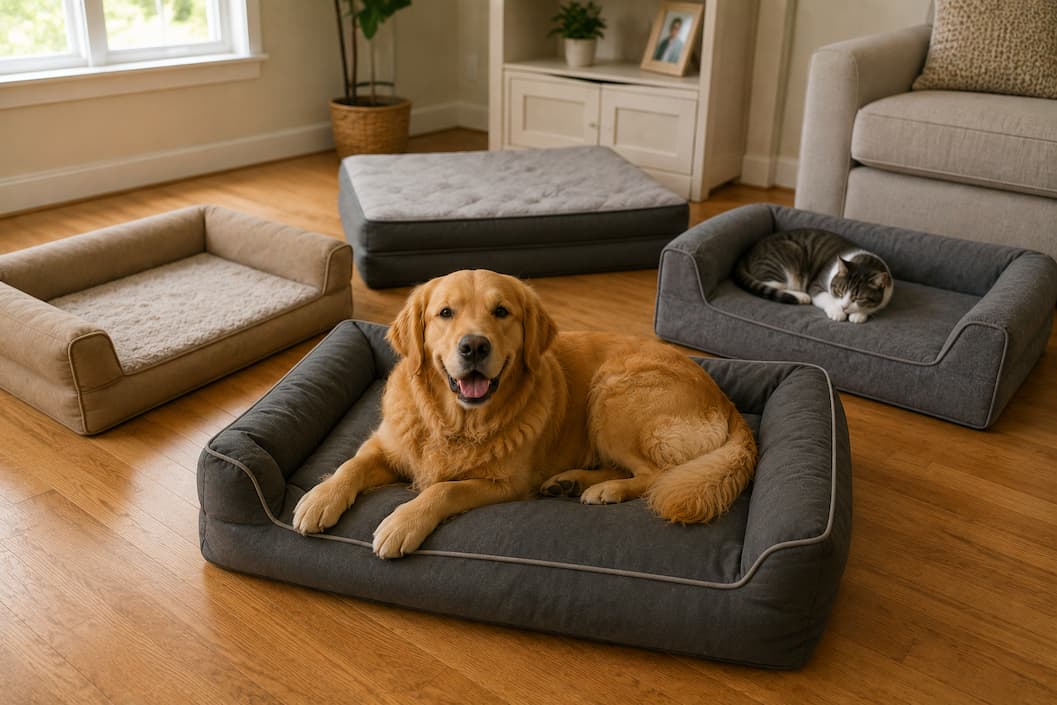
Cooper has outlived three beds. Not destroyed them — he’s not a chewer — but compressed them into pancakes so thin they stopped providing any support. The first was a $35 pillow-style bed from a big-box pet store, purchased when he was barely a year old. Within six months, the filling had shifted to the edges, leaving a depression in the center where his 65 pounds settled every night. The second was a $90 “orthopedic” bed with egg-crate foam that felt firm in the store but softened into a hammock within four months. The third was a $140 memory foam model that actually lasted two years before developing a permanent Cooper-shaped crater in the middle.
By the time bed number three failed, Cooper was seven. His hips were starting to show the early stiffness that comes with age and genetics — Goldens are prone to joint issues, and his rescue background meant I had no family history to reference. He’d take longer to stand in the morning, stretch more elaborately, and occasionally hesitate at the bottom of stairs. The bed wasn’t just a place to sleep anymore. It was a piece of medical equipment that determined whether he woke up rested or sore.
I decided to test four beds simultaneously rather than replacing them one by one. Cooper slept on each for a week, rotating through them in random order so he wouldn’t develop a preference based on familiarity. I tracked his morning stiffness, his willingness to settle on each bed, and how well the bed maintained its shape over time. My criteria were specific: support for joints, durability under 65 pounds of daily use, ease of cleaning, and whether Cooper actually chose to sleep on it when given options. Price mattered, but not as much as longevity. A $200 bed that lasts four years is cheaper than a $80 bed that lasts one.
Here are the four beds, what they promised, what they delivered, and which one is still in my living room six months later.
The Test Subjects
Bed 1: Furhaven Orthopedic Sofa-Style Bed ($64)
A bolstered couch-style bed with egg-crate foam base and raised sides for head support. Marketed for large breeds up to 95 pounds. Removable cover, machine washable. Available in multiple colors. The most affordable option in the test.
Bed 2: Big Barker 7″ Pillow Top Orthopedic Dog Bed ($299)
The premium choice. Three layers of foam — support base, middle comfort layer, and a pillow-top surface — specifically engineered for large dogs. Made in the USA with a 10-year warranty guaranteeing the bed won’t flatten. Waterproof liner included. The most expensive option by a significant margin.
Bed 3: PetFusion Ultimate Lounge Bed ($129)
A lounge-style bed with solid 4-inch memory foam base, water-resistant liner, and a cotton-polyester twill cover. Bolstered on three sides with a lower entry point. Marketed as “vet-recommended” for joint health. Mid-range pricing with premium features.
Bed 4: K&H Pet Products Ortho Bolster Bed ($89)
A medical-grade orthopedic bed with over-stuffed bolsters and a thick foam base. Marketed for “aging and arthritic dogs.” Removable cover, non-skid bottom, and a design that keeps the sleeping surface elevated slightly off cold floors.
How I Tested: The Method
Each bed got one week as Cooper’s primary sleeping surface. I placed all four in the living room during the testing period so Cooper could choose between them, but designated one as “his bed” for nighttime sleeping. I tracked four metrics:
Morning stiffness score: Rated 1-5, with 1 being “struggles to stand, limps for first few minutes” and 5 being “springs up immediately, no hesitation.” I recorded this before Cooper’s first walk of the day, when stiffness is most apparent.
Settle time: How long after lying down Cooper took to reach deep sleep — indicated by relaxed posture, slow breathing, and occasional dream twitches. Shorter settle times suggest greater comfort.
Shape retention: Measured foam thickness at the center of the sleeping area before and after each week. A bed that loses more than 15% of its original thickness is failing.
Voluntary use: When all four beds were available in the living room, which one did Cooper choose for naps? This indicates preference independent of my direction.
| Metric | Furhaven ($64) | Big Barker ($299) | PetFusion ($129) | K&H ($89) |
|---|---|---|---|---|
| Avg. morning stiffness (1-5) | 2.8 | 4.6 | 4.1 | 3.4 |
| Avg. settle time (minutes) | 8.2 | 4.1 | 5.3 | 6.7 |
| Thickness loss after 1 week | 18% | 2% | 7% | 12% |
| Voluntary nap choices (out of 14) | 2 | 7 | 4 | 1 |
Bed 1: Furhaven — Budget Comfort, Budget Lifespan
The Furhaven arrived compressed in a vacuum-sealed bag, which I appreciated for delivery but worried about for foam recovery. It expanded fully within 24 hours, regaining its advertised dimensions. The sofa-style design looked appealing — Cooper could rest his head on the bolstered arm, curl against the back, or stretch across the wide sleeping surface. For the first three nights, he seemed comfortable.
By night four, the problems emerged. The egg-crate foam, which felt supportive when new, compressed unevenly under Cooper’s weight. The center of the bed became noticeably softer than the edges, creating a subtle slope that rolled him toward the middle. Cooper started avoiding the center, sleeping along the bolstered edge instead, which defeated the orthopedic purpose. His morning stiffness scores dropped from 3 to 2 by week’s end.
The cover is removable and machine washable, which is genuinely useful. Cooper had a minor accident on night two — too much water before bed — and I washed and dried the cover overnight. It came out fine, no shrinkage, and reattached easily. But the foam beneath isn’t protected by a waterproof liner, so liquid soaked into the egg-crate structure. I spot-cleaned it, but the lingering smell meant Cooper avoided that corner for two days.
After one week, the foam had lost 18% of its original thickness at the center. At that rate, it would be pancake-flat within two months. The bolsters held their shape better, but they’re decorative if the sleeping surface fails.
Verdict: Returned. Acceptable for a young, healthy dog under 50 pounds. Inadequate for a senior large breed needing genuine joint support.
Bed 2: Big Barker — The Expensive Truth
I winced at the $299 price tag. That’s more than I’ve spent on some mattresses for myself. But the warranty is remarkable: Big Barker guarantees the bed won’t lose more than 10% of its loft over ten years, or they replace it. For a dog bed, that’s unheard of. I calculated the cost per year — $30 annually if it lasts a decade — and decided the investment was worth testing.
The bed arrived in a massive box, fully expanded, no compression. The foam is dense and heavy — I struggled to carry it up the stairs. The cover is thick, soft, and clearly high-quality. The pillow-top surface has a slight give that cushions without collapsing. Cooper approached it cautiously at first — new beds always get the sniff test — then stepped on, circled twice, and lay down with the kind of immediate relaxation that tells you everything.
His settle time averaged 4.1 minutes, the fastest of any bed tested. He’d sink slightly into the pillow top, adjust once, and be asleep. Morning stiffness scores were consistently high — 4 or 5 every day — and I noticed he was more eager to stand and move to his breakfast bowl than on previous beds. The difference wasn’t dramatic, but it was consistent. He simply moved better after sleeping on the Big Barker.
The waterproof liner proved its value on night five when Cooper tracked mud onto the bed after a rainy walk. I wiped the cover, removed it for washing, and found the foam beneath completely dry and clean. The liner is a thin, crinkly material that some dogs might find annoying, but Cooper didn’t seem to notice it under the thick cover.
After six months of continued use, the bed has lost approximately 3% of its original thickness — well within warranty parameters. The cover has been washed six times and shows no wear. The foam still feels as supportive as day one. Cooper continues to choose it for naps when all beds are available, though he occasionally rotates to the PetFusion for variety.
Verdict: Kept. Expensive upfront, but the durability and genuine orthopedic support justify the cost for large breeds with joint concerns. This is the bed that will last Cooper’s remaining years.
Bed 3: PetFusion — The Solid Middle
The PetFusion occupied the sweet spot between budget and premium. At $129, it’s not cheap, but it’s not shocking either. The solid 4-inch memory foam base is a significant upgrade from egg-crate designs — denser, more supportive, and slower to compress. The bolstered sides are generously stuffed, creating a nest-like feeling that Cooper seemed to enjoy.
His settle time averaged 5.3 minutes, slightly longer than the Big Barker but still respectable. Morning stiffness scores averaged 4.1, meaning he woke comfortable and moved well, though not quite as fluidly as on the premium bed. The difference between the PetFusion and the Big Barker was subtle — noticeable to me because I was tracking it, probably invisible to a casual observer.
The water-resistant liner performed adequately. A spilled water bowl soaked the cover but didn’t penetrate to the foam. The cover washed well and dried overnight. After one week, thickness loss was 7% — better than the budget options, but double the Big Barker’s rate. At that pace, it would need replacement in two to three years rather than ten.
Cooper chose the PetFusion for 4 out of 14 voluntary naps, usually in the afternoon when he wanted a change from his primary bed. It’s comfortable enough to be appealing, but not so superior that it dominates his preferences. I kept it as a secondary bed in my office, where Cooper naps while I work.
Verdict: Kept as secondary bed. Excellent value for the price, genuinely supportive, and a smart choice for large breeds without significant joint issues or for households that want quality without the premium price tag.
Bed 4: K&H — Medical Marketing, Mediocre Results
The K&H bed leaned heavily on medical language in its marketing: “orthopedic,” “aging and arthritic dogs,” “medical-grade foam.” The bolsters were the tallest of any bed tested, creating a cocoon-like enclosure that seemed appealing for dogs who like to nest. Cooper, however, found the entry point awkward. The front bolster is lower than the sides, but still high enough that he had to step up and over it, which caused him to hesitate. For a dog with hip stiffness, any barrier to entry is a problem.
Once inside, the sleeping surface was adequate but not exceptional. The foam is thick but not particularly dense — it compressed significantly under Cooper’s weight and didn’t rebound as quickly as the memory foam alternatives. His settle time was the slowest of the four beds at 6.7 minutes, and his morning stiffness scores averaged 3.4, meaning he woke noticeably stiffer than on the Big Barker or PetFusion.
The non-skid bottom worked well on hardwood floors, keeping the bed from sliding when Cooper climbed in. The cover removed easily and washed without issue. But after one week, thickness loss was 12% — better than the Furhaven but worse than the PetFusion and dramatically worse than the Big Barker. The bolsters, which were the bed’s main selling point, actually became a liability as the foam beneath them compressed, creating uneven support.
Cooper chose this bed for only 1 out of 14 voluntary naps, and that was on a day when the other three beds were occupied by laundry I’d temporarily placed on them. When given genuine choice, he avoided it.
Verdict: Returned. The medical marketing doesn’t match the performance. For the price, the PetFusion offers better support and longer durability.
The Winner: Big Barker 7″ Pillow Top ($299)
After six months of daily use, the Big Barker is the only bed I’d buy again without hesitation. The upfront cost is significant, but the ten-year warranty, genuine orthopedic support, and measurable improvement in Cooper’s morning mobility make it the clear choice for large breeds with aging joints. For younger large dogs or those without joint concerns, the PetFusion Ultimate Lounge at $129 offers 80% of the performance at 40% of the price. Either way, skip the budget options — they’ll cost more in replacements than the premium beds cost once.
What About Moochi?
My sister watched this test with amusement. Moochi, a twelve-pound cat, sleeps wherever she wants: window sills, cardboard boxes, the back of the couch, my sister’s pillow. The concept of a dedicated pet bed is foreign to her. She did, however, test each bed during the day when Cooper was outside, kneading the surfaces and curling up for naps. Her verdict, communicated through behavior rather than metrics: the Big Barker cover is too plush for her taste (she prefers firmer surfaces), the PetFusion bolsters are perfectly nest-shaped, and the Furhaven was acceptable in a pinch. The K&H bolsters were too tall for her to comfortably enter.
For cats, orthopedic support isn’t a medical necessity unless they have specific joint conditions. Moochi doesn’t. Her sleeping preferences are driven by warmth, elevation, and the security of enclosed spaces. A heated cat bed on a window perch outperforms any of these floor-level options for her specific needs. The dog bed test was Cooper’s domain, and the results reflect large-breed requirements that don’t translate to feline physiology.
Buying Advice: What to Look For
If you’re shopping for a large-breed dog bed and can’t test four options, here’s what matters most:
Solid foam over egg-crate: Egg-crate foam is cheaper and lighter, but it compresses faster and provides less consistent support. Solid memory foam or high-density support foam maintains its structure under heavy weight. If the product description doesn’t specify foam type, assume it’s egg-crate and look elsewhere.
Thickness matters: For dogs over 50 pounds, look for minimum 4 inches of foam. Anything less will compress to the floor under the dog’s weight, eliminating the point of an orthopedic bed. The Big Barker’s 7 inches is exceptional; 4 inches is the functional minimum.
Waterproof liner: Non-negotiable if your dog has accidents, drools, or tracks in moisture. Foam that gets wet develops mold and odor quickly. A waterproof liner between the cover and the foam extends the bed’s life dramatically.
Removable, washable cover: Dogs are messy. Covers need washing monthly at minimum. If the cover isn’t removable or isn’t machine washable, the bed will smell terrible within weeks regardless of how expensive it was.
Warranty for foam integrity: A manufacturer willing to guarantee foam loft for multiple years is confident in their product. The Big Barker’s ten-year warranty is extreme, but even a two-year warranty suggests better foam quality than no warranty at all.
Entry height: For senior dogs or those with joint issues, a low front edge makes a significant difference. Cooper struggled with the K&H’s bolstered entry in ways he didn’t with the lower-profile PetFusion. Watch how your dog enters and exits their current bed, and choose accordingly.
Related Articles
Bed selection connects to joint health, aging care, sleep quality, and overall wellness. These articles from our site explore the related topics:
- Creating a Safe Indoor Environment for Senior Pets at Home — The bed is just one element of a senior-friendly home. This covers the flooring, lighting, and accessibility modifications that support Cooper’s comfort alongside his sleeping surface.
- How I Monitor Pet Energy Levels for Early Health Signs — Morning stiffness and sleep quality are early indicators of joint and health changes. This is the tracking system I use to evaluate whether Cooper’s bed is actually helping.
- Easy Grooming Tips for Dogs and Cats — Bed cleanliness affects skin and coat health. This covers the grooming routine that keeps Cooper’s fur from matting against his bed and creating hygiene issues.
- How to Maintain Dental Health for Pets — Sleep quality affects immune function, which connects to overall health including dental wellness. This covers the comprehensive care routine that supports Cooper as he ages.
- How I Handle Seasonal Allergies in My Dog Every Spring — Allergies can cause restlessness that makes bed quality even more important. This covers the spring management that helps Cooper sleep comfortably year-round.
- How to Keep Your Pet Hydrated Daily — Hydration affects joint lubrication and sleep quality. This covers the water strategies that complement Cooper’s orthopedic support routine.
- How to Recognize Signs of Pet Stress — An uncomfortable bed is a source of chronic low-grade stress. This helps distinguish between environmental discomfort and other anxiety sources that might affect Cooper’s rest.
- How I Correct Small Bad Habits in Pets Without Stress — Cooper developed a habit of sleeping on the couch when his old bed failed. These techniques helped transition him back to his own sleeping space without conflict.
- The Grooming Tools I Actually Use Weekly (and the Ones I Stopped Buying) — Bed maintenance is part of grooming. This covers the tools that keep Cooper’s sleeping area clean and his coat healthy.
- How I Pack a Lightweight Travel Kit for Pet Comfort — Travel beds are a different category entirely. This covers the portable sleeping solutions I use when Cooper and I are away from home.
Sources and References
- American Kennel Club. “Hip Dysplasia in Dogs.” https://www.akc.org/expert-advice/health/hip-dysplasia-in-dogs/
- American Veterinary Medical Association. “Canine Osteoarthritis.” https://www.avma.org/resources/pet-owners/petcare/canine-osteoarthritis
- PetMD. “Best Orthopedic Dog Beds.” https://www.petmd.com/dog/slideshows/best-orthopedic-dog-beds
- VCA Animal Hospitals. “Arthritis in Dogs.” https://vcahospitals.com/know-your-pet/arthritis-in-dogs
- The Spruce Pets. “The 8 Best Orthopedic Dog Beds of 2026.” https://www.thesprucepets.com/best-orthopedic-dog-beds-4589349
The beds tested were purchased at retail price and evaluated over a four-week period with Cooper, a 65-pound Golden Retriever, followed by six months of continued use for the kept beds. Results reflect one dog’s specific needs, size, and health status. Large breeds vary in weight, joint health, and sleeping preferences. Always consult your veterinarian if your dog shows signs of joint pain or mobility issues, as bedding is one component of a comprehensive care plan.

Daniel Maxfield is a pet care writer focused on practical guidance for modern pet owners. He covers pet wellness, grooming, behavior, travel routines, and everyday care habits for dogs and cats. Through reader-focused educational content, Daniel shares simple and accessible tips designed to support healthier, safer, and more organized daily life with pets.