
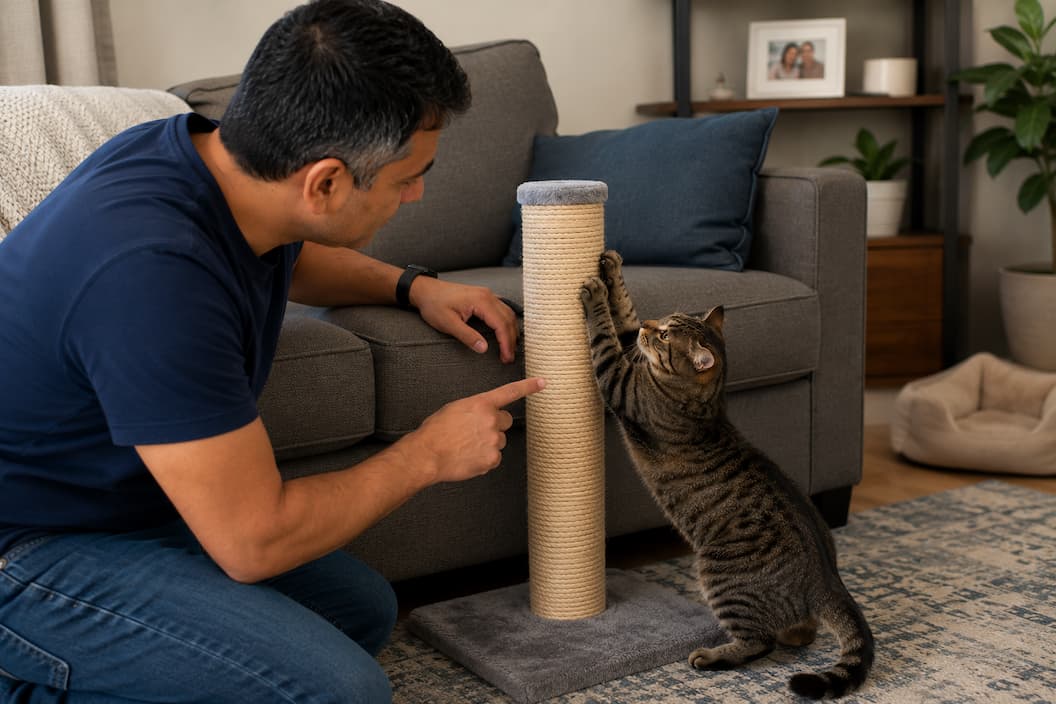
My sister’s cat, Mochi, destroyed a $2,400 leather sofa in fourteen months. Not gradually. Not with warning. With the focused intensity of a creature that understood exactly what she was doing and simply didn’t care. The sofa was oatmeal-colored, mid-century modern, purchased after my sister’s divorce as a symbol of new beginnings. Mochi started on the left armrest. By month six, both armrests were shredded down to the foam. By month ten, the back panel looked like someone had attacked it with a weed whacker. By month fourteen, my sister was sitting on a blanket-covered wreck, telling visitors she was “going for a distressed look,” while Mochi watched from the windowsill with the calm satisfaction of a job well done.
I tell this story because it illustrates something the internet gets wrong about cat scratching: it’s not a behavior problem. It’s not something you “fix” with a spray bottle or a stern voice. Mochi wasn’t anxious. She wasn’t stressed. She was a cat being a cat, and my sister had failed to provide her with anything better to scratch. The sofa was tall, stable, made of material that felt satisfying under her claws, and positioned in the center of the living room where her scent marks would be most visible to any theoretical rival cats. From Mochi’s perspective, the sofa was perfect. The problem was entirely human.
What follows isn’t gentle advice. It’s what I learned helping my sister dig out of that disaster, combined with what veterinary behaviorists and actual research say about why cats scratch and what actually redirects them. Some of it contradicts popular wisdom. All of it works.
Why Your Cat Is Scratching Your Furniture (The Real Reasons)
Cats scratch for four reasons, and understanding which one drives your cat’s behavior determines your solution.
Claw maintenance. The outer layer of a cat’s claw is called the sheath. It grows continuously and eventually becomes dull and frayed. Scratching pulls that sheath off, exposing the sharper claw beneath. You might find these discarded sheaths near favorite scratching spots — they look like small, curved fingernail clippings. This is normal. This is healthy. A cat that doesn’t scratch develops overgrown claws that can curl into paw pads, causing pain and infection.citeweb_search:8#1web_search:8#14
Stretching and exercise. Scratching is a full-body stretch. The cat extends front legs, arches back, engages shoulders. It’s the feline equivalent of a morning yoga routine. Cats often scratch immediately after waking, when their muscles are tight from sleep. The ASPCA notes that most cats want a post tall enough to stretch fully — which may explain why they prefer drapes, which offer height that most commercial scratching posts don’t.citeweb_search:8#0
Territory marking. This is the one people miss. Cats have scent glands between their paw pads. When they scratch, they deposit pheromones that contain information about their health, sex, and reproductive status. Other cats detect these signals. Even in single-cat households, this marking behavior persists — the cat is communicating with themselves, creating a familiar scent landscape that reduces anxiety. The visual marks left by scratching reinforce this chemical message.citeweb_search:8#1web_search:8#9
Stress relief. A 2024 study published in the Journal of Veterinary Behavior found a direct correlation between environmental stressors — loud noises, children in the home, irregular routines — and increased scratching frequency. Cats in high-stress environments scratch more, not because they’re being destructive, but because scratching releases calming chemicals in the brain.citeweb_search:8#7
The critical insight: you cannot stop scratching. You can only redirect it. Any approach that tries to eliminate the behavior entirely — declawing, punishment, keeping the cat in a room with no furniture — fails because it fights biology. The ASPCA is explicitly opposed to declawing, noting that it doesn’t solve behavioral issues and can create new ones, including aggression and litter box avoidance.citeweb_search:8#0
The Post That Actually Works (And Why Most Don’t)
My sister’s first attempt at solving the Mochi problem was a $12 cardboard scratcher from the grocery store. Mochi ignored it completely and went back to the sofa. The second attempt was a carpeted post from a pet store chain. Mochi scratched it twice, then returned to the sofa. The third attempt, a sisal rope tower, got more use — but only when the sofa was covered in aluminum foil, and only until the foil came off.
The breakthrough came when I stopped thinking about what posts were available and started thinking about what Mochi actually preferred.
Height matters more than material. The average commercial scratching post is 24-30 inches tall. Mochi wanted to stretch to full extension, which for a 10-pound domestic shorthair means something closer to 32-36 inches. The Pioneer Pet SmartCat Ultimate Scratching Post is 32 inches tall with a heavy base — Wirecutter’s top pick specifically because it accommodates full stretching without tipping.citeweb_search:8#6 My sister bought one. Mochi used it immediately. Not occasionally. Not as an alternative. As her primary scratching surface.
Stability is non-negotiable. A post that wobbles when scratched triggers a cat’s self-preservation instinct. In the wild, cats scratch tree trunks — immobile, deeply rooted, completely stable. A lightweight post that shifts under pressure signals danger. The SmartCat Ultimate weighs 16 pounds, most of it in the base. The SHENGOCASE 20.5-inch Corner Sisal Scratcher solves stability differently — it mounts to walls or furniture with Velcro fasteners, eliminating the tipping problem entirely.citeweb_search:8#2
Material preferences are individual. Sisal rope is the most commonly recommended material, and many cats prefer it. But not all. Some cats prefer corrugated cardboard, which shreds satisfyingly under their claws. The Catit Lounge Scratcher is a budget cardboard option that doubles as a resting surface — cats who scratch horizontally often prefer this style.citeweb_search:8#2 Others prefer carpet, wood, or woven sisal mats like the FUKUMARU Cat Scratcher Mat, which attaches to floors or walls with adhesive backing.citeweb_search:8#2
Mochi’s preference, discovered through expensive trial and error: tall vertical sisal for territorial scratching, horizontal cardboard for post-nap stretching. She uses both daily. The sofa, now recovered in a thick slipcover, remains untouched.
Placement: The Detail That Determines Success
Here’s where most people fail. They buy a beautiful scratching post, place it in a corner where it looks nice, and wonder why the cat ignores it.
Cats scratch where they scratch for reasons. My sister’s sofa was in the center of the living room, facing the front door — prime territory for scent marking. The cardboard scratcher was tucked behind a side table where no cat would bother announcing their presence. The solution wasn’t to move the cat’s behavior. It was to move the post.
The correct placement strategy:
- Next to the damaged furniture first. Not eventually. First. The cat has already chosen that location as valuable. You’re offering an alternative in the exact same spot, not asking them to relocate their behavior to a less desirable area. Once the cat consistently uses the post, you can move it gradually — inches per day — to a more convenient location.citeweb_search:8#0web_search:8#9
- Near sleeping areas. Cats stretch and scratch upon waking. A post near their preferred napping spot captures this natural rhythm. The Cats.org.uk guidance specifically recommends placing posts near beds, since cats often scratch immediately after sleep.citeweb_search:8#12
- At entry points. Doors, windows, and transitions between rooms are high-value territorial locations. If your cat scratches near these areas, they’re marking boundaries. Place posts accordingly.
- In multiple locations. The general rule is one post per cat, plus one extra. In multi-cat households, some cats will claim specific posts and prevent others from using them. Having options reduces conflict and ensures every cat has access.citeweb_search:8#11
My sister now has three posts in a 900-square-foot apartment: the tall SmartCat in the living room, a horizontal cardboard scratcher in the bedroom near Mochi’s sleeping spot, and a wall-mounted sisal mat by the front door. The sofa is no longer a target because every location Mochi valued now has a better option.
Deterrents: What Actually Works vs. What People Recommend
The internet is full of deterrent advice. Most of it is ineffective or counterproductive.
Double-sided tape: Works temporarily. Cats dislike the sticky texture on their paws. The problem: it looks terrible on furniture, leaves residue, and many cats simply move to an untreated section of the same piece. My sister used it on the sofa arms for three weeks. Mochi scratched the back panel instead. It’s a useful bridge tool while establishing posts, not a permanent solution.
Aluminum foil: Similar limitations. Some cats hate the sound and texture. Others ignore it. Mochi was in the ignore camp — she scratched right through it. The RSPCA Australia notes that covering furniture with thick, shiny plastic sheeting can be effective, but requires complete coverage and looks unsightly.citeweb_search:8#11
Citrus sprays and scented deterrents: Mixed results. Cats generally dislike citrus, menthol, and certain essential oils. Nature’s Miracle makes a scratch deterrent spray with rosemary, cinnamon, and citronella oils.citeweb_search:8#13 The issue is that scents fade quickly and need reapplication — daily at first, then gradually less as the habit breaks. Some cats also develop tolerance. Mochi ignored citrus spray after four days.
Motion-activated deterrents: These devices detect movement and emit a puff of air or startling sound. According to Cats.com, they can be effective because they create a negative association with the furniture location without connecting that association to the owner.citeweb_search:8#4 The downside: they can startle the cat generally, increasing anxiety, which may actually increase scratching as a stress-relief behavior. Use cautiously.
Squirt bottles and punishment: Don’t. Just don’t. The ASPCA explicitly warns against spraying cats with water or yelling, noting that punishment creates anxiety and damages the human-animal bond. The cat doesn’t learn not to scratch — they learn to avoid you while scratching, which often means more destructive behavior when you’re not home.citeweb_search:8#0web_search:8#1
The only deterrent I recommend: Make the furniture physically unavailable during retraining. My sister covered her sofa in a thick, fitted slipcover for six months while Mochi established post habits. The slipcover was unappealing to scratch — too smooth, no satisfying resistance. Meanwhile, the posts were positioned, scented with catnip, and rewarded with treats when used. After six months, the slipcover came off. Mochi never returned to the sofa.
The Catnip and Reward Strategy
Catnip isn’t magic, but it’s useful. About 70% of cats respond to nepetalactone, the active compound in catnip. Rubbing it on a new post makes that post interesting. Hanging a toy from the top encourages climbing and exploration. The ASPCA recommends scenting posts with catnip and placing them in areas where the cat is already inclined to climb.citeweb_search:8#0
More important than catnip: positive reinforcement. When Mochi used a post, my sister gave her a treat immediately. Not thirty seconds later. Not when she happened to notice. Immediately. Timing matters because cats connect consequences to actions in roughly a three-second window. Wait longer and the association is lost.
She also used a clicker — a small device that makes a distinct clicking sound — to mark the exact moment Mochi’s claws touched the post. Click, then treat. The click becomes a bridge signal, telling the cat precisely which behavior earned the reward. After two weeks, Mochi was seeking out posts and looking at my sister expectantly, waiting for the click.
This isn’t complicated training. It’s consistency. Three to five repetitions daily, always rewarding the post, always ignoring the sofa (not punishing — ignoring). Cats are trainable. They’re just not trainable through force.
Nail Trimming and Caps: The Supplementary Tools
Trimming claws doesn’t stop scratching. It reduces damage. My sister trims Mochi’s claws every three weeks — not short enough to cause discomfort, just enough to remove the sharp tips. The procedure: wrap Mochi in a towel, expose one paw at a time, clip the translucent tip of each claw avoiding the pink quick (the living tissue inside). A sharp clipper is essential — dull blades crush the nail, causing pain and splitting.citeweb_search:8#15
Nail caps are plastic covers that glue onto trimmed claws. They last four to six weeks and prevent damage even if the cat scratches furniture. Soft Paws is the best-known brand. My sister tried them once. Mochi tolerated the application but chewed two caps off within 48 hours. The remaining six fell off over three weeks. They’re useful for some cats, especially during the initial retraining period, but they’re not a long-term solution for most.
When Scratching Signals Something Else
Sudden increases in scratching frequency, especially in established cats, can indicate stress, anxiety, or medical issues. A cat that previously used posts exclusively and suddenly returns to furniture may be responding to:
- New pets or people in the home
- Changes in routine (work schedule, travel, renovations)
- Outdoor cats visible through windows
- Medical issues causing discomfort or anxiety
The 2024 NPR interview with veterinary behaviorist Yasemin Salgirli Demirbas specifically highlighted environmental stressors — loud noises, children, irregular play — as triggers for increased scratching. Her research found that designing calmer environments reduced scratching behavior more effectively than any single intervention.citeweb_search:8#7
If your cat’s scratching pattern changes suddenly, rule out medical causes first. A vet visit can identify arthritis, skin conditions, or neurological issues that manifest as altered scratching behavior. Then assess environmental changes. Then adjust your intervention accordingly.
What I Would Do Differently (If I Could Start Over With Mochi)
My sister’s mistakes were preventable. Here’s the sequence I would follow with a new cat or kitten:
- Before bringing the cat home: Purchase two posts — one tall vertical sisal, one horizontal cardboard. Place one near the intended sleeping area, one near the main living space entrance.
- Day one: Show the cat the posts. Rub catnip on them. Reward any investigation with treats. Do not allow access to furniture you care about — use slipcovers, keep the cat in a limited area, or accept that temporary confinement is better than permanent damage.
- Week one: Reward every post use. Ignore furniture scratching completely — no reaction, no punishment, no attention. The goal is to make post use the most rewarding behavior in the cat’s environment.
- Month one: Add a third post if the cat shows preference for a specific location or material. Remove deterrents from furniture gradually. Monitor for regression.
- Ongoing: Trim claws every three weeks. Replace cardboard scratchers when worn (cats prefer shredded surfaces, but eventually the material loses structural integrity). Check that vertical posts remain stable — bases loosen over time.
The total cost of this approach: approximately $80 for initial posts, $15 for catnip and treats, $40 for a slipcover. Compare to $2,400 for a new sofa. The math is not difficult.
Related Articles
- Easy Grooming Tips for Dogs and Cats — How I trim Mochi’s claws without bloodshed, and why nail maintenance is part of every grooming routine
- Building Positive Behavior in Pets Through Daily Reinforcement — The clicker training method I used with Mochi, adapted from what I learned with my dog Cooper
- How to Recognize Signs of Pet Stress — When increased scratching is a symptom of anxiety rather than a training issue
- How I Correct Small Bad Habits in Pets Without Stress — Why punishment backfires with cats and what redirection actually looks like in practice
- Creating a Safe Indoor Environment for Senior Pets at Home — How aging affects scratching behavior and why senior cats need different post considerations
- How to Maintain Dental Health for Pets — The connection between oral pain and behavioral changes, including altered scratching patterns
Sources and References
- PetMD. (2023, April 27). How to Stop Cats From Scratching the Furniture. By Hannah Hart, DVM. petmd.com
- ASPCA. (2026). Destructive Scratching. aspca.org
- Petplan UK. (2026). How to stop cats scratching furniture. petplan.co.uk
- Cats.com. (2025, October 23). The 8 Best Cat Scratch Deterrents. cats.com
- NPR. (2024, July 11). Why your cat scratches furniture – and how to get it to stop. Interview with Yasemin Salgirli Demirbas and Mikel Delgado. npr.org
- New York Times Wirecutter. (2026). The Best Cat Scratchers for 2026. nytimes.com/wirecutter
- Cats.com. (2026, January 9). 15 Best Scratching Posts for 2026—We Tested Them All. By Katelynn Sobus. cats.com
- RSPCA Australia. (2024, June 17). Why does my cat scratch the furniture?. kb.rspca.org.au
- Cats.org.uk. (2024, March 11). Why Do Cats Scratch?. cats.org.uk
- Alley Cat Allies. (2023, August 22). 6 Ways to Redirect Your Cat’s Scratching Behavior. alleycat.org
- North Shore Veterinary Hospital. (2023, August 30). How To Stop Your Cat From Scratching The Furniture. northshorevethospital.com

Daniel Maxfield is a pet care writer focused on practical guidance for modern pet owners. He covers pet wellness, grooming, behavior, travel routines, and everyday care habits for dogs and cats. Through reader-focused educational content, Daniel shares simple and accessible tips designed to support healthier, safer, and more organized daily life with pets.