
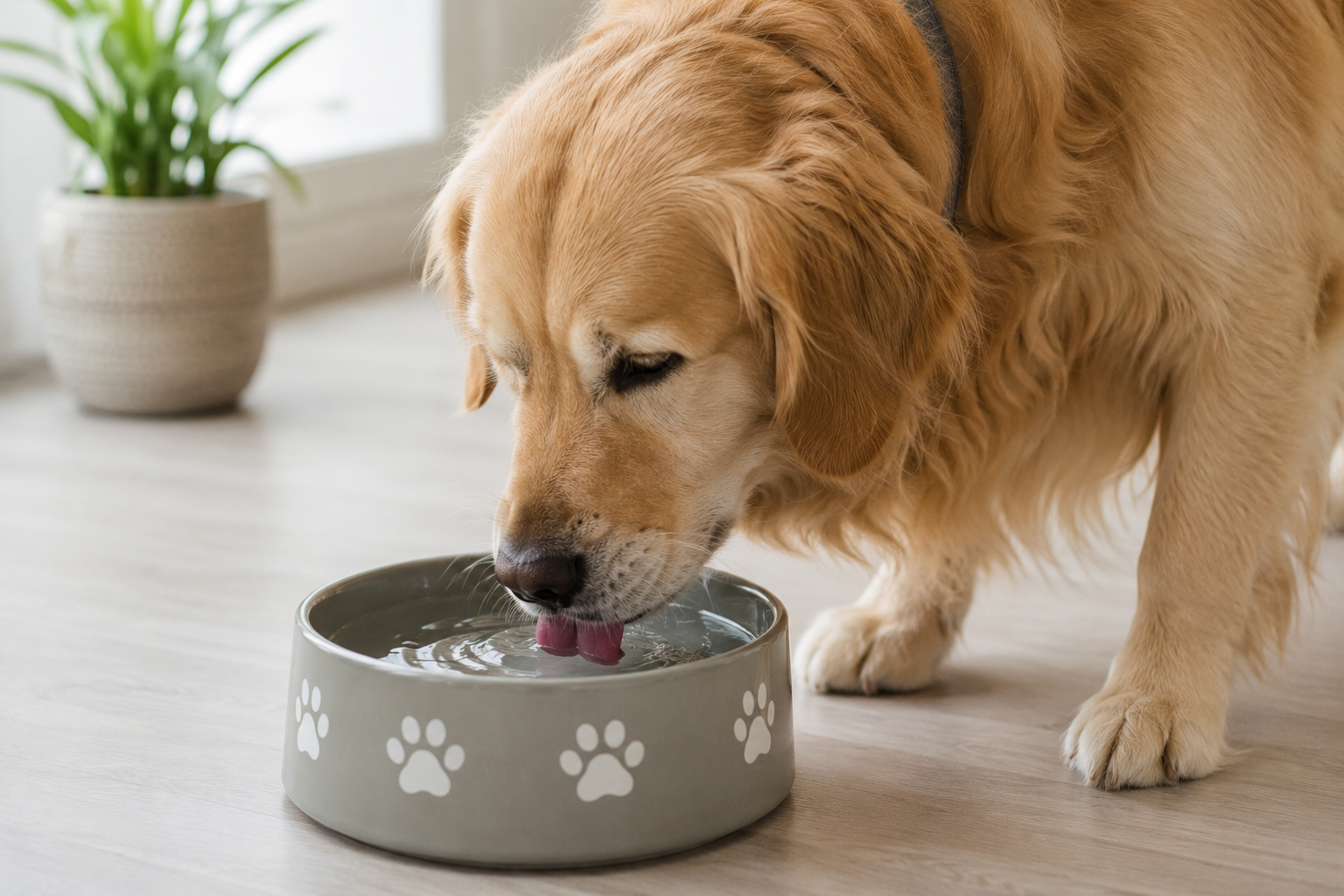
Every morning at 6:15, I fill three bowls. One for Cooper, my Golden Retriever, in the kitchen. One for Mochi, my sister’s cat who I’m watching this month, in the guest bathroom. One backup, always clean, always ready, in the hallway closet. This ritual started three years ago, after Cooper’s first urinary tract infection. The vet asked a simple question — how much water does he drink daily? — and I realized I had no idea. I filled his bowl when it looked empty. I never measured. I never paid attention.
That infection cost $340 in emergency vet fees, antibiotics, and a week of watching Cooper strain to urinate. The vet’s follow-up was blunt: Labs are prone to UTIs and kidney issues. Dehydration accelerates both. Start tracking water intake. I did. What I learned changed how I think about the most basic element of pet care.
This article isn’t about fancy fountains or gadgets, though I’ll mention them. It’s about understanding what your pet actually needs, how to tell if they’re getting it, and the small daily habits that prevent the problems nobody talks about until they’re happening.
What Daily Hydration Actually Looks Like
The numbers surprised me. A resting dog needs approximately 40-60 ml of water per kilogram of body weight daily. For Cooper, at 32 kg, that’s roughly 1.3 to 1.9 liters — about half a gallon — just to maintain normal function. That need increases three to four times with exercise or heat. A summer hike can push his requirement to nearly 4 liters.Cats need less by weight — about 60 ml per kg — but their biology makes hydration harder. Cats evolved as desert hunters, deriving most moisture from prey. Their thirst drive is low, their kidneys concentrate urine aggressively, and many cats simply don’t drink enough from still water sources. This is why wet food matters so much for cats. A cat eating exclusively dry kibble may consume only half their necessary water through drinking, relying entirely on food moisture that isn’t there.citeweb_search:9#5
I tracked Cooper’s intake for two weeks using a measuring cup. His baseline: 1.4 liters on rest days, 2.1 liters after our Saturday morning park runs. Mochi, eating wet food twice daily, drank only 120 ml from her bowl — but her total water intake, including food moisture, was closer to 200 ml, which is appropriate for her 4 kg weight. The bowl measurement alone would have suggested dehydration. The full picture did not.
The Bowl Problem Nobody Discusses
Plastic bowls are everywhere. They’re cheap, lightweight, come in colors. I used one for Cooper’s first two years. Then I noticed the scratches — fine lines in the plastic where his tags hit the rim, where his teeth gripped the edge during enthusiastic drinking. Those scratches harbor bacteria. Even with daily washing, biofilm builds up in the crevices. Cooper started developing mild chin acne, small black dots along his jaw that the vet linked to bacterial contamination from his bowl.
I switched to stainless steel. The acne cleared within three weeks. The bowl stays cleaner longer. It doesn’t retain odors. It doesn’t crack or scratch deeply. Ceramic is similarly good — non-porous, easy to sanitize, heavy enough that Cooper can’t push it across the floor. Glass works too, though it’s fragile.
What I avoid now: any plastic bowl, any bowl with deep scratches, any bowl that smells even slightly after washing. The cost difference is negligible. A good stainless steel bowl costs $8. A ceramic one, $12. The vet bill for Cooper’s chin acne was $85. The math is simple.
My Morning and Evening Routine
6:15 AM. I rinse Cooper’s bowl with hot water, fill it with fresh tap water — our municipal supply is good, but I let it run for ten seconds to clear any standing water in the pipes. I place it in the same spot, on a rubber mat that prevents sliding. Consistency matters. Cooper knows where his water is. He doesn’t have to search.
I check Mochi’s bowl too. She drinks less in the morning, more in the evening. Her bowl is smaller, shallower — cats prefer not to have their whiskers touch the sides. The whisker stress phenomenon is real; a bowl too narrow discourages drinking. Her ceramic dish is 6 inches wide, 1.5 inches deep. She drinks from the center, whiskers clear.
Midday, I do a visual check. Both bowls should still have water. If either is empty before evening, I note it. Consistently empty bowls mean I need to increase the morning fill or add a midday refresh. Cooper’s bowl rarely empties. Mochi’s does, sometimes, on hot days.
6:00 PM. I empty both bowls entirely — not just refill on top. Standing water collects dust, hair, food particles. Bacteria multiply. The ASPCA recommends changing water at least once daily, more often in warm weather. I wash both bowls with dish soap, rinse thoroughly, dry with a clean towel, then refill. Fresh start, every evening.
Before bed, around 10:00 PM, I do a final check. Cooper usually drinks after his last walk. Mochi often drinks after her evening play session. Both bowls should have enough to last until morning. I don’t fill to the brim — water gets warm and stale overnight. I fill to about two-thirds, enough for overnight needs, fresh in the morning.
When I Knew Something Was Wrong
Last August, Cooper’s water intake dropped. Not dramatically — from 1.4 liters to about 900 ml over three days. He seemed fine. Eating normally. Energy good. But the numbers don’t lie. On the fourth day, I found him straining in the yard, producing only small amounts of dark urine. I called the vet.
The examination revealed mild dehydration. Not severe enough for emergency fluids, but enough to cause concentrated urine and early bladder irritation. We caught it early because I was tracking. The treatment: subcutaneous fluids at the clinic, increased water intake at home, and monitoring. Cost: $120. If I’d waited until he was visibly lethargic or vomiting, the bill would have been ten times higher, and the recovery longer.
The early signs I now watch for, learned from that experience and from veterinary guidance:
| Sign | What It Looks Like | What I Do |
|---|---|---|
| Decreased drinking | Measuring less than baseline for two consecutive days | Add water to food, offer ice cubes, call vet if continues to day three |
| Dark urine | Amber or orange instead of pale yellow | Increase water immediately, monitor next elimination, vet if no improvement in 24 hours |
| Dry gums | Gums feel tacky instead of moist and slippery | Offer small amounts of water frequently, check for other symptoms, vet if accompanied by lethargy |
| Skin tenting | Skin at neck stays raised when gently pinched, doesn’t snap back | Vet immediately — this indicates moderate to severe dehydration |
| Lethargy | Unusual tiredness, reluctance to walk or play | Vet immediately — can indicate severe dehydration or underlying illness |
The skin tent test is the one I use most. Gently pinch the skin between the shoulder blades, lift, release. In a well-hydrated dog, it snaps back instantly. In Cooper, during his mild dehydration, it took about two seconds to settle. That’s the threshold where I call the vet.citeweb_search:9#3web_search:9#5
Travel and Weather Adjustments
My routine changes when we travel. I bring bottled water — the same brand Cooper drinks at home. Water chemistry varies by city, and sudden changes can cause stomach upset. During a trip to Phoenix, I let him drink from a campground spigot. He had loose stools for thirty-six hours. Never again. I now carry two gallons for any trip longer than a weekend.
Hot weather means more water, more frequent checks, more vigilance. Last summer, Austin had seventeen consecutive days above 100°F. Cooper’s intake increased to nearly 2.5 liters daily. I added a third bowl in the bedroom, where the air conditioning is strongest. I refreshed all bowls twice daily instead of once. I watched for panting, for lethargy, for any sign that the heat was overwhelming his ability to cool.
Cold weather matters too. Heated indoor air is dry. Dogs pant less, so they lose less moisture through respiration, but they still need consistent intake. I don’t reduce Cooper’s water in winter. His activity level drops, but his baseline need remains.
The Fountain Question
I tried a fountain. The Petlibro Dockstream, battery-operated, 2.5 liter capacity, whisper-quiet. Cooper ignored it for three days, then drank from it enthusiastically. Mochi approached it once, watched the water move, and walked away. She hasn’t used it since.
The fountain stays in the kitchen now, running continuously. Cooper uses it as his primary source. Mochi uses her still bowl in the bathroom. The fountain requires weekly disassembly and cleaning — pump, filter, reservoir, all the small parts. The filter needs replacement every two to four weeks. It’s more work than a bowl. But Cooper drinks more from it, and his intake is more consistent, so the tradeoff is worth it for him.
For cats, fountains can help. The moving water mimics a stream, appealing to their preference for fresh, flowing sources. But not all cats adapt. Mochi’s indifference isn’t unusual. If you’re considering a fountain, introduce it alongside the existing bowl, don’t replace it immediately. Let the pet choose. If they ignore it after two weeks, return it. Don’t force the issue.
The Catit Flower Fountain is a budget option at under $25, with adjustable flow and large capacity. The Pioneer Pet Raindrop is stainless steel, easier to clean, with a simple two-part design. The Petkit Eversweet 3 Pro has a longer-lasting filter — up to eight weeks in smart mode — and app connectivity for monitoring. I haven’t tried the Petkit. The Petlibro works for Cooper, so I haven’t needed to switch.
What I Wish I’d Known Earlier
Hydration isn’t dramatic. It’s not the kind of pet care that gets celebrated on social media. No one posts photos of a full water bowl. But it’s the foundation that everything else builds on. Digestion, temperature regulation, joint lubrication, kidney function, waste elimination — all depend on adequate water intake.
The most important thing I learned: pay attention before there’s a problem. Measure for a week. Establish a baseline. Know what’s normal for your pet. Then notice deviations. A 20% drop in intake is significant, even if your pet seems fine. Dark urine is significant, even if they’re still playing. Dry gums are significant, even if they’re still eating. These early signals are gifts. They give you time to act before the situation becomes urgent.
I fill three bowls every morning now. Not because I’m obsessive. Because I understand what happens when I don’t.
Related Articles
- How I Handle Feeding Schedules While Traveling With Pets — Why I never skip the bottled water, even for short trips, and how travel disrupts normal drinking patterns
- How to Maintain Dental Health for Pets — The connection between dry mouth, gum health, and overall hydration that my vet explained after Cooper’s UTI
- How I Monitor Pet Energy Levels for Early Health Signs — How decreased water intake showed up in Cooper’s activity data before I noticed it behaviorally
- Managing Pet Stress During Loud Noises and Busy Days — Why anxious pets pant more and lose moisture faster, requiring adjusted hydration monitoring
- How to Recognize Signs of Pet Stress — The subtle behavioral changes, including altered drinking, that signal stress before obvious symptoms appear
- Creating a Safe Indoor Environment for Senior Pets at Home — Why aging pets need water sources on every floor and how diminished mobility affects hydration
Sources and References
- Cats.com. (2026, May 29). 17 Best Cat Water Fountains in 2026 — And We Tested Them All. By Katelynn Sobus. cats.com
- Forbes. (2026, March 12). Best Cat Water Fountains 2026. forbes.com
- Loveland Regional Animal Hospital. (2025, November 22). Dog Dehydration: Signs, Causes, Treatment and Prevention. lovelandregional.com
- Ocean Animal Hospital. (2026). How to Recognize Pet Dehydration and Heat Stress. oceananimalhospital.com
- Paumanok Veterinary Hospital. (2025, October 21). Pet Dehydration Signs And Fluid Therapy Explained. paumanokvethospital.com
- VetCheck Pet Urgent Care Center — Bloomington. (2026). Recognizing Life-Threatening Dehydration Signs in Pets. vetcheckforpetsbloomington.com
- Wilderness Medical Society. (2026). Vet Medicine: Canine Hydration. wms.org
- Banfield Pet Hospital. (2026). Signs of dehydration in dogs and cats. banfield.com

Daniel Maxfield is a pet care writer focused on practical guidance for modern pet owners. He covers pet wellness, grooming, behavior, travel routines, and everyday care habits for dogs and cats. Through reader-focused educational content, Daniel shares simple and accessible tips designed to support healthier, safer, and more organized daily life with pets.