
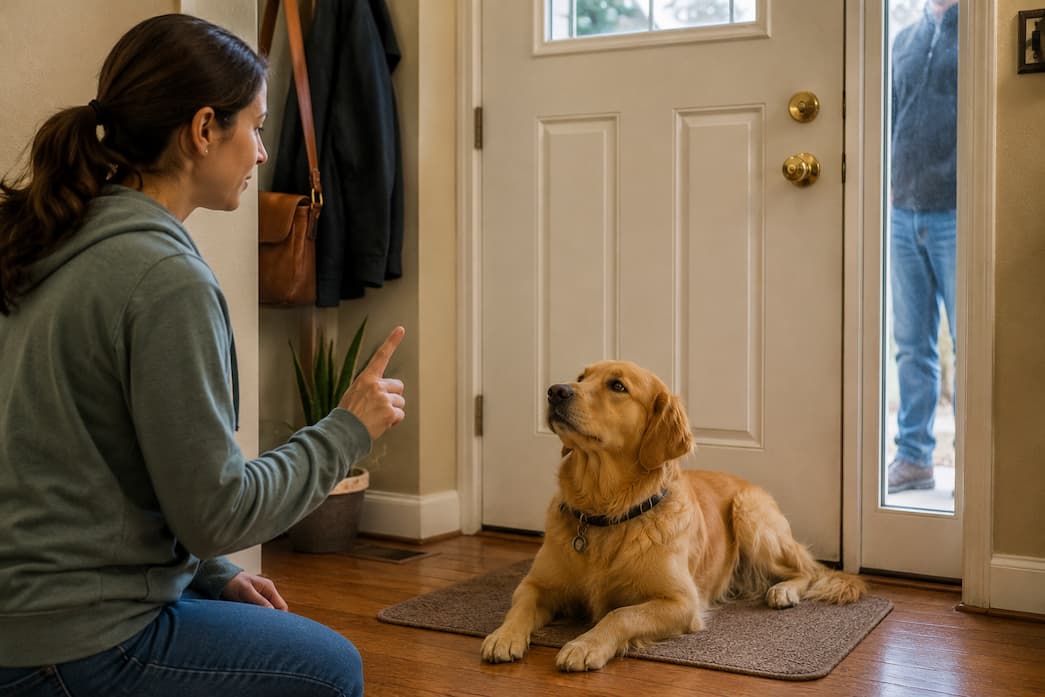
Cooper did not bark at the doorbell when I first got him. He was too overwhelmed by everything else — the new house, the new smells, the new human who kept trying to pet him. For the first few months, when someone rang the bell, he would freeze, lower his head, and back toward the nearest wall. No barking. No lunging. Just retreat.
That changed around his second birthday. I do not know what flipped the switch. Maybe it was a delivery driver who knocked aggressively. Maybe it was the accumulation of strangers appearing at the door over months. Whatever the cause, Cooper developed a full-blown doorbell reactivity that made my life miserable for three years. The sound of the bell would trigger a bark so loud and sudden it could wake the dead. He would sprint to the door, hackles up, tail stiff, and bark until whoever was on the other side left or I physically removed him from the entryway. Guests were terrified. Delivery drivers started leaving packages at the end of my driveway. I stopped ordering pizza because I could not face the embarrassment.
I tried yelling “no.” I tried shaking a can of coins. I tried a squirt bottle. None of it worked. Cooper was not being defiant. He was genuinely distressed, and my attempts to suppress the behavior only made him more anxious. The turning point came when a friend who trains service dogs watched Cooper react to the doorbell and said something simple: “You are trying to stop the bark. You need to change what the bell means.”
That conversation started a six-month process that completely transformed how Cooper responds to the doorbell. He is not perfect. He still alerts me when someone arrives. But the panic is gone. The barking lasts three seconds instead of three minutes. And I can answer my own door again.
Understanding What the Doorbell Actually Means to Your Dog
Before I could fix Cooper’s reaction, I had to understand it. To me, the doorbell is a notification. To Cooper, it was a threat alarm. Someone is approaching our territory. I need to alert the pack. I need to drive them away. The barking was not bad behavior. It was Cooper doing exactly what his instincts told him to do.
The problem is that doorbells are unpredictable. Cooper could not see who was coming. He could not smell them through the door. The sound arrived without warning, and his nervous system responded with a surge of adrenaline. Every time the bell rang and a stranger entered, Cooper’s brain confirmed the pattern: bell equals threat equals barking equals stranger leaves. The behavior was self-reinforcing. The stranger always left eventually, which Cooper interpreted as his barking working.
I also realized I was part of the problem. When the bell rang, I would rush to the door, tense and annoyed. My heart rate spiked. My voice got sharp. Cooper read my body language as confirmation that something was wrong. Dogs are social animals. They take emotional cues from their humans. If I was stressed, Cooper was stressed. I had to change my own response before I could change his.
Phase One: Disconnecting the Real Doorbell
The first step was the hardest because it felt ridiculous. I disconnected my actual doorbell. I put a handwritten sign on the front door that said “Doorbell broken — please text or knock gently.” I told friends and family to text when they arrived. I left delivery instructions asking drivers not to ring. For two weeks, my house was a doorbell-free zone.
This was not laziness. It was strategic. Every time Cooper barked at the real doorbell, he practiced the unwanted behavior and reinforced the neural pathway that connected the sound to panic. I needed to stop the rehearsals before I could teach a new script. Think of it like trying to teach someone a new golf swing while they are still playing three rounds a week with their old swing. You have to pause the old pattern before the new one can take hold.
During those two weeks, I also started paying attention to Cooper’s baseline stress. Was he sleeping well? Was he reactive on walks? Was he licking his paws excessively? Stress is not compartmentalized. A dog who is anxious about other things will be more reactive to triggers. I made sure Cooper was getting enough exercise, mental stimulation, and rest. I reduced his exposure to other stressors — construction noise, unfamiliar dogs, crowded spaces — so his nervous system had capacity to learn.
Phase Two: Teaching a New Association
With the real doorbell silenced, I started counterconditioning. The goal was simple: make the doorbell sound predict something good, not something scary. I recorded the doorbell on my phone — the exact chime, not a generic sound from the internet. Dogs recognize specific sounds. Cooper knew my doorbell. A different chime would not transfer.
I played the recording at the lowest possible volume. So low I could barely hear it myself. Cooper was in the living room, relaxed, not expecting anything. The moment the sound played, I tossed a piece of chicken his way. Not a training treat. Real cooked chicken breast, cut into pea-sized pieces. The good stuff. He ate it, looked at me, and went back to what he was doing.
I repeated this ten times per session, three sessions per day. Same volume. Same timing — sound, then treat. Never treat, then sound. The order matters. The sound has to predict the treat, not the other way around. If you treat first and then play the sound, you are not building an association. You are just feeding your dog and making noise.
After four days at the lowest volume, I raised it one notch. Still quiet, but noticeable. Cooper’s ears flicked toward the sound, but he did not tense up. He looked at me expectantly. That was the sign I was waiting for. When a dog starts looking at you after hearing a trigger, it means they are anticipating the reward. The association is forming.
I continued this process for three weeks, raising the volume one level every few days. There were setbacks. One day I got impatient and jumped two volume levels. Cooper barked. I went back to the previous level for three more days. There is no prize for speed. The only goal is accuracy.
Phase Three: Adding Context
Once Cooper was calm at full volume indoors, I started adding context. I played the recording while standing near the front door. Then while touching the doorknob. Then while opening the door slightly. Each new element was introduced separately, at low intensity, with treats following immediately.
The door opening was the hardest part. Cooper associated the door with strangers, not just the bell. I had to separate the two. I opened the door while playing the recording, gave Cooper a treat, and closed the door without anyone being there. No stranger. No threat. Just door opens, treat happens. I did this twenty times over a week until Cooper stopped tensing when the door moved.
Then I added a fake guest. My neighbor would stand outside, I would play the recording, open the door, and she would step inside quietly — no eye contact with Cooper, no speaking, no reaching toward him. She would drop a treat on the floor and walk past him to the kitchen. Cooper’s job was to stay calm and collect the treat. If he barked, she stepped back outside, the door closed, and we tried again at a lower intensity.
This phase took four weeks. Some days felt like we made no progress. Some days Cooper surprised me by staying completely quiet while a new person entered. I learned to celebrate small wins and not get discouraged by bad days. Reactivity is not a straight line. It is a jagged graph with ups and downs.
Phase Four: The Real Doorbell Returns
After six weeks of training with recordings and fake guests, I reconnected the real doorbell. I was nervous. The first ring was a delivery driver. Cooper barked once — a single alert bark — then looked at me. I said “yes” and tossed a treat. He caught it mid-air and sat down. The driver looked confused. I did not care. It was the best bark I had ever heard.
Over the next month, I reinforced the new pattern every time the real bell rang. Sound, then treat. Sound, then treat. I kept high-value rewards in a jar by the door so I was never caught empty-handed. I also managed my own energy. When the bell rang, I walked to the door slowly, breathing normally, speaking in a calm voice. Cooper watched me. My calm became his calm.
I did not expect silence. Cooper is a dog. Alert barking is normal. What I wanted was control — the ability to interrupt the bark, redirect Cooper’s attention, and have him settle within seconds. That is what we achieved. The three-minute panic attacks were gone. The hackles-up sprint to the door was gone. What remained was a dog who noticed the doorbell, announced it briefly, and then looked to me for guidance.
What I Learned About My Own Behavior
This process taught me as much about myself as about Cooper. I had been reinforcing his reactivity without realizing it. When the bell rang, I would tense up, rush to the door, and speak in a sharp voice. My body language screamed threat. Cooper was not wrong to be alarmed. He was reading me accurately.
I also learned that punishment does not work for fear-based behavior. Yelling at Cooper for barking at the doorbell was like yelling at someone for flinching when a car backfires. The reaction is involuntary. You cannot punish it away. You can only change the underlying emotion that drives it.
The most important lesson was patience. I wanted a quick fix. I wanted to watch a YouTube video, apply a technique, and see results in a week. Real behavior change takes months. Cooper’s neural pathways were shaped by three years of doorbell equals threat. Rewiring them required hundreds of repetitions at low intensity before the real trigger could be introduced safely. There is no shortcut.
When to Call a Professional
I did this training myself, but I had guidance. I consulted a certified behavior consultant early in the process who helped me identify Cooper’s threshold, choose the right rewards, and recognize when I was pushing too fast. If your dog’s doorbell reactivity is severe — involving aggression toward guests, self-injury from lunging, or generalized anxiety that affects other areas of life — I recommend working with a professional from the start.
Look for a trainer certified by the Certification Council for Professional Dog Trainers (CCPDT) or the International Association of Animal Behavior Consultants (IAABC). Avoid anyone who recommends shock collars, prong collars, or alpha-rolling for this issue. Those methods suppress behavior without addressing the fear underneath. The barking might stop, but the anxiety usually gets worse.
Related Articles
- How I Stopped My Dog From Pulling on the Leash in 3 Weeks — The same impulse control and redirection principles that made doorbell training possible also solved Cooper’s leash reactivity.
- My Experience With Clicker Training: 30-Day Results — The marker-based system I used during doorbell training to precisely time rewards and build Cooper’s understanding of what behavior earned the treat.
- What I Learned From a Professional Dog Trainer in 5 Sessions — Professional guidance that shaped my approach to Cooper’s reactivity and taught me why punishment fails for fear-based behavior.
- How I Correct Small Bad Habits in Pets Without Stress — The positive reinforcement framework I use for all behavior modification, including the doorbell protocol described here.
- Managing Pet Stress During Loud Noises and Busy Days — Doorbells are not the only sound trigger. This covers how I manage Cooper’s stress during thunderstorms, fireworks, and other high-noise events.
- How to Recognize Signs of Pet Stress — Before you can train reactivity, you need to read your dog’s stress signals. This covers the body language that tells you when to push forward and when to back off.
- Building Positive Behavior in Pets Through Daily Reinforcement — Doorbell training is not a one-time fix. This covers the daily habits that keep Cooper’s behavior stable long after the initial training.
- Creating a Safe Indoor Environment for Senior Pets at Home — As Cooper ages, his sensory sensitivity changes. This covers how I adapt his environment to reduce unexpected triggers.
Sources and References
- Oregon Humane Society. (2021, December 2). “Creative Solutions to Poor Door Greeting Behavior.” Oregon Humane Society. https://www.oregonhumane.org/portland-training/creative-solutions-to-poor-door-greeting-behavior/
- East Bay SPCA. (2024). “Desensitization and Counter Conditioning (DS/CC).” East Bay SPCA Behavior Resources. https://eastbayspca.org
- Marin Humane. “Counterconditioning.” Marin Humane Behavior & Training. https://www.marinhumane.org
- Sniffspot. (2020, July 8). “Overview of Counterconditioning for Reactive Dogs.” Sniffspot Blog. https://www.sniffspot.com
- Canine Scholars. (2017, August 23). “Dog & Puppy Counter Conditioning Training.” Canine Scholars. https://www.caninescholars.com
- DVM360. (2026, June 3). “Desensitization, Counter-Conditioning Can Help Curb Excessive Barking.” DVM360. https://www.dvm360.com
- Oakland Dog Trainer. (2026, April 27). “Why Counterconditioning Fails for Reactive Dogs (and How to Fix It).” The Dog Lab. https://www.oaklanddogtrainer.com
The doorbell training described reflects personal experience with Cooper, a 65-pound Golden Retriever adopted from rescue at eight months old, now approximately eight years old. Every dog has different thresholds, stress levels, and learning speeds. What took Cooper six months might take another dog three weeks or a year. If your dog shows signs of aggression, extreme fear, or self-injury in response to doorbell sounds, consult a certified behavior professional before attempting desensitization protocols.

Daniel Maxfield is a pet care writer focused on practical guidance for modern pet owners. He covers pet wellness, grooming, behavior, travel routines, and everyday care habits for dogs and cats. Through reader-focused educational content, Daniel shares simple and accessible tips designed to support healthier, safer, and more organized daily life with pets.