
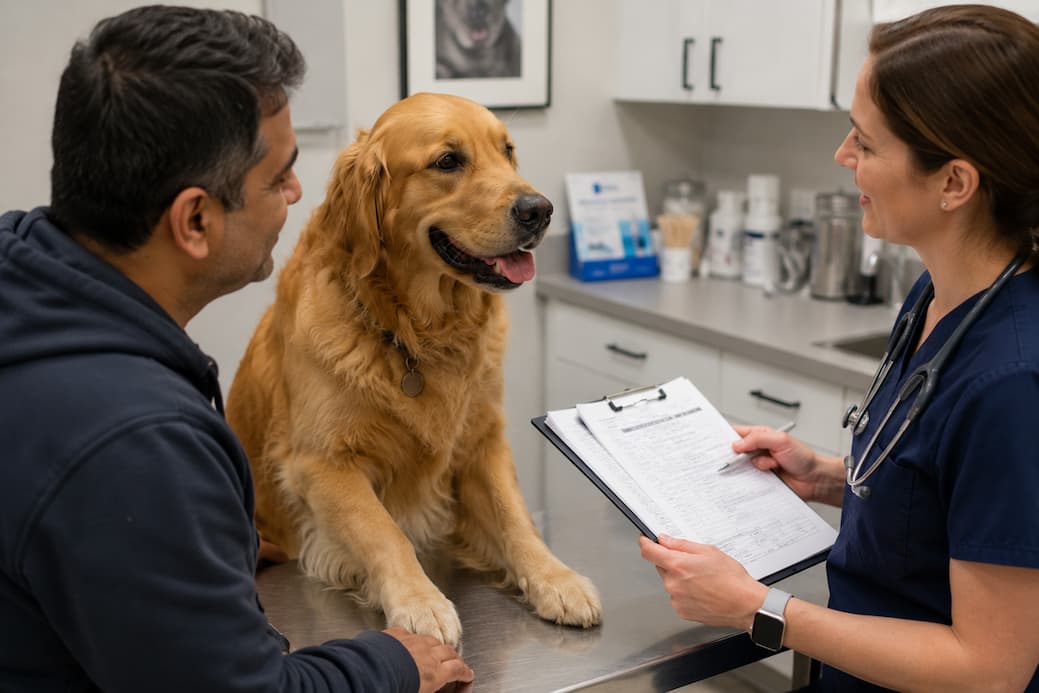
My vet said something during a routine checkup that stopped me mid-question. I’d asked whether I could skip the annual booster since the dog seemed perfectly healthy, and she looked at me the way teachers look at students who have confidently given the wrong answer.
“The vaccine card isn’t just for your dog,” she said. “It’s for everyone your dog meets.”
That one sentence reframed the entire conversation for me. I’d been thinking about vaccinations as something I did for my dog. She was pointing out that some of it — especially rabies — exists in a wider ecosystem of public health, legal obligation, and community protection. After that visit, I started asking more questions. Over the next year and a half, across several appointments and a lot of reading, I built up a picture of what vaccination schedules actually mean — not as a checklist to tick, but as a living, adjustable plan for the specific animal in front of you.
This is what I learned, mostly from her, partly from my own research, and partly from getting things slightly wrong before correcting them.
The Core vs Non-Core Distinction — and Why It Actually Matters
The first thing my vet explained, and the thing I wish I’d understood from the start, is that not all vaccines are equal in terms of who needs them. There’s a meaningful split between what professionals call “core” and “non-core” vaccines, and confusing them leads to either under-protecting your pet or over-vaccinating unnecessarily.
Core vaccines are the non-negotiables — the ones recommended for every dog or cat regardless of lifestyle, geography, or living situation. The 2024 guidelines from the World Small Animal Veterinary Association (WSAVA), which represent the current international standard, define core vaccines as protection against diseases that are severe, widely distributed, or pose a public health risk. For dogs that means: canine distemper virus, canine parvovirus, canine adenovirus, and rabies (in regions where it’s endemic or required by travel law). For cats, core coverage targets feline panleukopenia, feline herpesvirus, and calicivirus — sometimes grouped together as FVRCP — plus rabies where relevant.
Non-core vaccines are different. These are recommended based on actual risk assessment — where you live, how your pet lives, what they’re exposed to. A dog who swims in lakes and has contact with wildlife will have a different non-core list than a dog who walks on clean pavements twice a day and barely meets other animals. My vet’s approach was always to ask first, then recommend — not to assume every dog needs every available vaccine.
Core vs Non-Core: A Quick Reference
| Pet | Core Vaccines | Common Non-Core (lifestyle dependent) |
|---|---|---|
| Dog | Distemper, Parvovirus, Adenovirus (DAP/DHPPi), Rabies* | Leptospirosis, Bordetella (kennel cough), Lyme disease, Canine influenza |
| Cat | Panleukopenia, Herpesvirus, Calicivirus (FVRCP), Rabies* | Feline Leukaemia (FeLV), Bordetella, Chlamydophila felis |
* Rabies is legally required for international travel in the UK and many other countries. Not required domestically in the UK where the country is officially rabies-free, but essential for pets that travel abroad.
The Puppy Schedule — Why the First Year Is the Most Critical
When I got my dog as a puppy, I knew he needed “shots.” What I didn’t understand was the reasoning behind the timing — why vets space those early injections a few weeks apart rather than giving them all at once.
My vet explained it this way: puppies are born with maternal antibodies — immunity passed from their mother. These antibodies protect them initially but also interfere with vaccines, essentially neutralizing them before the immune system has a chance to respond. The problem is that maternal antibody levels vary between individual puppies and decline at different rates. No one can know exactly when a given puppy’s maternal immunity drops low enough for a vaccine to take hold.
The solution is a series of injections spaced several weeks apart — typically starting at six to eight weeks and running through to around sixteen weeks — essentially giving multiple opportunities to catch that window. The series isn’t redundant; it’s insurance against timing variation. Missing or significantly delaying any step in the puppy series doesn’t just push things back — it can leave genuine gaps in protection.
After the puppy series, a booster at around twelve months consolidates everything. This is the one I’d been tempted to skip. My vet was firm: the twelve-month booster is not routine bureaucracy. Core vaccines like distemper and parvovirus have been shown to provide long immunity after a completed series — potentially three years or more — but confirming that immunity requires either revaccination or a titer test. More on that below.
What Leptospirosis Taught Me About Geography
This is a good example of how non-core decisions should actually work. Leptospirosis is a bacterial disease, not viral — it spreads through contact with contaminated water or soil, and infected animals (including rats and wildlife) pass it in urine. It’s zoonotic, meaning it can pass to humans.
Where I live, leptospirosis is a real risk. My vet recommended it as effectively essential given our dog’s access to green spaces, wet ground, and his tendency to drink from puddles regardless of how many times I tell him not to. In some parts of the world, leptospirosis is treated as a core vaccine rather than non-core for exactly this reason. The WSAVA guidelines explicitly acknowledge that core and non-core classification can shift depending on local disease prevalence.
The leptospirosis vaccine requires an annual booster. It doesn’t provide multi-year immunity the way distemper and parvovirus vaccines can. My vet was direct about this distinction — some vaccines need annual refreshing and some don’t, and conflating the two leads to either unnecessary injections or actual protection gaps.
How Often Do Boosters Actually Need to Happen?
| Vaccine | Initial Series | Booster Frequency | Titer Testing Option? |
|---|---|---|---|
| Distemper / Parvovirus (DAP) | Puppy series + 12-month booster | Every 3 years (or per titer) | Yes — well-validated |
| Rabies | Single dose (after 12 weeks) | 1–3 years (legal/travel rules apply) | Limited — legal status often overrides |
| Leptospirosis | 2-dose primary + annual | Annual (no long-term immunity) | Not recommended |
| Bordetella (kennel cough) | Single dose or 2-dose | Annual or per boarding/kennel requirement | No |
| Feline FVRCP (cats) | Kitten series + booster | Every 3 years (adults) | Yes — panleukopenia component |
| Feline Leukaemia (FeLV) | 2-dose kitten series | Annual for at-risk cats | No |
Frequencies reflect general WSAVA/AAHA guidance and should be confirmed with your vet, who will adjust based on your pet’s health status and local disease risk.
Titer Testing — The Option My Vet Didn’t Volunteer Until I Asked
About two years in, I asked whether there was a way to know if the boosters were actually necessary — whether my dog still had immunity rather than just assuming it had lapsed. My vet paused for a moment, and what she said next surprised me.
“Yes. It’s called a titer test. I don’t always bring it up because most clients just want to keep things straightforward.”
A titer test is a blood test that measures the concentration of antibodies against specific diseases — canine distemper, parvovirus, and adenovirus are the ones where titers are most meaningful and clinically validated. If the result shows adequate antibody levels, it indicates existing immunity, potentially making a booster unnecessary at that point. If the result is negative, a booster is recommended.
The veterinary community is nuanced on this. The WSAVA guidelines support titer testing for assessing duration of immunity for core vaccines in dogs. The AVMA notes that the correlation between antibody levels and actual protection has not been fully established for all vaccines — so titer testing is a tool, not a replacement for clinical judgment. For dogs with a history of adverse vaccine reactions, immune-mediated conditions, or sensitivities, it’s particularly worth discussing.
There’s also a practical consideration. Titer testing costs more than a booster in most practices, and you need the actual test and the potential follow-up booster anyway if the result comes back low. But for owners who are concerned about over-vaccination — a legitimate concern, particularly for dogs prone to immune-related issues — it offers a way to vaccinate based on actual immune status rather than a fixed calendar.
Rabies is an exception: even if a titer shows immunity, legal and travel requirements often mandate revaccination on a fixed schedule regardless. The law doesn’t accept a blood test in place of a stamp on a certificate.
The Annual Visit Question (Which Is Really a Different Question)
One thing I got wrong for a long time: I conflated “annual vaccination” with “annual vet visit.” My vet gently separated these.
Not every vaccine needs annual administration. Some — like leptospirosis and bordetella — genuinely need yearly renewal. Others, like the core distemper and parvovirus vaccines in adult dogs with a completed primary series, can often extend to three-year intervals. But the annual visit itself remains valuable independently of whatever injections happen that day. Weight monitoring, dental assessment, skin checks, early detection of age-related changes — none of that is tied to the vaccine needle.
The WSAVA guidelines put it directly: vets should encourage annual health checks as distinct from vaccination appointments. Framing everything as “vaccine time” actually undersells the checkup itself, and it can lead owners to skip visits when boosters aren’t due — which means health issues go unnoticed for longer than they should.
My vet now uses a health plan approach where vaccines are one item on the agenda, not the headline. That reframe has made me more consistent about bringing my dog in, not less.
Questions Worth Asking at Your Next Appointment
These are the ones I either asked too late or wish I’d thought to ask earlier:
- Which of these vaccines are legally required vs. clinically recommended for our specific situation?
- Is my dog’s lifestyle genuinely high-risk enough to warrant non-core vaccines like leptospirosis or Lyme?
- Is a three-year interval appropriate for the core boosters, given their completed primary series?
- Could titer testing be worth considering instead of automatic boosters this year?
- If we’re planning international travel, what does the schedule need to look like, and how far in advance?
- Is there anything in my pet’s health history that would make spacing vaccines differently a good idea?
What Happens When You Let a Vaccination Lapse
I know someone whose dog had a several-month gap in its leptospirosis vaccination because they moved house and the reminder got lost in the chaos. Their new vet informed them that lapsed vaccines often need to be restarted rather than simply topped up — the immune system’s memory of the previous vaccination may no longer be enough to mount a rapid response to a booster.
For core vaccines like distemper and parvovirus, a short lapse doesn’t necessarily require a full restart — the immune system can often respond well to a single booster even after a gap, especially in a dog with a documented completed primary series. But this isn’t guaranteed, and it depends on how long the gap was and the individual dog’s immune history.
For rabies, lapsing is a more serious issue on multiple fronts. Legally, a pet that has allowed its rabies certificate to expire is considered unvaccinated for travel and insurance purposes. In jurisdictions where rabies vaccination is legally mandated, an expired certificate creates genuine compliance problems. The practical implications of an unvaccinated dog being involved in a biting incident are significant — in the US, for example, the CDC recommends euthanasia for unvaccinated dogs exposed to potentially rabid animals, or alternatively a strict quarantine of several months at the owner’s cost. No one wants to be in that situation over a missed appointment.
For the UK specifically: rabies vaccination isn’t required for dogs staying in the country, since the UK is officially rabies-free. But for any dog travelling internationally, the timing rules are strict — the primary vaccination must be given at least 21 days before travel, the dog must be microchipped before or on the same day as vaccination, and any lapse in the booster sequence resets the pet to “primary vaccination” status, requiring the full 21-day wait again before travel is permitted.
Adverse Reactions — What Actually Happens and How Often
The question I hear from people most often is about side effects. It’s a fair one, and my vet answered it without being dismissive or falsely reassuring.
Most reactions are mild and temporary: lethargy for a day, soreness at the injection site, reduced appetite, occasionally a low-grade fever. These usually resolve within 24 to 48 hours. Serious reactions — anaphylaxis, facial swelling, collapse — are genuinely rare, and when they happen they tend to occur within an hour of the injection, which is why many vets suggest waiting briefly after vaccination before leaving the clinic.
Certain dogs are more likely to have reactions: small breeds, dogs with a history of prior reactions, and those receiving multiple vaccines on the same day. For dogs with sensitivities, my vet recommended separating vaccines across different visits with at least three weeks between them. It adds appointments but meaningfully reduces reaction risk. Titer testing in these cases becomes more clearly worthwhile from both a welfare and practical standpoint.
Dogs with immune-mediated diseases or predispositions to them warrant an even more careful conversation — over-vaccination in animals with compromised immunity has been linked to additional immune stress. This isn’t a reason to avoid vaccination entirely; it’s a reason to tailor the schedule carefully rather than applying the same protocol to every patient.
After a Vaccine: What’s Normal and What Isn’t
Usually nothing to worry about (resolves in 24–48 hours):
- Mild tiredness or reduced energy
- Soreness or small lump at the injection site
- Reduced interest in food
- Low-grade temperature
Contact your vet promptly if you see:
- Facial swelling, hives, or skin reactions
- Vomiting or diarrhoea within hours of the vaccine
- Difficulty breathing or collapse
- Persistent lethargy beyond 48 hours
- Swelling at the injection site that hardens or grows over days (particularly in cats — rare but worth monitoring)
The Bigger Picture — What I Actually Took Away
If I’m being honest, I walked into that first real conversation about vaccination schedules thinking it was going to be a simple chart. Puppy at eight weeks, then twelve, then sixteen. Annual booster. Done.
The reality is more interesting than that. Core vaccines form a baseline that every dog and cat should have. Non-core vaccines need genuine risk assessment rather than automatic administration. Boosters don’t all operate on the same clock — some need annual renewal and some don’t. Titer testing exists and can be genuinely useful for certain dogs. The annual visit matters regardless of what vaccines are due. And lapsing has consequences that scale from inconvenient to serious depending on which vaccine it is and where you live.
None of that is complicated once you understand the logic behind it. But it does require asking questions at the appointment rather than just nodding at whatever gets recommended. My vet has never seemed put out by a direct question. Usually the opposite — she seems to prefer having owners who’ve actually thought about it.
The card she fills in isn’t just a formality. It’s a record of decisions made deliberately, and that’s a different thing entirely.
Related Articles
- How I Monitor Pet Energy Levels for Early Health Signs — Health isn’t only visible during vet visits. This is how day-to-day observation fills in the gaps between appointments.
- How I Switched My Dog to a Raw Diet and What Happened — Nutrition and immunity are connected. Here’s what changed when I overhauled what my dog was eating.
- How to Maintain Dental Health for Pets — Another area vets check at every appointment that owners often underestimate at home.
- How I Handle Seasonal Allergies in My Dog Every Spring — Skin and immune responses that look like allergies sometimes have overlap with post-vaccine sensitivity. Worth knowing both sides.
- The Real Cost of Pet Ownership: My First Year Breakdown — Vaccination costs are just one part of the financial picture. This is a frank look at everything the first year actually cost.
- How I Prepare My Pet for Holiday Boarding and When I Skip It — Bordetella and up-to-date vaccinations are usually required by boarding facilities. This is how I plan around that.
- My Experience Flying with a Pet: What Airlines Don’t Tell You — If your pet travels internationally, rabies certification timing becomes critically important. This covers the broader travel picture.
- Creating a Safe Indoor Environment for Senior Pets at Home — Vaccination protocols shift with age. Senior pets need tailored conversations with their vet, not just the standard schedule.
Sources & References
- World Small Animal Veterinary Association Vaccination Guidelines Group (2024). 2024 Guidelines for the Vaccination of Dogs and Cats. WSAVA. wsava.org
- Squires, R. et al. (2024). 2024 guidelines for the vaccination of dogs and cats — compiled by the VGG of the WSAVA. Journal of Small Animal Practice. onlinelibrary.wiley.com
- American Animal Hospital Association (AAHA). 2022 AAHA Canine Vaccination Guidelines (updated 2024). aaha.org
- UC Davis School of Veterinary Medicine (June 2025). Vaccination Guidelines for Dogs and Cats. vetmed.ucdavis.edu
- WebMD Veterinary Contributors, reviewed by Claussen K., DVM (August 2024). Pet Vaccines: Schedules for Cats and Dogs. webmd.com
- DVM360 (March 2026). Understanding the Use of Antibody Titers in Veterinary Practice. dvm360.com
- Animal Health Foundation (September 2024). Vaccine Titer Testing for Dogs and Cats. animalhealthfoundation.org
- American Veterinary Medical Association (AVMA). Titer or Revaccinate — JAVMA commentary on antibody testing policy. avma.org
- Today’s Veterinary Practice. Antibody Titers Versus Vaccination — clinical interpretation guidance. todaysveterinarypractice.com
- Kansas State Veterinary Diagnostic Laboratory (October 2025). Dog and Cat Vaccines and Titer Testing. ksvdl.org
- LegalClarity (May 2026). Rabies Vaccination for Pets: Laws, Schedules and Costs. legalclarity.org
- PDSA. Rabies in Dogs — UK travel and vaccination requirements. pdsa.org.uk
- Woodgreen Pet Charity (May 2026). Dog Vaccinations: Schedule, Costs and Lifetime Guide. ask.woodgreen.org.uk
- ASL Vets UK (June 2025). Rabies Vaccinations UK: Travel Rules, Timing and Vaccine Validity. aslvets.co.uk

Daniel Maxfield is a pet care writer focused on practical guidance for modern pet owners. He covers pet wellness, grooming, behavior, travel routines, and everyday care habits for dogs and cats. Through reader-focused educational content, Daniel shares simple and accessible tips designed to support healthier, safer, and more organized daily life with pets.