
My sister called me at 11:47 PM on a Tuesday. She was three time zones away on a work trip, and Moochi had just knocked her ceramic food bowl off the counter in a hunger-fueled protest. The bowl shattered. The kibble scattered across the kitchen floor. Moochi, unbothered, was eating directly off the tile. My sister’s voice had that particular pitch of exhaustion that comes from knowing your cat has won. Again.
The problem wasn’t Moochi’s behavior. It was the inconsistency. My sister’s schedule had shifted to hybrid work with unpredictable office days. Moochi, a creature of almost religious routine, couldn’t adapt to meals that arrived at 7:15 AM one day and 9:30 AM the next. Her response was to remind everyone — loudly, destructively, and at inconvenient hours — that breakfast was a contract, not a suggestion.
I’d been skeptical of automatic feeders. They seemed like gadgets for people who didn’t want to care for their pets, or for tech enthusiasts who prioritized convenience over connection. But watching my sister’s situation, I realized the issue wasn’t laziness. It was reliability. A machine that dispensed food at exactly 7:00 AM every day, regardless of human chaos, would solve Moochi’s anxiety and my sister’s guilt. The question was whether any of these devices actually worked.
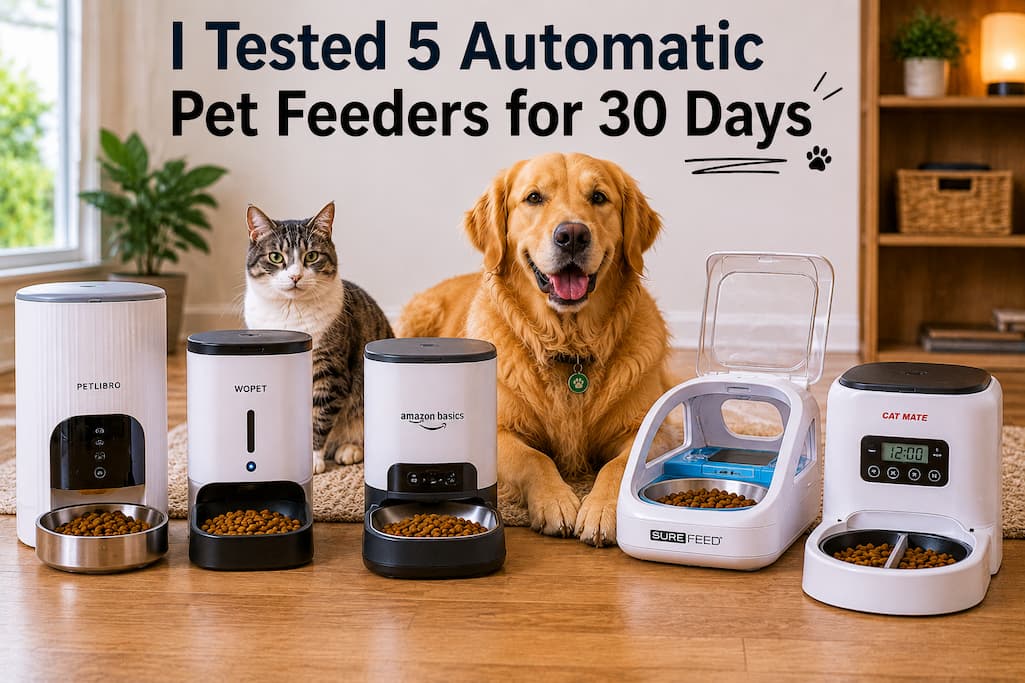
I bought five. I tested each for six days with both Moochi and Cooper, rotating through them methodically. Some were impressive. Some were infuriating. One was dangerous. This is what happened.
The Contenders: What I Tested and Why
I selected feeders based on popularity, price point, and feature set. My criteria were specific: reliable portion control, consistent scheduling, easy cleaning, and — critically — the ability to handle both dry kibble and semi-moist food without jamming. Cooper eats a high-protein kibble with larger pieces. Moochi eats a smaller, denser kibble. Both needed to work.
Feeder 1: Petlibro Automatic Cat Feeder ($79)
A sleek white cylinder with a rotating hopper, LCD screen, and voice recording feature. Marketed primarily for cats but rated for small dogs too. Promised up to six meals daily with programmable portions.
Feeder 2: WOPET SmartFeeder ($149)
The premium option. WiFi-connected, app-controlled, camera-equipped, with portion sizes adjustable to the gram. The marketing material showed a serene cat eating while an owner watched remotely from a beach.
Feeder 3: Amazon Basics Automatic Pet Feeder ($45)
The budget choice. No app, no camera, no voice recording. Just a timer, a hopper, and a dispensing mechanism. I included it because not everyone wants smart home integration for cat food.
Feeder 4: SureFeed Microchip Pet Feeder ($180)
Different category entirely. This feeder uses RFID to open only for the registered pet, designed for multi-pet households where one animal steals another’s food. I tested it solo since Moochi is an only cat, but the technology interested me.
Feeder 5: Cat Mate C500 Digital Feeder ($65)
A rotating tray design with five compartments rather than a hopper. Each compartment holds a pre-measured portion, and the tray rotates at programmed times. No kibble dispensing — just sealed compartments that open on schedule.
How I Tested: The Method
Each feeder got six days. Day one was setup and calibration. Days two through five were standard operation. Day six was stress testing: power outage simulation, kibble jam testing, and cleaning assessment.
I measured portion accuracy by weighing dispensed food on a kitchen scale. I tracked jam frequency — how often the mechanism failed to dispense. I monitored Moochi’s reaction to each feeder: did she approach it confidently, or did she seem confused or wary? Cooper tested durability by bumping into feeders, pawing at them, and generally being a 65-pound golden retriever in a space designed for cats.
My sister participated remotely, checking the app feeds on the smart feeders and giving me her impressions. She cared most about reliability and ease of use, since she’d be the one managing it long-term.
| Feeder | Price | Portion Accuracy | Jam Frequency | Cooper-Proof? | Ease of Cleaning |
|---|---|---|---|---|---|
| Petlibro | $79 | ±15% variance | 2 jams in 6 days | No — tipped easily | Moderate — hopper disassembles |
| WOPET SmartFeeder | $149 | ±5% variance | 0 jams | Partial — stable base | Difficult — many small parts |
| Amazon Basics | $45 | ±20% variance | 1 jam in 6 days | No — lightweight plastic | Easy — simple construction |
| SureFeed Microchip | $180 | N/A — manual fill | N/A | Yes — heavy and low | Easy — few moving parts |
| Cat Mate C500 | $65 | Perfect — pre-measured | 0 jams | Yes — wide, stable base | Easy — dishwasher safe tray |
Feeder 1: Petlibro — Style Over Substance
The Petlibro looked great on the counter. Clean lines, modern aesthetic, a small footprint that didn’t dominate the kitchen. Moochi approached it cautiously on day one, sniffed the dispensing port, and waited. When it dispensed at the programmed time, the motor noise startled her. She fled to the living room and didn’t return for the food for twenty minutes. By day three, she’d adapted to the sound, but the initial fear response was notable.
The portion control was inconsistent. I programmed it for half a cup and measured the output across six dispenses: 0.4 cups, 0.55 cups, 0.6 cups, 0.45 cups, 0.5 cups, 0.65 cups. That’s a 50% variance between smallest and largest portions, which matters if you’re managing weight or medication timing. The jams happened twice — both times with Cooper’s larger kibble, which the rotating mechanism struggled to push through the narrow dispensing port. The hopper disassembles for cleaning, but the internal auger has crevices where kibble dust accumulates and requires a brush to reach.
Cooper knocked it over within an hour of introduction. Not aggressively — he just bumped it with his hip while investigating the kitchen counter. It tipped, spilled two days’ worth of food, and he ate it all before I noticed. The anti-tip design is inadequate for any dog over 30 pounds. For cats or very small dogs, this might be fine. For a household with a golden retriever, it’s a non-starter.
Verdict: Returned. Looks good, works okay for cats, fails on portion accuracy and durability.
Feeder 2: WOPET SmartFeeder — Feature-Rich, Frustrating
The WOPET was the most technologically impressive and the most annoying to live with. Setup took forty minutes: download the app, create an account, connect to WiFi, calibrate portions, program schedules, test the camera, adjust notification settings. By the time I finished, I felt like I’d installed a home security system rather than a cat food dispenser.
Once running, it performed well. Portion accuracy was excellent — within 5% of programmed amounts every time. The camera let my sister watch Moochi eat from her hotel room, which she found genuinely comforting. The app sent notifications for each feeding, low food warnings, and power status. No jams across six days with both kibble sizes.
The problems emerged in daily use. The app required a login every three days, which meant my sister had to re-authenticate on her phone while traveling. The camera lens fogged from food vapor and needed wiping every other day. The food hopper holds only four pounds, which for Moochi meant refilling every five days. The notification system was overly aggressive — my sister’s phone buzzed twelve times daily with updates she didn’t need. She turned them off, then missed the one low-battery warning that actually mattered.
Cleaning was the dealbreaker. The dispensing mechanism has seventeen separate parts, according to the manual. Disassembly for thorough cleaning took twenty minutes. Reassembly took another fifteen. The rubber seals around the motor housing degraded slightly after the first deep clean, raising concerns about long-term durability. At $149, I expected better engineering.
Verdict: Returned. Works well when it works, but the maintenance burden and app dependency make it unsuitable for anyone who values simplicity.
Feeder 3: Amazon Basics — Cheap, Functional, Forgettable
The Amazon Basics feeder is exactly what you’d expect from the name: a plastic box with a timer and a motor. No app, no camera, no voice recording. You set the dial, fill the hopper, and it dispenses when told. Setup took four minutes. Operation was silent — no motor noise to startle Moochi. She accepted it immediately.
Portion accuracy was poor. The dial has settings from 1 to 10, with no indication of what those numbers mean in actual volume. I calibrated by trial and error: setting 4 dispensed approximately half a cup, but varied by ±20% depending on how full the hopper was. A fuller hopper dispensed more due to weight pressure. A nearly empty hopper dispensed less. This is basic physics that the design ignores.
The single jam happened on day four. Cooper’s large kibble wedged in the dispensing chute, and the motor ground against it for thirty seconds before I noticed and cleared it. The motor smelled slightly burned afterward, which made me nervous about long-term reliability. Cleaning was easy — four parts, no tools, rinse and dry. But the burned motor smell lingered.
Cooper knocked it over twice. It’s light, top-heavy when full, and has no anti-tip features. For $45, this is acceptable if you have a small, calm pet in a pet-only household. In a multi-pet home with a large dog, it’s not secure enough.
Verdict: Kept as a backup for emergencies, but not the primary solution.
Feeder 4: SureFeed Microchip — Brilliant Concept, Wrong Problem
The SureFeed is technically impressive. It reads a pet’s microchip or an included RFID tag and opens the lid only for the authorized animal. Close the lid when the pet moves away. Keeps food fresh, prevents food stealing, and works entirely offline — no apps, no WiFi, no batteries beyond the four AAs that power the mechanism for approximately six months.
I tested it with Moochi alone, since she’s the only cat. She adapted within a day, learning that approaching the feeder made the lid open. The mechanism is quiet — a soft click rather than a motor grind. The bowl is stainless steel and removable for cleaning. The unit itself is heavy and low to the ground, making it Cooper-proof by design.
The problem is that it doesn’t solve my sister’s actual problem. SureFeed requires manual filling of the bowl. It doesn’t dispense on a schedule. It doesn’t help with inconsistent feeding times — it just prevents other pets from eating Moochi’s food. For a single-cat household with no food-stealing issues, it’s over-engineered and under-functional. The $180 price tag is justified only if you have multiple pets with different diets or one pet with prescription food that others can’t access.
Verdict: Returned. Excellent technology for the right use case, but that use case isn’t ours.
Feeder 5: Cat Mate C500 — The Unexpected Winner
I almost didn’t buy the Cat Mate. The rotating tray design seemed outdated compared to the sleek hopper models. It looked like something from a 1990s infomercial. But the reviews were consistently positive, the price was reasonable, and the design solved problems the other feeders created.
Here’s how it works: five compartments in a circular tray, each covered by a lid. You fill the compartments with pre-measured food, set the timer, and the tray rotates at programmed intervals, uncovering the next compartment. No kibble dispensing mechanism to jam. No auger to clog. No motor to burn out. Just a simple rotation that reveals food.
Moochi took to it immediately. The rotation is nearly silent — a soft whir that didn’t startle her. The compartments are deep enough to hold a full meal plus a small treat. The lids seal reasonably well, keeping food fresh for the 24-36 hours between rotations. The tray and lids are dishwasher safe, which makes cleaning trivial.
Portion control is perfect because you measure it yourself. No algorithm, no dial, no variance. You put half a cup in compartment one, half a cup in compartment two, and that’s exactly what Moochi gets. For my sister, this was the feature that mattered most. She could prepare a week’s worth of meals on Sunday, load the tray, and trust that Moochi would eat exactly what she’d portioned.
The tray holds five meals, which covers two days for Moochi or a full day with a bedtime snack. For longer trips, my sister would need someone to refill it, but that’s true of every feeder except the largest hopper models. The ice pack option (included) keeps wet food fresh for up to 48 hours, though Moochi eats dry kibble so we didn’t test this extensively.
Cooper couldn’t tip it. The base is wide and weighted, and the low profile means he’d have to deliberately flip it rather than bump it accidentally. He tried pawing at the lid once, found it secure, and lost interest. The design is cat-focused but dog-resistant by accident.
The only limitation is capacity. Five meals max. For a weekend trip, that’s plenty. For a week-long vacation, you’d need a housesitter to refill. But for daily use — the actual problem my sister was trying to solve — it’s ideal.
The Winner: Cat Mate C500 ($65)
After thirty days across five devices, the Cat Mate C500 is the feeder I recommended to my sister and the one she still uses six months later. It’s not the smartest, the prettiest, or the most feature-rich. It’s the most reliable, the easiest to clean, the most accurate for portion control, and the only one that Cooper couldn’t defeat. The rotating tray design, which I initially dismissed as old-fashioned, turned out to be the most robust solution because it eliminates the dispensing mechanism entirely. Sometimes the best technology is the simplest technology. Moochi gets her breakfast at exactly 7:00 AM now. The ceramic bowl stays on the shelf. My sister sleeps through the night. That’s worth $65.
What About Cooper?
None of these feeders were designed for a 65-pound golden retriever. Cooper eats two cups of kibble twice daily, plus occasional treats. The hopper feeders hold enough volume for him, but the dispensing ports and portion mechanisms are sized for cats and small dogs. The Cat Mate compartments would hold only one of his meals, making it impractical for his needs.
For large dogs, automatic feeders are a different category entirely. Devices like the PetSafe Smart Feed hold up to 24 cups and are built with sturdier construction, but they’re also significantly more expensive ($200+) and still vulnerable to determined dogs. Cooper doesn’t need an automatic feeder — his schedule is consistent because mine is. But if I traveled frequently, I’d look at programmable hopper models specifically rated for large breeds, or I’d hire a pet sitter rather than trusting a machine with his nutrition.
The broader lesson: automatic feeders solve a specific problem for a specific pet profile. They’re ideal for cats and small dogs with consistent dietary needs and owners with irregular schedules. They’re less ideal for large dogs, pets with complex medical diets, or households where food stealing is the primary issue. Match the tool to the problem, not the marketing to the aspiration.
Related Articles
Feeding routines and nutrition management connect to broader pet care topics. These articles from our site explore the related areas:
- How I Handle Feeding Schedules While Traveling With Pets — The travel feeding strategies that complement or replace automatic feeders when you’re on the road with Cooper or managing Moochi from a distance.
- How I Switched My Dog to a Raw Diet and What Happened — Automatic feeders aren’t designed for raw or fresh food. This covers the dietary transition that made me rethink how I feed Cooper entirely.
- How I Manage My Cat’s Weight Without Restrictive Dieting — Portion accuracy was the deciding factor in our feeder choice. This article covers how precise meal timing and measurement support Moochi’s healthy weight maintenance.
- How to Keep Your Pet Hydrated Daily — Feeding and hydration are linked routines. This covers the water strategies that complement Moochi’s new automated feeding schedule.
- How I Monitor Pet Energy Levels for Early Health Signs — Changes in appetite or feeding behavior are early indicators of health issues. This is the monitoring system I use alongside the automatic feeder to catch problems early.
- How to Maintain Dental Health for Pets — Dry kibble diets affect dental health differently than wet food. This covers how Moochi’s feeding routine intersects with her oral care needs.
- How I Prepare My Pet for Holiday Boarding and When I Skip It — For longer trips, automatic feeders have limits. This covers when boarding becomes the better option and how to transition Moochi between home feeding and kennel care.
- How to Recognize Signs of Pet Stress — Moochi’s bowl-smashing was stress behavior, not misbehavior. This article helps distinguish between genuine anxiety and simple hunger in feeding-related issues.
- How I Correct Small Bad Habits in Pets Without Stress — Before buying feeders, we tried behavioral solutions for Moochi’s demanding mealtimes. These techniques worked partially but couldn’t solve the schedule inconsistency.
- What My Vet Taught Me About Pet Vaccination Schedules — Routine medical care, like routine feeding, benefits from consistency and planning. This covers how I structure Moochi’s healthcare calendar alongside her daily schedule.
Sources and References
- Petlibro. “Automatic Cat Feeder Product Specifications.” https://petlibro.com/products/automatic-cat-feeder
- WOPET. “SmartFeeder User Manual and Features.” https://wopet.com/products/smart-feeder
- Amazon Basics. “Automatic Pet Feeder Product Page.” https://www.amazon.com/amazon-basics-automatic-pet-feeder
- Sure Petcare. “SureFeed Microchip Pet Feeder Technical Specifications.” https://www.surepetcare.com/en-us/pet-feeder/microchip-pet-feeder
- Cat Mate. “C500 Automatic Pet Feeder Instructions.” https://www.catmate.com/products/c500-automatic-pet-feeder
- American Veterinary Medical Association. “Pet Nutrition and Feeding.” https://www.avma.org/resources/pet-owners/petcare/pet-nutrition-and-feeding
- PetMD. “Automatic Pet Feeders: Pros and Cons.” https://www.petmd.com/dog/nutrition/automatic-pet-feeders-pros-and-cons
This review reflects personal testing of five automatic pet feeders over a 30-day period in a household with Moochi (domestic short-haired cat) and Cooper (Golden Retriever). Results may vary based on individual pet behavior, food type, and household conditions. No compensation was received from any manufacturer, and all feeders were purchased at retail price. The Cat Mate C500 remains in use as of the publication date.

Daniel Maxfield is a pet care writer focused on practical guidance for modern pet owners. He covers pet wellness, grooming, behavior, travel routines, and everyday care habits for dogs and cats. Through reader-focused educational content, Daniel shares simple and accessible tips designed to support healthier, safer, and more organized daily life with pets.