
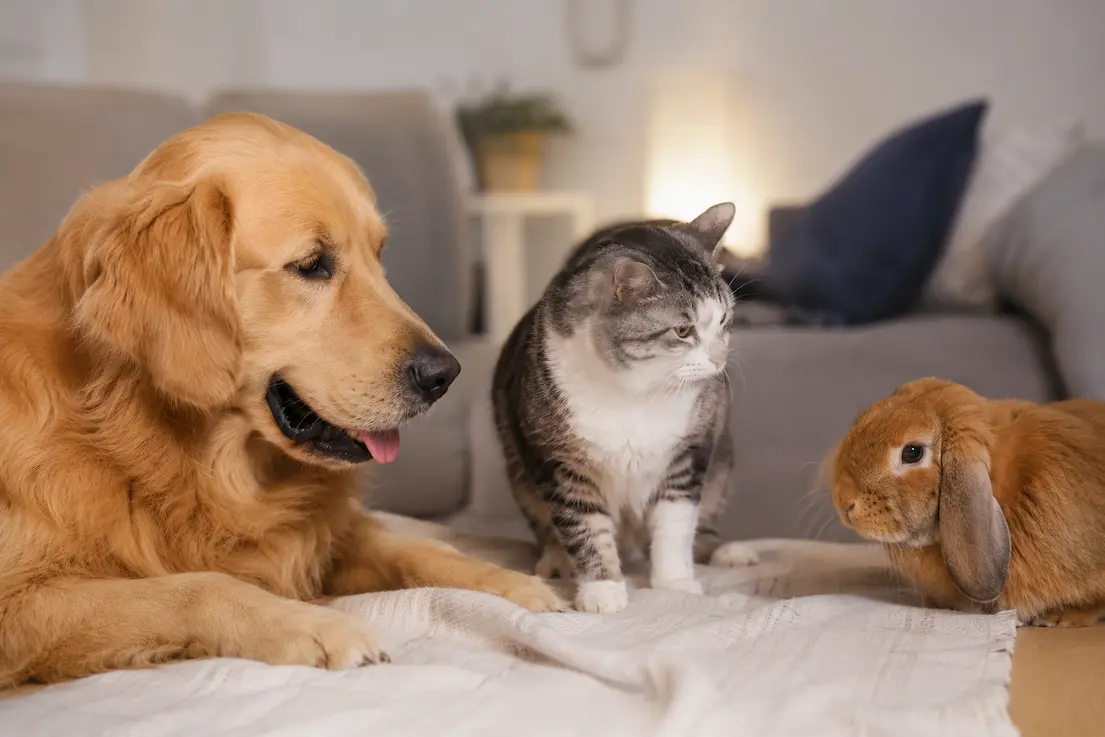
When my sister brought Moochi home from the shelter twelve years ago, the cat hid under the bed for three days. She was not aggressive. She was not destructive. She simply vanished into the smallest, darkest space she could find and refused to come out. My sister left food and water nearby, changed the litter box quietly, and waited. On the fourth day, Moochi emerged, ate, and retreated again. It took two weeks before she would stay in the room while a human was present. That was Moochi’s baseline — a cat who had been surrendered twice before age two, who had learned that new environments meant loss and fear, who coped by withdrawing rather than fighting. When my sister needed to travel for work last year, Moochi came to stay with me for six weeks. The challenge was not just that Moochi was shy. It was that I already had Cooper, a 65-pound golden retriever with the social enthusiasm of a golden retriever. Two animals with opposite coping styles, sharing a house that neither of them considered fully theirs. I did not expect them to become friends. I expected them to tolerate each other without stress. That is what we achieved, and the process taught me more about interspecies socialization than any book or video ever could.
Understanding Moochi’s Starting Point
Before I could introduce Moochi to Cooper, I had to understand what socialization meant for her specifically. Not all shy cats are shy in the same way. Some are fearful of humans but fine with other animals. Some are territorial and react aggressively to intruders. Some, like Moochi, are generally anxious and need time to adjust to any change, regardless of species. Moochi’s history mattered. She had lived with a dog briefly in her second home — a small terrier who chased her. The experience was not traumatic enough to cause lasting fear, but it was not positive either. She had no frame of reference for a large, calm dog. Her default assumption was that any unfamiliar animal was a threat until proven otherwise. I also had to account for her age. At twelve, Moochi’s sensory abilities were declining. Her hearing was not as sharp, her vision was slightly clouded by early cataracts, and her reaction time was slower. An older cat cannot process new information as quickly as a kitten. Every introduction step needed to be slower, longer, and more predictable than standard protocols recommend. The final factor was health. Before any socialization attempt, I took Moochi to the vet for a full checkup. Stress can trigger or worsen medical issues in senior cats — urinary problems, digestive upset, immune suppression. Her bloodwork was normal, her thyroid was stable, and her joints were mobile enough to escape quickly if needed. The vet gave me the green light, with the caveat that I should watch for any signs of stress-related illness and stop immediately if they appeared.
The Setup: Creating Two Worlds in One House
The first rule of introducing a shy cat to a resident dog is separation. Not brief separation. Not supervised separation. Complete, total, cannot-see-each-other separation for as long as the cat needs to feel secure in her new space. I set up Moochi in my guest bedroom — a room Cooper rarely entered, with a door that closed securely. The room had everything she needed: a litter box in the far corner, food and water on opposite sides of the room, a cat tree by the window, a cardboard box with a blanket inside, and a Feliway diffuser plugged into the wall. The diffuser releases synthetic feline facial pheromones that mimic the scent cats leave when they rub their faces on objects to mark territory. It is not a sedative. It is a signal that the space is safe and familiar. Cooper’s routine stayed the same. He slept in my room, ate in the kitchen, went on his regular walks. The only change was that the guest bedroom door was now closed, and sometimes he could smell Moochi on my clothes when I came out. I did not let him investigate the door. I redirected him with a treat or a toy whenever he showed interest. His job was to ignore the closed door, not to investigate what was behind it. This separation phase lasted ten days. Some people rush this step. I have read guides that recommend three to four days. For Moochi, ten days was the minimum. She needed to establish the guest bedroom as her territory before she could handle the stress of adding another animal to her mental map. On day ten, she was sleeping on the windowsill, eating with me in the room, and greeting me at the door when I entered. Those were my signals that she was ready for the next step.
Phase One: Scent Before Sight
After ten days of separation, I started scent swapping. This is the most underrated step in interspecies introductions. Animals process the world primarily through smell. Before Moochi ever saw Cooper, she needed to know what he smelled like in a context that felt safe. I took a soft blanket that Moochi had been sleeping on and placed it on the floor in the living room, near Cooper’s bed but not in his direct path. Cooper sniffed it, circled it, and eventually lay down next to it. That was good — relaxed interest, not fixation. I left the blanket there for two hours, then returned it to Moochi’s room. She sniffed it when I put it back, detected Cooper’s scent, and — this was the critical part — did not react. No hissing, no retreat, no flattened ears. She simply noted the smell and went back to her window. The reverse swap was trickier. I took Cooper’s bed blanket and put it in Moochi’s room. She approached it cautiously, sniffed extensively, and then — to my surprise — rubbed her face against it. This was a positive sign. Cats rub their faces on objects to deposit their own scent, marking them as safe. Moochi was not just tolerating Cooper’s smell. She was adding her own scent to it, claiming the object as part of her territory. I repeated this swap daily for five days, using different items each time — a toy, a piece of my clothing that had touched both animals, a towel. By day five, both animals were ignoring the swapped items. The smell had become background noise. That was my cue to move to visual contact.
Phase Two: The Barrier Meeting
I replaced the solid guest bedroom door with a baby gate that had a fabric cover over the lower half. The cover blocked direct eye contact — which can be threatening for cats — while allowing scent and sound to pass through. The gate was tall enough that Moochi could not jump over it, and the mesh was small enough that Cooper could not stick his nose through. The first barrier session lasted three minutes. I sat on Moochi’s side of the gate with treats, and my partner held Cooper on a leash on the other side. Cooper saw the gate, saw me, and immediately tried to push through. My partner redirected him with a treat. Moochi watched from the cat tree, body low, ears forward but not pinned. She did not hiss. She did not flee. She watched. I ended the session while both animals were still calm. This is the hardest part of any introduction — stopping before things go wrong. The temptation is to keep going when things are going well, to push for more progress, to get to the “they are friends now” moment faster. But every session that ends on a positive note builds confidence. Every session that goes too long and ends with stress undoes progress. I repeated these barrier sessions twice daily for a week, gradually increasing the duration from three minutes to ten. Cooper learned that the gate meant treats and calm behavior. Moochi learned that Cooper could see her but could not reach her. By day seven, she was eating her dinner while Cooper sat on the other side of the gate, watching quietly. That image — a twelve-year-old cat eating calmly while a large dog observed from three feet away — was the moment I knew we were going to succeed.
Phase Three: Controlled Visual Contact
After the barrier sessions were stable, I removed the fabric cover from the gate. Now they could see each other directly. This changed the dynamic immediately. Cooper’s tail started wagging when he saw Moochi. Moochi’s pupils dilated. I shortened the sessions back to three minutes and increased the distance — Cooper was held on a leash ten feet from the gate, not right up against it. The key behavior I watched for was Moochi’s blinking. Cats blink slowly when they are relaxed. A cat who stares without blinking is tense or threatened. On day two of uncovered gate sessions, Moochi looked at Cooper, held his gaze for two seconds, and then blinked. Cooper, miraculously, did not lunge or bark. He wagged his tail and looked at me. I treated both of them. By day five of visual contact, Moochi was comfortable enough to approach the gate and sniff Cooper’s nose through the mesh. Cooper remained seated, tail wagging gently, not pushing forward. I held my breath. Moochi sniffed for three seconds, turned, and walked back to her cat tree. It was not affection. It was assessment. But assessment without fear is the goal. I kept the gate up for another week, even after they seemed comfortable. The gate was Moochi’s security blanket. Removing it too soon would have stripped her of her escape route. Patience in this phase is what separates successful introductions from failed ones.
Phase Four: Shared Space
On day twenty-five, I opened the gate for the first time. Cooper was on a leash, held by my partner. Moochi had free access to her room and the hallway. The rule was simple: Cooper could not enter Moochi’s room. That was still her territory. The hallway and living room were neutral ground. Moochi emerged from her room slowly, hugging the wall. Cooper saw her and started to stand. My partner asked him to sit. He sat, tail thumping the floor. Moochi crept past him, keeping maximum distance, and disappeared into the kitchen. She explored for five minutes, then returned to her room. The entire interaction lasted under ten minutes. I repeated these shared-space sessions daily for another week, gradually increasing the time and decreasing Cooper’s leash tension. By day thirty, Moochi was walking past Cooper without hugging the wall. Cooper had learned to stay seated when she passed. They were not interacting. They were coexisting. That was the goal.
What Success Actually Looks Like
By the end of six weeks, Moochi and Cooper had settled into a routine. Moochi had the run of the house during the day, with access to her room whenever she wanted. Cooper ignored her unless she walked directly in front of him, at which point he would lift his head and watch her pass. They never played together. They never cuddled. They occupied the same space without conflict, and that was enough. On Moochi’s last day with me, she walked across the living room while Cooper was sleeping on his bed. She paused, looked at him for a moment, and then jumped onto the couch — a piece of furniture she had avoided for weeks because Cooper sometimes slept there. It was a small act of territorial confidence, and it meant more to me than any viral video of a cat and dog becoming best friends. Real interspecies socialization is not about friendship. It is about safety. It is about both animals feeling secure enough to relax in shared space. Moochi and Cooper achieved that. They would never be companions, but they were no longer threats to each other. In the world of a shy rescue cat, that is a profound victory.
Related Articles
- Creating a Safe Indoor Environment for Senior Pets at Home — The environmental setup that made Moochi’s safe room effective, including the Feliway diffuser and elevated escape routes.
- How to Recognize Signs of Pet Stress — The body language cues I used to monitor Moochi’s stress levels throughout the introduction process.
- Managing Pet Stress During Loud Noises and Busy Days — How I managed Cooper’s excitement and Moochi’s anxiety during high-activity periods in the house.
- How I Correct Small Bad Habits in Pets Without Stress — The redirection techniques I used with Cooper when he showed too much interest in Moochi’s door.
- How to Keep Your Pet Hydrated Daily — Managing multiple pets’ water needs in a shared household, including Moochi’s preference for moving water.
- Easy Grooming Tips for Dogs and Cats — How grooming sessions became a way to give both animals individual attention during the socialization period.
- How I Monitor Pet Energy Levels for Early Health Signs — The daily checks I performed on Moochi to catch any stress-related health changes early.
- Building Positive Behavior in Pets Through Daily Reinforcement — The consistent daily routines that helped both animals adjust to the new household dynamic.
Sources and References
- Best Friends Animal Society. “How to Introduce a Dog to a Cat.” Best Friends Animal Society. https://bestfriends.org/pet-care-resources/how-introduce-dog-cat
- PetMD. (2023, November 1). “How To Introduce Cats the Right Way.” PetMD. https://www.petmd.com/cat/behavior/how-to-introduce-cats
- San Diego Humane Society. (2025, October 20). “Introducing Dogs and Cats: The Complete Guide.” San Diego Humane Society. https://sdhumane.org/resources/introducing-dogs-and-cats-complete/
- Animal Humane Society. (2025, April 3). “How to introduce a dog and cat.” Animal Humane Society. https://www.animalhumanesociety.org/resource/how-introduce-dog-and-cat
- iCatCare. “Introducing cats and dogs.” International Cat Care. https://icatcare.org/articles/introducing-cats-and-dogs
- RSPCA Australia. (2024, July 1). “How to introduce your new cat to the family dog.” RSPCA Australia. https://www.rspca.org.au/latest-news/blog/how-introduce-your-new-cat-family-dog/
- Pet Harmony Training. (2023, May 20). “7 Tips for Introducing a New Dog or Cat to Your Resident Pets.” Pet Harmony Training. https://petharmonytraining.com
The socialization process described reflects a six-week period with Moochi, my sister’s 12-year-old domestic short-haired cat, and Cooper, my 65-pound Golden Retriever adopted from rescue at eight months old, now approximately eight years old. Every cat and dog combination is unique. A shy senior cat requires a slower timeline than a confident kitten or a well-socialized adult. Always prioritize the cat’s comfort and safety, provide multiple escape routes, and consult a veterinary behaviorist if either animal shows signs of aggression, extreme fear, or stress-related illness during introduction.

Daniel Maxfield is a pet care writer focused on practical guidance for modern pet owners. He covers pet wellness, grooming, behavior, travel routines, and everyday care habits for dogs and cats. Through reader-focused educational content, Daniel shares simple and accessible tips designed to support healthier, safer, and more organized daily life with pets.