
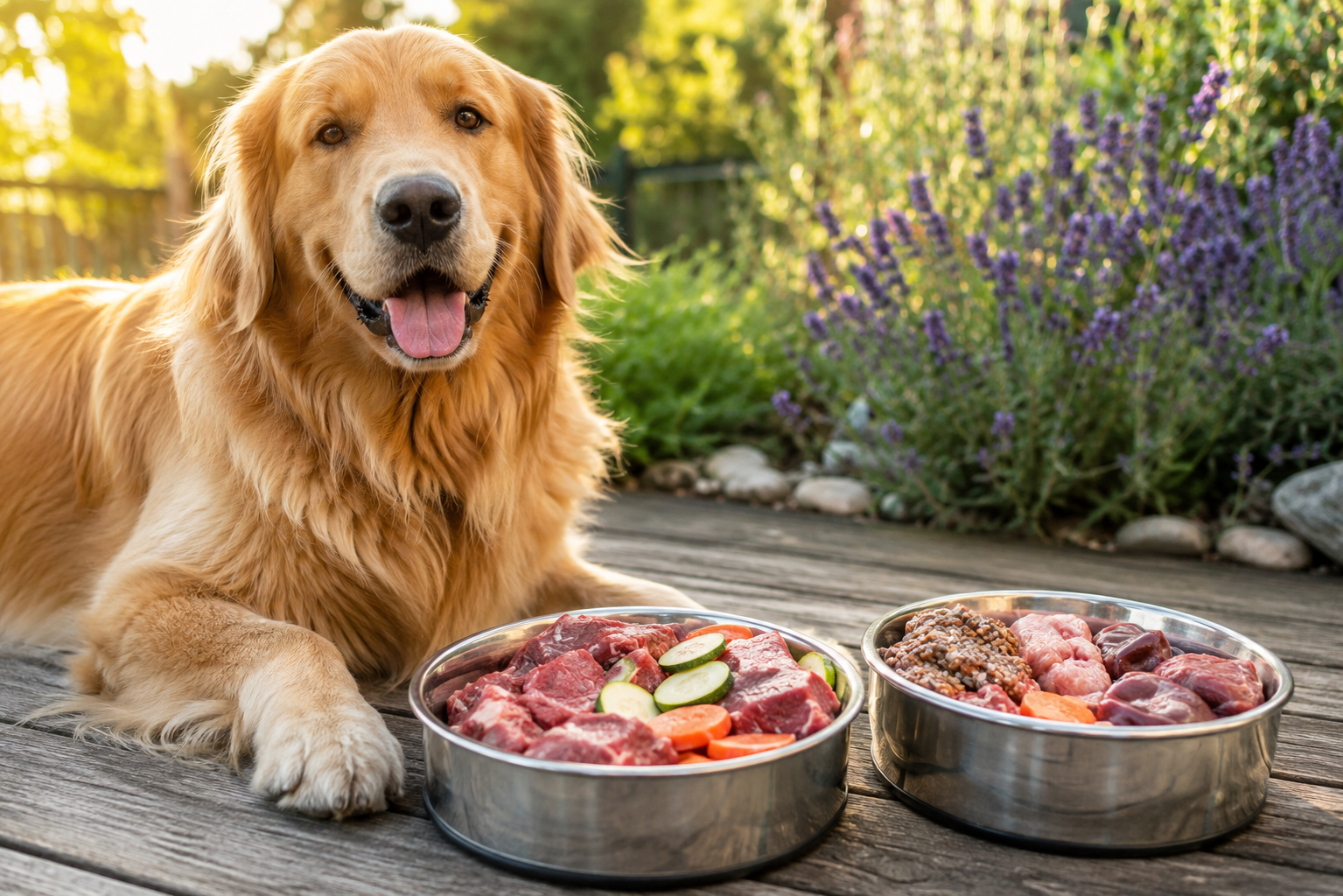
I didn’t wake up one morning and decide to overhaul everything my dog ate. It was more gradual than that — a slow pile of frustrations that eventually became impossible to ignore. Scratchy skin that flared every few weeks, breath that could clear a room, stools that were somehow both soft and enormous, and a coat that looked dull no matter how often I brushed it. I tried switching kibble brands. I tried adding supplements. Nothing shifted much.
A friend mentioned raw feeding almost in passing. I dismissed it at first — it sounded complicated, expensive, and honestly a little extreme. But a few months later, after yet another vet visit about Baxter’s skin, I started reading. Really reading. And eventually, I decided to try it.
What followed was about six months of trial, adjustment, occasional panic, and some genuinely surprising changes. This is what actually happened — not a polished sales pitch, just a real account of how it went.
Why I Even Considered It in the First Place
Baxter is a four-year-old Labrador mix. He’s energetic, social, and eats absolutely anything, which made diet changes feel both easier and riskier at the same time. His main issues were skin irritation along his sides and belly, soft stool more often than not, and what I can only describe as a constant low-level tiredness in the afternoons despite getting plenty of exercise.
I’d read enough about raw feeding to know the basic argument — that dogs evolved from animals that ate unprocessed meat, bones, and organs, and that heavily processed kibble, however convenient, may not always align with that biological history. The concept was popularized in 1993 by Australian vet Ian Billinghurst, who called it the BARF diet, short for Biologically Appropriate Raw Food. His argument was simple: adult dogs would thrive on an evolutionary diet rather than grain-heavy commercial formulas.
That didn’t mean I jumped straight to raw. I spent about three weeks reading studies, watching my vet’s face very carefully as I brought it up (she was cautious, not dismissive), and joining a couple of online forums to understand what real people were doing day to day.
What the Research Actually Says Right Now
A 2025 controlled study from the University of Helsinki’s DogRisk team found that raw-fed dogs showed improved metabolic markers — including a lower TyG index, which is used as a proxy for insulin resistance in both human and veterinary medicine. Separately, a 2024 study published in Frontiers in Veterinary Science found enhanced local gut immunity in raw-fed dogs. On the other side, a Tufts University update (October 2025) and FDA research flagged that commercially available raw foods showed significantly higher rates of Salmonella and Listeria contamination than cooked alternatives. Both things can be true simultaneously — which is why how you source and handle raw food matters enormously.
How I Actually Transitioned Baxter
Every guide I read agreed on one thing: don’t switch cold turkey. I did a slow transition over about four weeks, which looked roughly like this:
| Week | Meal Breakdown | What I Watched For |
|---|---|---|
| Week 1 | 75% kibble / 25% raw chicken | Stool consistency, energy, vomiting |
| Week 2 | 50% kibble / 50% raw chicken + organ | Appetite, digestion, any signs of distress |
| Week 3 | 25% kibble / 75% raw with some veg | Coat changes, stool volume, skin |
| Week 4 onward | Full raw — meat, bone, organ, veg | Everything — energy, coat, breath, stools |
The transition wasn’t perfectly smooth. Week two brought two days of loose stool that genuinely worried me. But it passed, and by the end of week three, things had started to stabilize in a way I hadn’t seen in a long time.
I was buying chicken backs, turkey necks, beef heart, and chicken liver from a local butcher who let me source things directly. I added some blended vegetables — mainly leafy greens and a little pumpkin — and rotated proteins after the first month to include beef mince and occasional sardines.
What Changed, and in What Order
I kept rough notes during those first months because I wanted to actually track what shifted and when, rather than relying on memory. Here’s the honest timeline:
Around week three: The first thing I noticed was Baxter’s breath. It didn’t disappear overnight, but the constant sourness that had been there for years quietly reduced to almost nothing. I’d read that dental health often improves on raw because the mechanical action of chewing raw meaty bones naturally reduces plaque buildup. Whether that was the cause or whether something else changed, I can’t say for certain — but the timing lined up.
Around week five to six: His stool reduced dramatically in volume and became firmer. This surprised me because I’d assumed raw meat might make things looser. The opposite happened. I’d later learn that highly processed kibble often leads to larger stools partly because dogs absorb less of it — the filler content passes through. With a more digestible diet, the output shrinks.
Around week eight: Coat changes became visible. The dull, slightly rough texture along his back started softening. By the end of two months, I was getting comments from people at the park about how his coat looked. That felt significant.
Around month three: The skin irritation that had been my original motivation — the thing that started this whole process — noticeably reduced. It didn’t vanish completely, but the flare-ups became less frequent and much milder when they did happen.
Three Things That Surprised Me Most
- How quickly the breath changed. I expected coat changes first. Breath was week three.
- How much calmer mealtimes became. Baxter had always been frantic around food. On raw, he ate with noticeably less urgency — I don’t have a scientific explanation for it, but it was consistent.
- How much thought it required. Raw feeding is not difficult once you learn it, but it does require planning. Meal prep, sourcing, freezer space — none of that is passive the way pouring kibble is.
The Risks I Took Seriously (and One I Underestimated)
I’m not writing this as a pure endorsement. There are real risks to raw feeding, and I’d be leaving out something important if I skipped them.
The contamination concern is legitimate. Uncooked meat carries the possibility of Salmonella, E. coli, and Listeria. A two-year FDA study of over 1,000 pet foods found that commercially available raw varieties tested positive for pathogens at significantly higher rates than cooked alternatives. This affects not just the dog but anyone in the household — and it becomes especially relevant if you live with young children, elderly family members, or immunocompromised individuals.
I managed this through hygiene: stainless steel bowls that I cleaned immediately after each meal, strict handwashing, and sourcing from a butcher I trusted rather than supermarket meat that had already been sitting out. I also kept raw food frozen until the day of feeding and thawed it in the fridge overnight — never at room temperature.
The nutritional balance issue was the one I underestimated initially. It’s easy to feed a lot of muscle meat and forget that a raw diet needs organ meat, bone content, and enough variety across proteins to hit the full nutritional profile. A diet that’s mostly chicken breast without bone or organ isn’t balanced, even if the dog seems fine in the short term. I did eventually get a nutritional blood panel run through my vet at the three-month mark — everything came back within normal range, which gave me genuine confidence.
The AVMA, CDC, and FDA have all flagged that the risks of raw diets may outweigh the benefits in some contexts. I don’t dismiss that. What I’d say is that the risk picture is more nuanced than a flat warning — it depends heavily on how the diet is sourced, prepared, and formulated.
What My Vet Said (and Didn’t Say)
My vet’s initial response was cautious. She didn’t try to talk me out of it, but she did walk me through the bacterial contamination concern and asked a lot of questions about my household and hygiene practices. She also flagged bone safety — specifically that cooked bones are dangerous (they splinter), but raw meaty bones are generally manageable if fed appropriately and supervised.
What she didn’t say was that it was a bad idea in Baxter’s specific case. She asked me to keep notes, come back in three months with observations, and consider running bloodwork to check calcium, phosphorus, and other markers. I did all of that.
By the second visit, she acknowledged that his skin presentation had improved and his body condition looked good. She remained neutral on raw feeding as a general recommendation — which I respect. Her job is to consider the full population of pet owners, not just the ones who read obsessively and source carefully.
What Baxter Actually Eats Now (a Typical Week)
| Protein Source | Type | Frequency |
|---|---|---|
| Chicken backs / necks | Meaty bone | 3–4x per week |
| Beef heart | Muscle meat | 2x per week |
| Chicken liver | Secreting organ | 2x per week (small portions) |
| Sardines (fresh or canned in water) | Oily fish / omega-3 | Once per week |
| Blended leafy greens + pumpkin | Vegetable matter | Daily (small amount) |
The Honest Downsides
Meal prep takes time. Not enormous amounts of time, but enough that on a chaotic week I’ve definitely wished I could just scoop from a bag. I batch-prepare and freeze portions in advance, which helps, but there’s an upfront time cost that kibble simply doesn’t have.
Storage requires planning. A decent chest freezer has become a household fixture. Raw meat takes up real space, and rotating stock requires a level of organization I hadn’t previously needed for pet care.
Cost is genuinely higher — though by how much depends entirely on where you source from. Buying direct from a butcher for offcuts and backs is significantly cheaper than commercial raw food brands. My monthly food cost roughly doubled from what I was spending on premium kibble, but it was less than I expected given that Baxter absorbs more of what he eats and the portions are smaller than kibble volumes.
Travelling with raw food adds another layer of logistics. I’ve had to think carefully about what to do during trips away — sometimes I use high-quality freeze-dried raw options as a temporary alternative, and other times I’ve sourced locally. It’s manageable, but it adds a planning step that didn’t exist before.
Six Months In — Where Things Stand
The skin condition that started this whole experiment is largely resolved. I can’t say with certainty that raw feeding is the only reason — we also identified and removed a fabric softener that may have been contributing — but the timing and consistency of the improvement points strongly to dietary change as a major factor.
Baxter’s coat is genuinely different. His breath is unremarkable, which sounds like a low bar but feels like a genuine improvement. His stool is consistently firm and smaller than it ever was on kibble. His energy levels across the day feel more stable — that flat afternoon slump that used to hit him regularly has largely disappeared.
None of that means raw feeding is right for every dog or every household. It requires commitment, education, and at least one honest conversation with a vet who will engage with the topic seriously rather than just dismiss it. But for Baxter, in our situation, it’s been worth it. That’s the most honest conclusion I can give you.
Before You Start: A Practical Checklist
- Talk to your vet honestly — present your plan, not just a question
- Research the 80/10/10 or BARF ratio models and decide which suits your situation
- Source from a butcher or supplier you can actually verify, not convenience meat
- Transition slowly — at least three to four weeks
- Invest in stainless steel bowls and clean them immediately after every meal
- Get bloodwork done at the three-month mark to confirm nutritional balance
- Keep a short log of changes — you’ll forget the details otherwise
- Never feed cooked bones — only raw meaty bones under supervision
Related Articles
- What My Vet Taught Me About Pet Vaccination Schedules — Vet conversations go better when you come prepared. Here’s what I learned about staying ahead of the schedule.
- How I Monitor Pet Energy Levels for Early Health Signs — Diet changes affect energy patterns. This is how I track those shifts day to day.
- How I Manage My Cat’s Weight Without Restrictive Dieting — A different approach to nutrition that avoids the stress of strict portion control.
- How I Handle Seasonal Allergies in My Dog Every Spring — If skin issues brought you here, this one covers the seasonal side of the same problem.
- Easy Grooming Tips for Dogs and Cats — Coat health doesn’t stop at diet. These grooming habits complement what you feed.
- How to Maintain Dental Health for Pets — Raw feeding often improves dental hygiene, but there’s more to the picture than diet alone.
- How I Pack a Lightweight Travel Kit for Pet Comfort — Travelling with a raw-fed dog takes extra prep. This kit guide helped simplify mine.
Sources & References
- Hielm-Björkman, A. et al. (2025). Controlled intervention study on blood metabolic markers in raw vs. kibble-fed dogs. The Veterinary Journal, University of Helsinki DogRisk team.
- DogRisk Research Group, University of Helsinki. Early-life diet and risk of allergy, atopy, and chronic enteropathy in dogs — longitudinal findings.
- Oklahoma State University (2024). Standardized raw diet study in dogs: gut microbiome and immune outcomes. Frontiers in Veterinary Science.
- Heinze, C.R. (October 2025). Raw Pet Food Risks: A Research Update. Tufts University Cummings School of Veterinary Medicine — Petfoodology. sites.tufts.edu
- U.S. Food and Drug Administration. Two-year evaluation of commercial pet foods including raw varieties for Salmonella and Listeria contamination. FDA Center for Veterinary Medicine.
- American Veterinary Medical Association (AVMA). Raw Pet Food Position Statement. avma.org
- Lee, E. (January 2024). Raw Dog Food Diet: Benefits and Risks. WebMD Pets. webmd.com
- Revival Animal Health (July 2025). Raw Diets for Dogs: Benefits, Risks, and What Every Pet Owner Should Know. revivalanimal.com
- Cornell University Riney Canine Health Center (December 2025). Raw Foods for Dogs: Evidence-Based Advice. vet.cornell.edu
- MDPI Animals (January 2025). Current Evidence on Raw Meat Diets in Pets: A Natural Symbol, but a Nutritional Controversy. Animals 15(3), 293. mdpi.com
- PMC / Journal of Veterinary Internal Medicine (2025). Association Between Diet Type and Owner-Reported Health Conditions in Dogs in the Dog Aging Project. pmc.ncbi.nlm.nih.gov
- Billinghurst, I. (1993). Give Your Dog a Bone. Warrigal Publishing. (Origin of the BARF diet concept.)

Daniel Maxfield is a pet care writer focused on practical guidance for modern pet owners. He covers pet wellness, grooming, behavior, travel routines, and everyday care habits for dogs and cats. Through reader-focused educational content, Daniel shares simple and accessible tips designed to support healthier, safer, and more organized daily life with pets.