
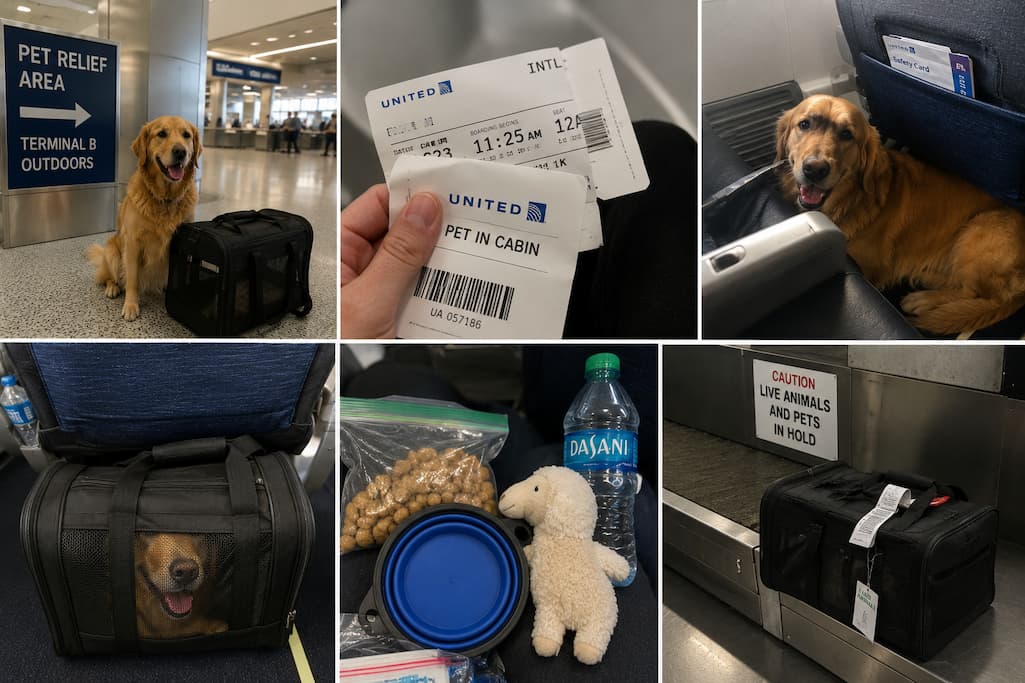
The gate agent looked at Cooper’s carrier, then at me, then back at the carrier. “That’s too big,” she said. Not asked. Stated, like a weather report. I had measured that carrier three times against the airline’s published dimensions. It was within limits by half an inch on every side. I had the confirmation email. I had the receipt. None of it mattered. What mattered was the measuring box sitting on the counter, a rigid plastic frame that represented the absolute maximum any carrier could be, and Cooper’s soft-sided carrier bulged slightly at the top because soft things bulge when they contain 65 pounds of golden retriever anxiety.
I ended up paying $125 to check Cooper as cargo. Not because the carrier was actually too big. Because the measuring box didn’t account for fabric flex, because the gate agent had the power to decide, and because I had a flight to catch and no leverage. That was the first thing airlines don’t tell you: the published rules are suggestions. Enforcement is arbitrary, and the person at the gate has final say over whether your pet flies in cabin or gets sent to the cargo hold.
That flight was three years ago. Since then, I’ve flown with Cooper four more times and helped my sister navigate one particularly harrowing trip with Moochi. I’ve learned what the airline websites actually mean, what they conveniently omit, and what you need to know before you ever set foot in an airport with an animal. This isn’t a guide to the rules. It’s a guide to the reality behind them.
The Cabin vs. Cargo Decision Nobody Prepares You For
Most pet owners assume cabin is always better. Smaller space, but you’re nearby, you can check on them, they can hear your voice. For some pets, this is true. For others, cabin travel is genuinely worse than cargo. The difference depends on your pet’s temperament, size, and health — and airlines won’t help you figure this out.
Cooper flew cabin once. He is not a small dog, but at the time he was under the weight limit for in-cabin pets on one particular airline (20 pounds including carrier, which he barely made). The experience was miserable for both of us. He was under the seat in front of me, which meant I couldn’t see him without unbuckling and leaning forward. The engine noise at floor level was deafening — much louder than at seat level. He couldn’t stand, couldn’t turn around, and spent the entire flight pressed against the carrier wall, panting heavily. I spent the flight leaning forward whispering reassurance I couldn’t tell if he heard.
For his subsequent flights, I chose cargo. Not because I wanted to. Because after that cabin experience, I realized Cooper is a dog who needs space to settle, who is comforted by darkness and quiet rather than proximity to me in a stressful environment. The cargo hold, pressurized and climate-controlled on modern aircraft, gave him a larger crate, darkness, and less sensory overload. He arrived calmer than he had after the cabin flight.
Moochi was the opposite. My sister’s single flight with her was cabin-only, and it worked because Moochi is small, naturally seeks enclosed spaces when stressed, and was comforted by my sister’s presence above her. The cat carrier fit under the seat without issue, and Moochi spent most of the flight asleep, apparently unfazed by engine noise.
The lesson: there is no universal right answer. Airlines present cabin as the premium, caring option and cargo as the budget, risky option. The truth is more nuanced, and the right choice depends entirely on your individual pet.
What “Pet-Friendly” Actually Means on Airline Websites
Airline pet policies are written by lawyers and marketing departments, not people who travel with animals. Here’s what the language actually translates to:
“We welcome pets on select flights” means “We accept pets on some routes, but capacity is limited and you need to book the pet reservation separately from your ticket, often by phone, and sometimes weeks in advance.” The “select flights” restriction often excludes codeshare flights, flights operated by partner airlines, and certain aircraft types. I once booked a ticket through Airline A only to discover the actual flight was operated by Airline B, which had a completely different pet policy that required 30 days advance notice. I found out 14 days before departure.
“Pets must remain in their carrier at all times” means exactly what it says, and they mean it. You cannot take your pet out for comfort, for bathroom breaks, or because they’re distressed. On a four-hour flight, that means four hours of confinement. For a dog like Cooper, that’s manageable in a properly sized crate. For a puppy or a high-anxiety animal, it can be genuinely traumatic. Airlines don’t mention this when they advertise their pet-friendly policies.
“Emotional support animals may require documentation” has become essentially meaningless. The DOT (Department of Transportation) revised its rules in 2021, and airlines are no longer required to accommodate emotional support animals as service animals. Most major carriers now treat ESAs as regular pets, subject to fees, carrier requirements, and cabin size limits. The websites still mention ESAs because the policy change is recent and confusing, but the practical reality is: unless your animal is a trained service dog, you’re paying the pet fee and following pet rules.
“Fees vary by destination” is airline-speak for “We charge whatever we want and change it without notice.” I’ve paid $95, $125, and $200 for the same route with the same airline in different years. International fees are higher and more complex, sometimes involving separate charges for each leg of the journey, customs documentation, and health certificate requirements that vary by destination country.
| Airline Policy Language | What It Actually Means | What You Should Do |
|---|---|---|
| “Carrier must fit under seat” | Dimensions vary by aircraft type; soft carriers may be rejected if they bulge | Call to confirm aircraft-specific dimensions; bring a backup plan |
| “Health certificate required” | Must be issued within 10 days of travel by a USDA-accredited vet | Book vet appointment 7-8 days before; certificates expire quickly |
| “Temperature restrictions apply” | Cargo pets may be refused if ground temp exceeds 85°F or drops below 45°F | Book early morning or evening flights in summer; avoid midday departures |
| “Pet must be at least 8 weeks old” | Some airlines require 16 weeks; rabies vaccination rules may require 12+ weeks | Verify age requirements with airline directly; don’t rely on website alone |
| “One pet per passenger” | Some airlines allow two in cabin if they fit; cargo limits vary by aircraft | If traveling with multiple pets, call airline; policies are inconsistently applied |
The Paperwork Nobody Warns You About
Domestic flights within the United States require a health certificate if your pet is traveling cargo. The certificate must be issued by a USDA-accredited veterinarian within 10 days of travel. Sounds simple. It isn’t.
First, not all vets are USDA-accredited. My regular vet wasn’t. I had to find an accredited vet 40 minutes away, pay for an exam I didn’t otherwise need, and schedule it within a narrow window. The certificate itself cost $65. The exam was another $85. The travel to get there: an hour round trip. Total cost for a piece of paper that says my dog is healthy: $150 and half a day.
Second, the certificate expires. If your return flight is more than 10 days after the certificate was issued, you need a new one for the return trip. For a week-long vacation, this means two vet visits, two certificates, double the cost. Some airlines accept certificates up to 30 days old for return flights, but this is airline-specific and not guaranteed. You have to ask.
International travel is an entirely different universe. Each country has its own requirements, which may include rabies titers (blood tests proving immunity, which take weeks), specific vaccination records, microchip documentation, and quarantine periods. Some countries require paperwork to be endorsed by the USDA APHIS office, which means mailing documents and waiting for return. My sister researched taking Moochi to the UK and abandoned the idea after calculating six months of preparation, $800 in documentation fees, and a mandatory quarantine that would have traumatized the cat.
The paperwork isn’t just bureaucratic inconvenience. It’s a genuine barrier that determines whether pet travel is feasible for your timeline and budget. Start researching requirements at least three months before international travel. For domestic, book your vet appointment two weeks out to ensure availability.
Preparing Your Pet: The Weeks Before Matter More Than the Day Of
The biggest mistake people make is focusing on travel day logistics while ignoring the weeks of preparation that determine whether travel day succeeds or fails. Cooper’s first flight was rough because I didn’t prepare him. His subsequent flights were manageable because I did.
Carrier conditioning: For cabin travel, your pet needs to view the carrier as a safe space, not a prison. I started putting Cooper’s meals in his travel carrier three weeks before the flight. I added his favorite blanket, a worn t-shirt that smelled like me, and a chew toy. He learned that carrier = good things. By flight day, he entered voluntarily. For cargo, the crate needs to be larger and more robust, but the same principle applies: make it familiar, comfortable, and associated with positive experiences.
Sound desensitization: Airport and aircraft noise is overwhelming. I played recordings of jet engines, gate announcements, and crowd noise at low volume while Cooper ate meals and relaxed at home. Gradually I increased the volume over two weeks. He never loved the noise, but he stopped reacting to it with fear. This is basic behavioral conditioning, and it works.
Exercise before departure: A tired pet is a calmer pet. I gave Cooper a long walk and play session before each flight. Not exhausting — you don’t want a dehydrated, overheated animal — but sufficiently tiring that his baseline energy is lower. For Moochi, my sister used an intense play session with a wand toy before the flight. The cat slept through most of the journey.
Fasting considerations: Airlines generally recommend no food for 4-6 hours before travel to reduce motion sickness and the need for bathroom breaks. Water should be available until departure. I followed this for Cooper and he never had an accident. I know owners who ignored the fasting recommendation and dealt with vomit or diarrhea in the carrier. Don’t be that owner. The discomfort of hunger is temporary. The discomfort of soiling yourself in a confined space is not.
What Actually Happens at the Airport
The airport experience for pet travelers is a gauntlet of poorly designed processes, inconsistent enforcement, and staff who may or may not know their own airline’s policies. Here’s the reality:
Check-in: If your pet is flying cargo, you check them at the ticket counter along with your luggage. The process takes 15-30 minutes longer than normal check-in because staff need to verify health certificates, inspect the crate, and process the pet fee separately. The crate will be weighed, measured, and tagged. You’ll be asked to remove your pet for a security screening of the empty crate, then return them to it. This is stressful. Plan extra time.
Security screening for cabin pets: You carry your pet through the metal detector in your arms while the carrier goes through the X-ray machine. This sounds simple. It isn’t. Some TSA agents want the pet out of the carrier completely. Others are fine with a hand check. Some want the collar off. Policies vary by airport and by agent. Cooper squirmed during this process, nearly slipped from my arms, and I had to ask for a private screening room to avoid a public escape. The room existed. No one offered it until I asked.
The gate area: If you’re flying cabin, you need to keep your pet in the carrier at the gate. This means no last-minute bathroom breaks for the pet, no comforting them out of the carrier, no letting them stretch. Some gate agents are understanding and will let you hold the carrier in your lap while waiting. Others enforce the rules rigidly. Don’t count on flexibility.
Boarding: Most airlines board passengers with pets early, which sounds helpful but means your pet is confined in the carrier under the seat for an extra 20-30 minutes while the rest of the plane boards. The engines aren’t running yet, so the cabin gets hot and stuffy. Cooper panted heavily during this period. I now ask to board with my regular zone rather than early, reducing the time he spends under the seat before takeoff.
Deplaning and pickup: For cabin pets, you leave with everyone else, carrier in hand. For cargo pets, you pick up at the airline’s cargo facility, not baggage claim. This is usually a separate building, sometimes a 10-minute shuttle ride from the terminal. Cooper’s longest wait was 45 minutes after landing because the cargo facility was understaffed. Bring water, a leash, and patience.
The Costs Nobody Lists Up Front
Airline pet fees are just the beginning. Here’s what I actually spent on Cooper’s most recent round-trip flight:
- Airline pet fee (cargo, each way): $200 x 2 = $400
- Airline-approved cargo crate: $85 (one-time purchase, reusable)
- Health certificate and exam: $150
- USDA endorsement (international only, not applicable here): $0
- Pre-flight vet check (recommended but not required): $65
- Calming pheromone spray for crate: $18
- Absorbent crate pads (pack of 10): $12
- Freeze-dried chicken treats for travel day: $8
- Pet-friendly hotel near airport (early departure): $120
- Parking at departure airport (extended stay): $85
Total for one round trip: $943
That doesn’t include the flight ticket for me, meals, ground transportation, or any costs at the destination. Flying with a pet is expensive in ways the airline website never mentions. For comparison, boarding Cooper at a high-quality kennel for the same period would have cost $350. Driving would have cost approximately $200 in gas and taken 12 hours each way.
The financial calculation isn’t just about the flight. It’s about whether the trip justifies the cost, stress, and risk to your pet. Sometimes the answer is yes. Sometimes it’s no, and driving or staying home is the better choice.
When You Shouldn’t Fly With Your Pet
Not every trip is worth taking your animal on. Here are the situations where I would not fly with a pet, based on experience and veterinary guidance:
Brachycephalic breeds: Pugs, bulldogs, boxers, Persian cats — any animal with a shortened muzzle. These breeds have compromised respiratory systems under normal conditions. The stress, heat, and pressure changes of air travel create genuine risk of death. Most airlines have banned brachycephalic breeds from cargo entirely, and even cabin travel is risky. If you own one of these breeds, do not fly with them unless absolutely necessary, and then only in cabin with vet clearance.
Animals with anxiety or behavioral issues: Cooper is a generally calm dog, and even he struggled. A dog with separation anxiety, noise phobia, or aggression will not magically handle air travel well. The confined space, unfamiliar environment, and inability to escape will amplify every existing issue. If your pet has diagnosed anxiety, consult a veterinary behaviorist before considering air travel.
Senior pets or pets with health conditions: Older animals, those with heart conditions, respiratory issues, or mobility limitations face compounded risks. The stress of travel can trigger cardiac events, breathing difficulties, or exacerbate chronic pain. Cooper is now eight, and I’m reconsidering whether I’ll fly with him again. The risk-reward calculation changes as pets age.
Short trips: If you’re traveling for a weekend, the stress and cost of flying with a pet rarely justify the convenience. Boarding, a pet sitter, or asking a friend to check in are less disruptive options. I only fly with Cooper for trips of five days or longer where the destination activities include him.
High-stress travel periods: Holidays, summer weekends, and peak travel seasons mean fuller flights, longer waits, more harried staff, and higher likelihood of delays or cancellations. A delayed flight that strands your pet on the tarmac in summer heat is a nightmare scenario. If you must travel during peak times, book early morning flights when temperatures are lowest and staff are freshest.
Related Articles
Pet travel involves logistics, preparation, and decisions that connect to broader care topics. These articles from our site explore the related areas:
- How to Plan a Pet-Friendly Vacation — The broader picture of traveling with pets, including destination selection, accommodation, and itinerary planning that accounts for your animal’s needs.
- How I Pack a Lightweight Travel Kit for Pet Comfort — The specific items I bring when flying with Cooper, from crate accessories to in-flight essentials, condensed into a carryable kit.
- How I Found Pet-Friendly Airbnb Rentals That Actually Welcome Dogs — Finding accommodations that accept pets is harder than it should be. This covers the filters, communication strategies, and red flags I use when booking.
- How I Prepare My Pet for Holiday Boarding and When I Skip It — Sometimes flying isn’t the right choice. This covers the boarding alternative, including how to prepare Cooper for kennel stays and when I decide to leave him home instead.
- How I Handle Feeding Schedules While Traveling With Pets — Travel disrupts routines. This is how I maintain Cooper’s nutrition and schedule across time zones and changing environments.
- My Honest Review of 3 Pet-Friendly Hotel Chains After 10 Stays — Not all pet-friendly hotels are actually pet-friendly. This is my experience with chains that deliver on their promises and those that don’t.
- How to Recognize Signs of Pet Stress — Air travel is inherently stressful. This covers how to distinguish normal travel anxiety from dangerous distress that requires intervention.
- Managing Pet Stress During Loud Noises and Busy Days — Airports are loud, crowded, and unpredictable. These techniques help reduce Cooper’s stress in high-stimulation environments.
- How I Explore Cities Safely With My Pet Step by Step — Once you arrive, navigating an unfamiliar city with a pet requires planning. This covers leash laws, safe spaces, and urban hazards.
- A Day in the Life: My Dog’s Routine at a Pet-Friendly Beach Town — The reward for surviving air travel: destinations that welcome pets. This is what a good pet-friendly trip actually looks like once you’re there.
Sources and References
- U.S. Department of Transportation. “Traveling with Service Animals and Pets.” https://www.transportation.gov/individuals/aviation-consumer-protection/traveling-service-animals
- USDA APHIS. “Pet Travel from the U.S. to Another Country.” https://www.aphis.usda.gov/aphis/pet-travel
- American Veterinary Medical Association. “Traveling with Your Pet FAQ.” https://www.avma.org/resources/pet-owners/petcare/traveling-your-pet-faq
- American Kennel Club. “Flying With Your Dog: Tips for Safe Air Travel.” https://www.akc.org/expert-advice/travel/flying-with-your-dog-tips-for-safe-air-travel/
- International Air Transport Association. “Live Animal Regulations.” https://www.iata.org/en/programs/cargo/live-animals/
- PetMD. “Tips for Flying With a Dog.” https://www.petmd.com/dog/travel/tips-for-flying-with-a-dog
- The Humane Society of the United States. “Travel Safely with Your Pet by Car, Airplane, Ship or Train.” https://www.humanesociety.org/resources/travel-safely-your-pet-car-airplane-ship-or-train
The experiences described reflect personal travel with Cooper, a Golden Retriever, and observations from my sister’s travel with Moochi, a domestic short-haired cat. Airline policies change frequently and vary by carrier, route, and aircraft. Always verify current requirements directly with your airline and consult your veterinarian before flying with any pet. The author assumes no liability for travel decisions made based on this information.

Daniel Maxfield is a pet care writer focused on practical guidance for modern pet owners. He covers pet wellness, grooming, behavior, travel routines, and everyday care habits for dogs and cats. Through reader-focused educational content, Daniel shares simple and accessible tips designed to support healthier, safer, and more organized daily life with pets.