
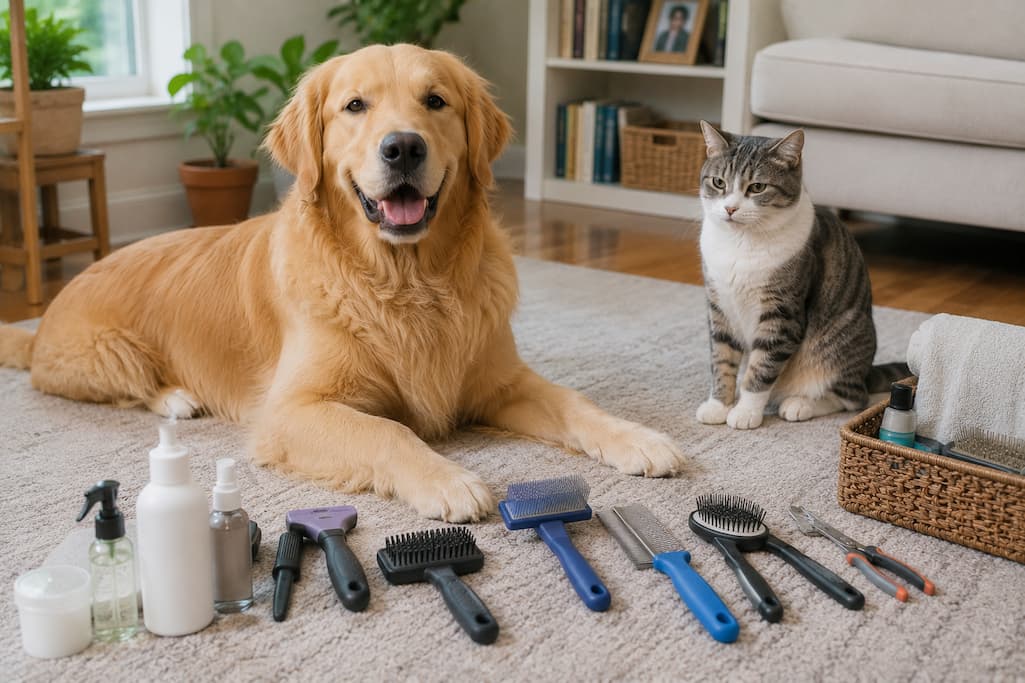
My bathroom cabinet used to look like the grooming aisle at a pet store exploded inside it. There was a slicker brush I bought because the packaging promised “professional results at home.” A deshedding tool that looked like a medieval torture device. A rubber curry brush, a pin brush, a comb with rotating teeth, a grooming mitt, and something called a “de-matting rake” that I used exactly once before Cooper yelped and I threw it in the back of the cabinet in shame. This went on for years. Every spring, when Cooper’s undercoat started coming out in clumps that could fill a pillow, I would panic-buy another tool. Every fall, I would do it again. The cabinet got fuller. Cooper’s coat stayed the same.
The fur on my couch, my clothes, and somehow inside my car’s air vents never decreased. Then about eighteen months ago, I stopped. I pulled everything out, laid it on the bathroom floor, and asked a simple question: which of these do I actually use in a typical week? The answer was humbling. Out of eleven tools, four got regular use. The rest were expensive clutter. I donated seven items to a local shelter and kept four. My grooming routine got faster, Cooper got calmer, and my bathroom cabinet finally closed all the way. This is not a guide to every tool on the market. This is what I actually use, why I use it, and what I stopped buying.
The Four Tools That Stayed
The slicker brush. This is the workhorse. I use a JW Pet Gripsoft Soft Slicker Brush, which has thin wire bristles angled away from the skin so they do not scratch. The bristles are flexible stainless steel with rounded tips, and the brush head is wide enough to cover Cooper’s flank in a few strokes. I brush him three times a week for about ten minutes, working in the direction of hair growth, starting at the neck and moving toward the tail. The slicker brush does two things: it removes loose hair from the outer coat before it ends up on my furniture, and it detangles the feathering on Cooper’s legs and tail before mats form. Golden retrievers are prone to matting behind the ears, under the legs, and around the collar area. The slicker catches these early. I have not had a serious mat in over a year. The key with a slicker brush is pressure. Too light and it skims the surface. Too hard and it irritates the skin. I test pressure on the inside of my forearm before using it on Cooper. If it feels uncomfortable on my skin, it will feel uncomfortable on his.
The undercoat rake. This is a seasonal tool, not a weekly one, but it is essential. I use it during Cooper’s two heavy shedding periods — late spring and early fall — when his undercoat “blows” and comes out in dense clumps. The rake has long, widely spaced metal teeth that reach through the topcoat and pull loose undercoat hair without damaging the guard hairs. I use the rake once a week during shedding season, working in short strokes and emptying the collected hair frequently. The amount that comes out is staggering. The first time I used it properly, I filled a grocery bag with undercoat from one session. Cooper looked visibly thinner afterward, though his outer coat was untouched. The rake does nothing for the outer coat, which is why it pairs with the slicker brush rather than replacing it.
The greyhound comb. This is my detail tool. It has two sides — wide teeth on one end, narrow teeth on the other. I use the wide teeth to check for mats after brushing, running the comb through Cooper’s coat to feel for any tangles the slicker missed. The narrow teeth clean around the ears, under the chin, and between the toe pads, where fur collects dirt and debris. The comb is also my early warning system. If I run it through Cooper’s coat and feel resistance, I know a mat is forming before I can see it. Catching mats early means I can work them out with my fingers or the slicker. Waiting means a trip to the groomer or, in worst cases, scissors.
Nail clippers and a styptic pencil. Not a brush, but grooming is not just about fur. Cooper’s nails grow fast, and long nails change how a dog walks, putting pressure on joints and tendons. I clip his nails every two weeks with a guillotine-style clipper, taking off small amounts and checking the quick — the pink vein inside the nail — after each cut. If I nick the quick, which has happened twice in seven years, the styptic pencil stops the bleeding in seconds. I do not use a nail grinder. I tried one. Cooper hated the vibration and the noise. The guillotine clipper is faster, quieter, and gives me more control. Some dogs tolerate grinders fine. Cooper is not one of them.
The Seven Tools I Stopped Buying
The Furminator. I know this is controversial. The Furminator is the most popular deshedding tool on the market, and many groomers swear by it. I owned two — the standard size and the large dog version. Both removed hair, and both damaged Cooper’s coat. The problem is the blade design. The Furminator has a sharp stainless steel edge that cuts through the topcoat to reach the undercoat. Used correctly, it is supposed to glide over the skin and only grab loose hair. In practice, I found it removed guard hairs along with undercoat, leaving Cooper’s coat looking thin and patchy in spots. After two uses, I noticed broken hairs where the blade had cut living fur rather than just removing shed fur. I also found it harsh on Cooper’s skin. Even with light pressure, he would flinch and try to move away. The slicker brush and undercoat rake accomplish the same deshedding goal without the cutting action. For me, the Furminator was an expensive mistake.
The rubber curry brush. I bought this for bath time, thinking it would help lather shampoo and massage Cooper’s skin. It did both, but it also trapped hair in the rubber nubs that was nearly impossible to clean out. After three baths, the brush smelled like wet dog regardless of how I washed it. I threw it away.
The grooming mitt. This seemed perfect — pet your dog and remove loose hair at the same time. The reality was that it removed very little hair and made my hand sweaty. Cooper enjoyed the petting, but the mitt did not reduce shedding in any measurable way. It was a novelty, not a tool.
The de-matting rake. I bought this during a panic after finding a mat behind Cooper’s ear. The rake has sharp, curved blades designed to cut through mats. I used it once, applied too much pressure, and nicked Cooper’s skin. He yelped. I felt terrible. Mats should be worked out gently with fingers, a comb, or professional help. A blade tool in the hands of an amateur is a laceration waiting to happen.
The pin brush. This is a gentler version of the slicker brush, with widely spaced metal pins set in a rubber cushion. It is good for finishing work and smoothing the coat after brushing. I used it for about a month and then stopped because the slicker brush already did the smoothing. The pin brush was redundant in my routine.
The rotating tooth comb. I bought this because the packaging claimed it reduced pulling and breakage. The teeth spin as you comb, supposedly gliding through tangles. In practice, the spinning teeth caught Cooper’s fur and pulled worse than a standard comb. I used it twice and gave it to a friend with a poodle, who reported similar results.
The spray-on detangler. Not a brush, but worth mentioning. I bought a bottle of coat conditioning spray that promised to reduce static and make brushing easier. It made Cooper’s fur greasy, attracted dirt, and smelled like cheap perfume. He also licked it obsessively for an hour after application. I checked the ingredients, found several I could not pronounce, and threw the bottle away.
What Moochi Taught Me About Cat Grooming
My sister’s cat, Moochi, is twelve years old and has a short, dense coat that sheds more than you would expect from a cat her size. When my sister was traveling last summer, I watched Moochi for three weeks and inherited her grooming supplies: a slicker brush, a metal comb, and a rubber grooming glove. The slicker brush was too aggressive for Moochi’s thin skin. She tolerated it for about thirty seconds before swatting at my hand. The rubber glove was better — she purred while I used it — but it removed almost no hair. The metal comb, surprisingly, was the winner. Moochi let me comb her back and sides for several minutes, and the fine teeth collected a surprising amount of loose fur. What I learned: cats are not small dogs.
Their skin is thinner and more sensitive. Their grooming needs are different. Moochi grooms herself extensively, so my role is supplemental — removing loose hair she misses and checking for mats in areas she cannot reach, like behind the shoulders. A weekly five-minute comb session is enough. Anything more is overkill and annoys her. I also learned that older cats need gentler handling. At twelve, Moochi’s joints are stiffer. She does not want to be held in positions that twist her spine or extend her legs. I groom her while she lies on her side, working with her posture rather than against it. This is not something a tool can fix. It is about reading the animal and adapting.
The Weekly Routine
Here is what my actual week looks like, not the aspirational version I planned when I bought all those tools.
| Day | Task | Tool | Time |
|---|---|---|---|
| Monday | Full body brush | Slicker brush | 10 minutes |
| Wednesday | Full body brush + comb check | Slicker brush, greyhound comb | 12 minutes |
| Friday | Full body brush | Slicker brush | 10 minutes |
| Every 2 weeks | Nail trim | Guillotine clippers, styptic pencil | 8 minutes |
| Spring/Fall (weekly) | Undercoat removal | Undercoat rake | 15 minutes |
That is it. Thirty-two minutes of active grooming per week, plus a seasonal rake session during shedding. The rest of the time, I run my hands through Cooper’s coat during petting to check for lumps, mats, or skin changes. That passive check takes no extra time and catches problems early.
When I Call a Professional
I do most of Cooper’s grooming at home, but there are times when a professional groomer is the right call. I take him twice a year for a full groom — bath, blow-dry, sanitary trim, ear cleaning, and nail grinding. The groomer has equipment I do not: a high-velocity dryer that blows out loose undercoat more effectively than any brush, and a grooming table with an arm that keeps Cooper secure and at a comfortable height. I also call the groomer if I find a mat I cannot work out. Mats close to the skin are dangerous to cut at home — one slip and you slice skin instead of fur. A professional has the tools and experience to remove mats safely. The cost is about $75 per visit, or $150 a year. That is less than I spent on unused brushes in a single year. Professional grooming is not a failure of home care. It is a complement to it.
Related Articles
- Easy Grooming Tips for Dogs and Cats — The foundational routine that supports everything described here, including how to introduce grooming to a reluctant pet.
- How to Maintain Dental Health for Pets — Grooming is more than coat care. This covers the dental routine I pair with Cooper’s weekly brushing schedule.
- How I Handle Seasonal Allergies in My Dog Every Spring — Cooper’s skin is more sensitive during allergy season, which affects how I groom him. This covers the seasonal adjustments I make.
- How to Recognize Signs of Pet Stress — Grooming should not stress your dog. This covers the behavioral cues that tell you when to stop, slow down, or change your approach.
- How I Monitor Pet Energy Levels for Early Health Signs — Grooming sessions are a chance to check for lumps, skin changes, and other health indicators. This covers what I look for during weekly brushes.
- Creating a Safe Indoor Environment for Senior Pets at Home — As Cooper ages, his grooming needs change. This covers how I adapt his environment and routine for comfort.
- I Replaced My Plastic Bowls With Stainless Steel — What Changed — Another example of simplifying pet care by cutting clutter and focusing on what actually works.
- The Best Dog Beds for Large Breeds — I Bought and Tested 4 — Cooper’s comfort extends beyond grooming. This covers the bed that supports his joints after a long brushing session on the floor.
Sources and References
- Business Insider. (2026, February 12). “Best Dog Brushes for Deshedding and Detangling.” Business Insider Reviews. https://www.businessinsider.com/guides/pets/best-dog-brush
- The Spruce Pets. (2026, March 13). “The 11 Best Dog Brushes of 2026.” The Spruce Pets. https://www.thesprucepets.com/best-dog-brushes-4172609
- People. (2026, May 1). “The 13 Best Dog Brushes, Tested by Pet Parents.” People. https://people.com/best-dog-brushes-7377043
- Riverview Grooming. (2026, February 18). “The Ultimate Golden Retriever Brushing Cheat Sheet: Dos and Don’ts.” Riverview Grooming. https://www.riverviewgrooming.com
- Hound Therapy. (2025, September 3). “Golden Retriever Grooming: Essential Tips for a Healthy Coat.” Hound Therapy. https://www.houndtherapy.com/blog/golden-retriever-grooming/
- Transgroom. “Golden Retriever Grooming Tips | Reduce Shedding & Care.” Transgroom. https://transgroom.com
The grooming routine described reflects personal experience with Cooper, a 65-pound Golden Retriever adopted from rescue at eight months old, now approximately eight years old, and Moochi, my sister’s 12-year-old domestic short-haired cat. Every dog and cat has different coat types, skin sensitivity, and tolerance for handling. What works for Cooper may not work for a dog with a different coat structure or temperament. When in doubt, consult a professional groomer or veterinarian for guidance tailored to your pet.

Daniel Maxfield is a pet care writer focused on practical guidance for modern pet owners. He covers pet wellness, grooming, behavior, travel routines, and everyday care habits for dogs and cats. Through reader-focused educational content, Daniel shares simple and accessible tips designed to support healthier, safer, and more organized daily life with pets.