
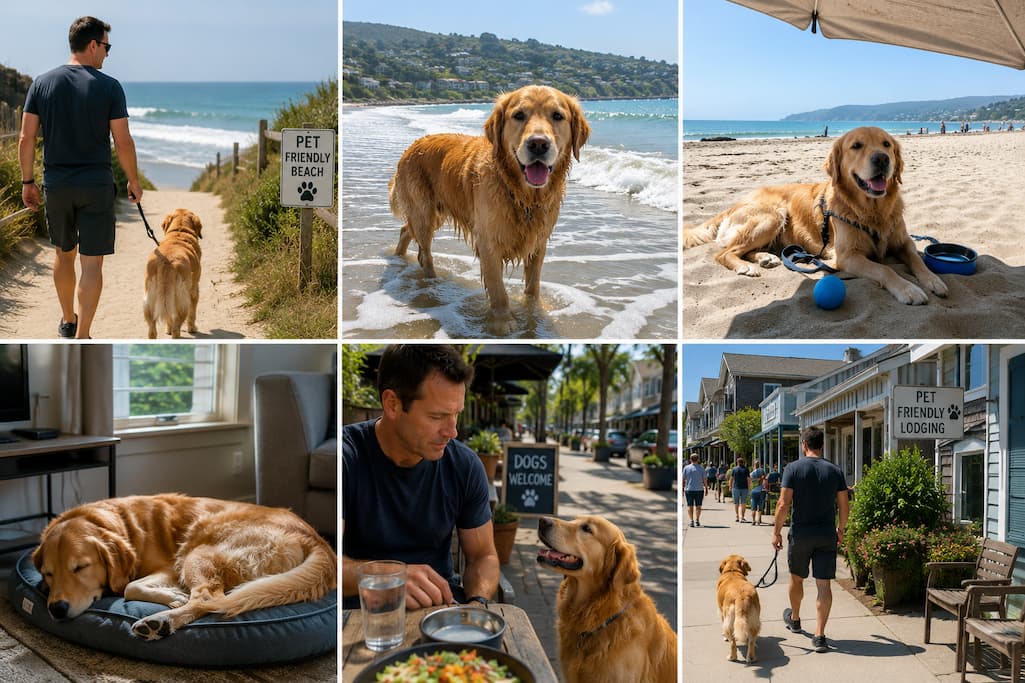
5:47 AM. The light through the rental’s thin curtains is still gray, but Cooper is already awake. I know because I can hear his tail thumping against the wicker chair in the corner of the bedroom, a steady drumbeat that starts the moment he registers I’m conscious. He doesn’t bark. He doesn’t jump on the bed. He just thumps, waiting, patient in the way only a dog who knows the morning routine can be.
We’re in a beach town on the Outer Banks of North Carolina, staying in a weathered cedar-shake cottage three blocks from the ocean. The rental allows dogs, which in this town is unremarkable — almost every property does, and the ones that don’t advertise it prominently so you can avoid them. This is a place built around the assumption that your dog is part of your vacation, not luggage you need to store.
I pull on shorts and a hoodie, clip Cooper’s leash to his collar, and we step onto the porch. The air smells like salt and pine and something faintly sweet I can’t identify. Cooper’s nose goes to work immediately, cataloging every molecule. We walk the three blocks to the beach access path in silence except for his nails clicking on the wooden boardwalk and the distant sound of waves. The sun hasn’t cleared the dunes yet. The sand is cool and firm underfoot, packed tight by the night’s tide. Cooper breaks into a run the moment we hit the open beach, leash trailing behind him because this stretch allows off-leash dogs before 9 AM, and we’re the only ones here.
He runs in a wide arc, kicking up spray, then stops abruptly to investigate a dead horseshoe crab half-buried in the sand. He sniffs it, sneezes, moves on. This is the pattern: sprint, investigate, sprint, investigate. He covers more ground in twenty minutes than I do in an hour. I walk behind him with a coffee thermos I filled before we left, watching the sky shift from gray to rose to pale blue. By 6:30, the sun is up, Cooper is panting happily, and we’ve walked nearly two miles along the waterline.
7:15 AM: Breakfast on the Porch
Back at the cottage, I rinse Cooper’s paws with the outdoor shower the host installed specifically for sandy dogs. He tolerates it, shaking each foot dramatically after I release it. Inside, I measure his breakfast — the same kibble he eats at home, because vacation isn’t the time to experiment with diet — and set it on the porch in his travel bowl. He eats while I make my own breakfast: eggs from the local farm stand, sourdough from the bakery two streets over, coffee from the French press.
The porch faces east, still catching the morning sun. Cooper finishes eating, drinks from his water bowl, and settles onto the outdoor rug with his chin on his paws, watching the street. A woman walks past with a Labradoodle. Cooper’s tail thumps twice — acknowledgment, not alarm. The Labradoodle pulls toward him, but the woman keeps walking. This is the rhythm of the town: dogs everywhere, but everyone respects the unspoken rule that not every dog wants to socialize, and that’s fine.
I eat slowly. There’s nowhere to be. No meetings, no deadlines, no errands. Cooper dozes in the sun, occasionally lifting his head to track a squirrel across the power lines. The temperature is already climbing toward seventy. By noon, the sand will be too hot for paws, but right now it’s perfect.
9:30 AM: The Coffee Shop and the Social Contract
We walk into town, a fifteen-minute stroll along streets lined with live oaks and hydrangeas in full bloom. The coffee shop has a sign in the window: “Dogs welcome on patio. Water bowls provided.” We order at the counter — cold brew for me, a dog biscuit from the jar by the register for Cooper — and take a table on the shaded patio. Three other dogs are already there: a beagle sleeping under its owner’s chair, a pug on a lap, a German Shepherd lying alert but relaxed near the entrance.
Cooper lies down under my table without prompting. This is trained behavior, not instinct — we practiced it at home for weeks before our first trip. A dog under a table is out of the way, not begging, not interfering with servers. The staff here know the dogs by name. The barista brings Cooper a second biscuit, unprompted, because she remembers him from yesterday. This is what pet-friendly looks like when it’s genuine: not tolerance, but integration.
I spend an hour reading a paperback I bought at the used bookstore down the street. Cooper alternates between dozing and watching the street traffic. A child approaches, hand outstretched, and I intercept gently: “He’s friendly, but let him sniff your hand first.” The child waits. Cooper sniffs, wags, accepts a cautious pat on the shoulder. The mother thanks me for controlling the interaction rather than letting her child charge at a strange dog. This mutual respect between pet owners and non-pet-owners is what makes a town like this work. It breaks down when either side gets entitled.
11:00 AM: The Heat Break
By late morning, the temperature hits eighty and the pavement is warming. Cooper is a Golden Retriever with a thick double coat — he overheats faster than short-haired breeds. We head back to the cottage for the midday break that defines beach town life for dogs.
I fill the kiddie pool the host left in the backyard. It’s two feet across, six inches deep, and Cooper’s favorite thing about this rental. He steps in, lies down, sighs heavily. The water cools his belly and groin, where dogs regulate temperature most effectively. He’ll spend the next two hours rotating between the pool, the shaded porch, and the air-conditioned living room, following the coolest spot as the sun moves across the sky.
I use this time to work — not vacation work, but the kind of maintenance that doesn’t require deep focus: answering emails, planning the week’s meals, researching tomorrow’s activities. Cooper sleeps at my feet, damp from the pool, occasionally twitching in a dream. The ceiling fan turns slowly. The house is quiet except for the distant sound of the ocean and the occasional seagull.
This midday break isn’t laziness. It’s necessity. Dogs can’t regulate their body temperature as efficiently as humans, and heatstroke is a genuine risk for thick-coated breeds in summer beach environments. The locals know this. The tourists who march their dogs down the boardwalk at noon, panting and miserable, are the ones who don’t. I watch them from the porch and feel a mix of judgment and pity.
2:00 PM: The Afternoon Adventure
The heat breaks around two, when the sea breeze strengthens and clouds build over the water. We head to the sound side of the island, where the water is calmer, warmer, and less crowded than the ocean beach. Cooper loves the sound. He wades in up to his chest, biting at the small waves, trying to catch fish that don’t exist. He swims in circles, retrieves a floating stick I throw, shakes water everywhere, and repeats.
The sound beach allows dogs year-round, unlike the ocean beach which has seasonal restrictions. This is a detail I researched before booking — not all beaches in this town are dog-friendly all the time, and the fines for violations are substantial. The sound side is quieter, muddier, and more interesting for a dog’s nose. The ocean side is dramatic and beautiful, but for Cooper’s purposes, the sound wins.
We stay for an hour. I bring a beach chair and a book, though I read maybe three pages. Mostly I watch Cooper, making sure he doesn’t drink too much salt water (he tries, despite my efforts), checking his paws for cuts from shells, monitoring his energy level. At three, he starts slowing down, seeking shade, lying down in the shallow water. That’s the signal. We pack up and walk back along the marsh trail, Cooper’s coat stiff with dried salt, his tongue lolling in happy exhaustion.
5:30 PM: The Evening Ritual
Dinner happens early in beach towns, especially with dogs. Restaurants fill their patios by six, and the dog-friendly ones book up fast. I made a reservation yesterday for a table at a seafood place with a fenced courtyard — not just pet-tolerant, but pet-designed, with separate water stations, a dog menu (grilled chicken, plain hamburger patty, sweet potato), and staff who genuinely seem to enjoy the animals.
Cooper gets the chicken, cut into small pieces and served in his travel bowl. I get blackened mahi-mahi and roasted vegetables. We eat at the same pace, me pausing between bites to make sure he’s not inhaling his food, him pausing to watch a passing dog with mild interest before returning to his bowl. The courtyard has six tables, four occupied by dogs. A Lab snores under a table. A terrier begs successfully from a soft-touch owner who should know better. Cooper ignores both, focused on his chicken and my occasional dropped french fry.
The sun sets during dinner, turning the sky orange and pink. The temperature drops ten degrees in half an hour. Cooper’s energy returns with the cool air — he stands, stretches, looks at me with the unmistakable expression that means “walk now?” We pay, tip generously because good pet-friendly service deserves it, and head out for the evening stroll that bookends the day.
8:00 PM: The Night Walk and the Wind Down
The beach is different at night. The crowds are gone, the temperature is perfect, and the bioluminescence in the surf creates faint blue sparks when Cooper splashes through the shallow water. We walk the same stretch as the morning, but slower now, both of us tired from the day’s activity. Cooper stays closer to me, less exploratory, his nose still working but his body language relaxed.
I let him off-leash again — the same pre-9 AM rule applies, and it’s now well past, but the beach is empty and I can see headlights from the patrol vehicle if it comes. He stays within fifty feet, trotting ahead, then circling back to check my position, then trotting ahead again. This is the bond that travel strengthens: the unspoken communication, the trust that he’ll return, the knowledge that I am his anchor in an unfamiliar place.
We walk for thirty minutes, then turn back. The cottage lights are visible from the beach, a warm yellow square among the darker shapes of neighboring houses. Cooper’s pace quickens slightly as we approach — he knows where dinner was, where his bed is, where the water bowl waits. He climbs the porch steps slowly, joints stiff from the day’s exertion, and collapses onto his bed with a groan that sounds like satisfaction.
10:30 PM: Sleep
I read for an hour while Cooper sleeps the deep sleep of a dog who has done exactly what he was bred to do: run, swim, retrieve, explore, and return. His breathing is slow and regular, occasionally interrupted by a dream whimper or a twitching paw. I don’t know what he dreams about, but I hope it’s this day, this beach, this life we’ve built together for a week in a town that understands that dogs are family.
The window is open, and I can hear the ocean. Tomorrow will be similar but not identical — different tide, different weather, different discoveries. That’s the gift of a routine in a new place: the comfort of structure with the excitement of variation. Cooper doesn’t need novelty every day. He needs reliability within a framework that allows for joy. This town, this cottage, this schedule — they provide that.
I turn off the light. Cooper sighs and shifts, pressing his back against my leg through the blanket. Outside, a dog barks somewhere down the street, answered by another. The beach town settles into the kind of quiet that isn’t silence, but the absence of urgency. We sleep.
What Made This Trip Work
Not every vacation with a dog looks like this. I’ve had trips where the rental was wrong, the weather was wrong, the town wasn’t actually as pet-friendly as advertised. This one worked because of specific choices made before we arrived:
The rental: Fenced yard, outdoor shower, proximity to beach access, host who provided the kiddie pool unprompted. These details don’t appear in standard listings. I found them by reading between the lines of reviews and asking direct questions before booking.
The location: A town where pet-friendly isn’t a marketing angle but a cultural assumption. The coffee shop doesn’t allow dogs to be trendy. They allow dogs because their customers have dogs, because the staff has dogs, because it’s normal.
The schedule: Built around Cooper’s needs, not mine. Morning activity before heat, midday rest during peak temperature, evening activity as it cools. I didn’t try to drag him to museums or shopping districts. I planned around what a dog can do and enjoy.
The flexibility: When Cooper was tired, we stopped. When he was energetic, we extended the walk. Vacation with a dog requires surrendering some control over the itinerary. The payoff is a companion who experiences the trip fully, not a burden you tolerate.
Related Articles
This trip connected to almost every aspect of traveling and living with pets. These articles from our site explore the related logistics and experiences:
- How to Plan a Pet-Friendly Vacation — The framework that shaped this trip, from destination research to daily itinerary design that balances human and canine needs.
- How I Found Pet-Friendly Airbnb Rentals That Actually Welcome Dogs — The specific search strategies that led to this cottage, including the review-reading techniques that revealed the outdoor shower and kiddie pool.
- How I Pack a Lightweight Travel Kit for Pet Comfort — Everything I brought for this trip, from the travel food bowl to the paw-cleaning supplies that kept sand out of the cottage.
- My Experience Flying With a Pet: What Airlines Don’t Tell You — We drove to the Outer Banks, but air travel is sometimes necessary. This covers when flying makes sense and when driving is the better choice.
- How I Handle Feeding Schedules While Traveling With Pets — Maintaining Cooper’s nutrition across time zones and changing environments, including why I don’t switch food on vacation.
- My Honest Review of 3 Pet-Friendly Hotel Chains After 10 Stays — Hotels are an alternative to Airbnb for shorter trips. This covers which chains deliver genuine pet welcome versus performative tolerance.
- How to Keep Your Pet Hydrated Daily — Beach environments dehydrate dogs faster than inland climates. This covers the hydration strategies that kept Cooper safe in heat and salt air.
- Easy Grooming Tips for Dogs and Cats — Salt water, sand, and sun take a toll on coats. This covers the post-beach grooming routine that kept Cooper’s skin and fur healthy during the trip.
- Managing Pet Stress During Loud Noises and Busy Days — New environments are inherently stressful, even pleasant ones. These techniques helped Cooper settle into the cottage faster and sleep better.
- How to Recognize Signs of Pet Stress — Vacation excitement can mask underlying anxiety. This helped me distinguish between Cooper’s normal travel adjustment and genuine distress that would require changing plans.
Sources and References
- American Kennel Club. “Beach Safety for Dogs.” https://www.akc.org/expert-advice/travel/beach-safety-for-dogs/
- PetMD. “How to Keep Your Dog Safe at the Beach.” https://www.petmd.com/dog/travel/how-to-keep-your-dog-safe-at-the-beach
- VCA Animal Hospitals. “Heatstroke in Dogs.” https://vcahospitals.com/know-your-pet/heatstroke-in-dogs
- The Spruce Pets. “Tips for Taking Your Dog to the Beach.” https://www.thesprucepets.com/tips-for-taking-your-dog-to-the-beach-1118615
- American Veterinary Medical Association. “Traveling With Your Pet FAQ.” https://www.avma.org/resources/pet-owners/petcare/traveling-your-pet-faq
This article describes a specific week-long vacation with Cooper, a Golden Retriever, in a pet-friendly beach town on the Outer Banks of North Carolina. Experiences vary by destination, season, and individual dog temperament. Always research local regulations, weather conditions, and your dog’s specific needs before planning a beach vacation with pets.

Daniel Maxfield is a pet care writer focused on practical guidance for modern pet owners. He covers pet wellness, grooming, behavior, travel routines, and everyday care habits for dogs and cats. Through reader-focused educational content, Daniel shares simple and accessible tips designed to support healthier, safer, and more organized daily life with pets.