
The kennel owner asked me three questions before she’d even let me tour the facility. Not about Cooper’s breed or his vaccination status. She wanted to know if he was neutered, whether he’d been boarded before, and how he reacted to being left alone in unfamiliar spaces. The third question stopped me. I realized I didn’t actually know. Cooper had never been left anywhere except with friends or family. The idea of him in a concrete run with strangers on the other side of a chain-link fence — barking dogs, unfamiliar smells, the absence of anyone he recognized — made my chest tight in a way that surprised me.
That was four years ago. Cooper has now been boarded six times, for durations ranging from a long weekend to twelve days. Three of those stays were at the same kennel where that owner asked her penetrating questions. Two were at a different facility I tried and abandoned. One was a house-sitting arrangement that worked better than either kennel. I’ve also skipped boarding entirely on three occasions, choosing instead to bring Cooper with me, hire a pet sitter, or adjust my plans. Boarding isn’t always the answer. Sometimes it’s the wrong answer. The trick is knowing which situation calls for which solution.
This article isn’t a guide to finding the perfect kennel. It’s a framework for deciding whether boarding is right for your specific pet, your specific trip, and your specific circumstances — plus the preparation that makes it survivable when it is the right choice.
The Boarding Decision: Questions I Ask Before I Book
Not every trip requires boarding. Not every pet handles boarding well. I run through this mental checklist before I even start searching for a facility:
How long is the trip? For anything under four days, I explore alternatives first. A pet sitter who visits twice daily, a neighbor who can walk Cooper and feed him, or adjusting my schedule to bring him along. Boarding is disruptive to a dog’s routine, and the stress-to-duration ratio matters. Four days of stress for a two-week trip is a reasonable trade. Four days of stress for a three-day weekend is not.
What’s the destination and purpose? A family holiday where I’ll be in one house with a yard and relaxed schedule? Cooper comes. A business conference in a downtown hotel with 12-hour days? He stays home, either boarded or with a sitter. A beach vacation where dogs are welcome on the sand? He comes. An international trip with quarantine requirements and flight logistics? He stays, and boarding is usually the only practical option.
How does my pet handle separation? Cooper has mild separation anxiety. Not destructive, not panicked, but he notices when I’m gone and his energy drops. He handles boarding better than being left alone in the house for extended periods, because at the kennel there’s activity, other dogs, and staff who interact with him. A pet with severe separation anxiety might do worse in boarding, where the separation is total and the environment is strange. For those animals, in-home pet sitting is usually better.
What’s the facility quality? This is where most people start their research, but I put it last. The best kennel in the world isn’t worth it if your pet doesn’t need to be there. Conversely, a mediocre facility might be fine for a confident, adaptable dog on a short stay. Match the facility to the pet and the situation, not to some abstract standard of perfection.
When I Skip Boarding Entirely
Three times in the past two years, I chose not to board Cooper despite having a trip planned. Each decision had different reasoning:
The family emergency: My mother had surgery last Thanksgiving. I needed to be there for four days, but the timing was chaotic — uncertain departure, uncertain return, high stress on my end. Boarding Cooper would have added another layer of logistics I couldn’t manage. Instead, I hired a professional pet sitter who stayed in my house. Cooper kept his routine, his bed, his neighborhood walks. The sitter sent photos twice daily. It cost more than boarding ($60 per day vs. $38) but eliminated one source of stress during an already difficult time.
The too-short trip: A friend’s wedding three hours away, Friday evening to Sunday afternoon. Forty hours total. Boarding would have meant dropping Cooper off Friday afternoon, picking him up Sunday evening — effectively two full days of boarding for less than two days of actual absence. I asked a neighbor to walk him Saturday and Sunday mornings, fed him extra Friday, and left him with puzzle toys and a frozen Kong. He was fine. The neighbor was fine. I saved $76 and Cooper never left home.
The bad fit: Last summer I considered boarding Cooper for a week while I visited a friend in Colorado. I toured a highly rated facility near my home. Clean, professional, well-reviewed. But during the tour, I watched a staff member handle a nervous dog by dragging it by the collar into a run. The dog was terrified, tail tucked, resisting every step. The staff member’s body language was impatient, not cruel, but not gentle either. I left without booking. Cooper is sensitive to handling. That facility might be fine for a confident Lab who bounds into any situation. It was not fine for my dog. I found a house-sitter instead.
The Preparation Timeline: Two Weeks Out
When boarding is the right choice, preparation starts early. Not the night before. Not the morning of. Two weeks minimum.
Day 14: Vet check and paperwork. Most kennels require proof of vaccinations (rabies, DHPP, bordetella) within the past year. Some require bordetella within the past six months. I schedule Cooper’s checkup two weeks before boarding so there’s time to update anything that’s expired and for vaccines to reach full efficacy. I also ask the vet for a copy of Cooper’s medical records and a brief health summary — just in case the kennel needs it or an emergency arises.
Day 10: Trial visit. If the kennel offers daycare or short-stay options, I book a half-day or overnight trial. This lets Cooper experience the facility without the pressure of a long stay, and it lets the staff assess how he interacts with other dogs, staff, and the environment. Cooper’s first trial visit revealed that he was nervous during feeding time when other dogs were excited. The staff adjusted his feeding to a quieter area. Without the trial, they wouldn’t have known, and his first full stay would have been more stressful.
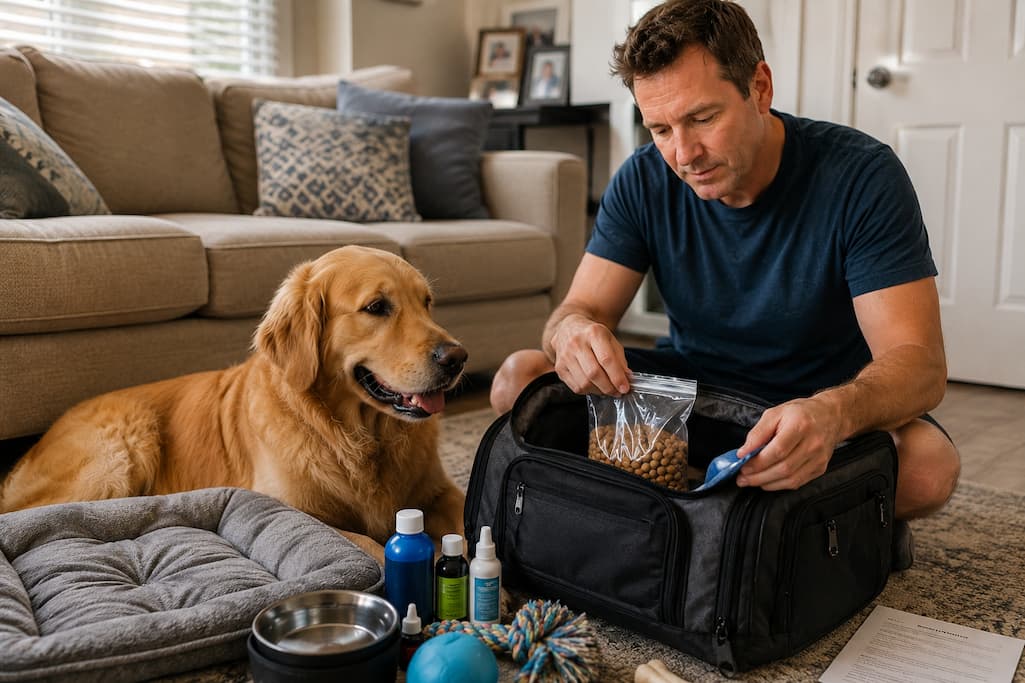
Day 7: Pack the bag. Cooper travels to boarding with his own food (enough for the stay plus two extra days in case of delays), his bed or a blanket that smells like home, a favorite toy, and a worn t-shirt of mine that carries my scent. I don’t pack his entire toy box — one or two familiar items are comforting; ten are clutter that the staff won’t manage. The food is non-negotiable. Switching diet during boarding is a recipe for digestive upset, which adds stress to an already stressful situation.
Day 3: Confirm details. I call the kennel to confirm drop-off and pick-up times, verify that they have my emergency contact information, and double-check any special instructions. Cooper gets a supplement with his dinner — I make sure the staff knows the dosage and timing. I also confirm their protocol for contacting me if something goes wrong. Some kennels call for anything unusual. Others only call for emergencies. I want to know which category I’m in.
Day 1: The drop-off. I keep this low-key. No long goodbyes, no emotional speeches, no lingering at the gate watching him walk away. I hand over the leash, say a calm “see you soon,” and leave. Dogs feed off human emotion. If I’m anxious, Cooper is anxious. If I’m matter-of-fact, he reads that as normal. The hardest part of boarding isn’t the facility. It’s the owner’s anxiety projecting onto the pet.
What I Look For During a Kennel Tour
The tour is your only chance to see the reality behind the website photos. Here’s what I check:
| What I Check | What I’m Looking For | Red Flags |
|---|---|---|
| Smell | Clean but not sterile; dogs live here, so it smells like dogs, not disinfectant | Overwhelming ammonia (urine), feces odor, or heavy chemical cover-up scents |
| Noise level | Some barking is normal; constant, frantic barking suggests stressed, understimulated dogs | Dogs pacing, spinning, or barking nonstop in runs; staff ignoring the noise |
| Staff interaction | Staff speak to dogs by name, use calm voices, handle gently | Staff dragging dogs, using harsh tones, or treating animals as inventory |
| Run size and condition | Large enough for dog to stand, turn, lie down comfortably; solid dividers between runs | Cramped spaces, rusted metal, broken latches, gaps between runs where dogs can interact unsafely |
| Outdoor access | Regular, supervised outdoor time; secure fencing; separate areas for different energy levels | No outdoor time, inadequate fencing, or all dogs in one chaotic yard regardless of temperament |
| Feeding routine | Individual feeding in runs or quiet spaces; accommodation for dietary needs | Group feeding in common areas; no flexibility for special diets or medications |
I also ask about staff-to-dog ratios, emergency protocols, and whether there’s a vet on call or nearby. The answers don’t need to be perfect, but they need to be specific. Vague assurances like “we handle emergencies” without details are worse than honest limitations.
The Pickup: What Cooper Tells Me
The moment of reunion reveals more than any webcam feed or staff report. I pay attention to:
Body condition: Is he at a healthy weight? Dehydration from stress or inadequate water access shows in sunken eyes and loose skin. Weight loss over a short stay suggests he wasn’t eating, which can indicate anxiety or illness.
Coat and skin: A dull coat, dry nose, or skin irritation can indicate stress, poor nutrition, or exposure to something in the environment. Cooper once came back with a mild rash on his belly from lying on a cleaning chemical residue. It cleared up in two days, but I switched kennels afterward.
Behavior: Is he excited to see me, or subdued? Some dogs are exhausted after boarding and sleep for a day — normal, especially if they played hard. But prolonged lethargy, loss of appetite, or behavioral regression (house soiling, increased anxiety) suggests the stay was too stressful. After Cooper’s longest stay (twelve days), he was clingy for three days and had one accident in the house. I considered that acceptable under the circumstances. If it had lasted a week, I would have reconsidered that kennel for future long stays.
The staff’s final words: What do they tell me unprompted? “Cooper was great, he loved the group play sessions” is different from “He was fine, here’s your receipt.” Enthusiastic, specific feedback means the staff paid attention. Generic reassurance means they didn’t, or they’re hiding something.
Alternatives to Boarding: The Full Picture
Boarding isn’t the only option, and sometimes it’s not the best. Here’s how the alternatives compare:
In-home pet sitting: A sitter stays in your house or visits multiple times daily. Best for pets who struggle with environmental change, have medical needs requiring close monitoring, or are anxious in group settings. More expensive than boarding ($50-80 per day for overnight sitting), but preserves routine and reduces stress. The risk is variable sitter quality — I’ve had excellent experiences and one disaster where the sitter forgot a medication dose.
House-sitting exchange: Someone stays in your house specifically to care for your pet, often in exchange for free accommodation. Platforms like TrustedHousesitters connect homeowners with sitters. Cost is minimal (annual membership fee), but vetting the sitter is your responsibility. I used this once for a ten-day trip and had a positive experience, but I wouldn’t use it for a pet with complex medical needs.
Bringing the pet: Sometimes the simplest solution. Cooper has traveled with me on road trips, to family gatherings, and to pet-friendly hotels. The feasibility depends on the destination, the pet’s travel tolerance, and your willingness to structure the trip around their needs. Not every vacation is pet-compatible, but more are than people assume.
Family or friends: The cheapest option, but not always the best. Cooper stayed with my sister once while I was away. She fed him, walked him, loved him. But she also let him sleep on her bed, fed him table scraps, and skipped two walks because she was busy. He came back happy, overweight, and with new habits I spent a month correcting. Family help is wonderful, but set boundaries clearly.
Related Articles
Boarding decisions connect to travel planning, pet behavior, health management, and alternative care arrangements. These articles from our site explore the related topics:
- How to Plan a Pet-Friendly Vacation — Sometimes the best boarding decision is not boarding at all. This covers how to structure trips that include your pet rather than leaving them behind.
- My Experience Flying With a Pet: What Airlines Don’t Tell You — Air travel with pets is complex but sometimes necessary. This covers when bringing your pet is feasible and when boarding is the only practical option.
- How I Found Pet-Friendly Airbnb Rentals That Actually Welcome Dogs — Pet-friendly accommodations reduce the need for boarding. This is how I find places where Cooper is genuinely welcome, not merely tolerated.
- How I Handle Feeding Schedules While Traveling With Pets — Whether boarding or traveling, maintaining nutrition consistency matters. This covers how I manage Cooper’s diet across different care arrangements.
- How to Recognize Signs of Pet Stress — Boarding is inherently stressful. This helps distinguish between normal adjustment behaviors and distress that requires changing your care plan.
- Managing Pet Stress During Loud Noises and Busy Days — Kennels are loud and busy. These techniques help reduce Cooper’s baseline anxiety before he even arrives at the facility.
- How to Maintain Dental Health for Pets — Boarding can disrupt oral care routines. This covers how I ensure Cooper’s dental health doesn’t regress during stays away from home.
- How I Monitor Pet Energy Levels for Early Health Signs — Post-boarding energy changes can indicate stress, illness, or inadequate care. This is the tracking system I use after Cooper returns from any stay.
- How I Correct Small Bad Habits in Pets Without Stress — Boarding sometimes creates or reinforces unwanted behaviors. These positive techniques help Cooper readjust to home routines without added anxiety.
- My Honest Review of 3 Pet-Friendly Hotel Chains After 10 Stays — Hotels are another alternative to boarding for shorter trips. This covers which chains deliver consistent pet-friendly experiences.
Sources and References
- American Kennel Club. “Boarding Your Dog: What to Know.” https://www.akc.org/expert-advice/training/boarding-your-dog-what-to-know/
- American Veterinary Medical Association. “What to Look for in a Pet Boarding Kennel.” https://www.avma.org/resources/pet-owners/petcare/what-look-pet-boarding-kennel
- PetMD. “How to Choose a Boarding Kennel for Your Dog.” https://www.petmd.com/dog/travel/how-to-choose-a-boarding-kennel-for-your-dog
- VCA Animal Hospitals. “Boarding Your Dog.” https://vcahospitals.com/know-your-pet/boarding-your-dog
- The Humane Society of the United States. “Choosing a Boarding Kennel.” https://www.humanesociety.org/resources/choosing-boarding-kennel
- The Spruce Pets. “How to Prepare Your Dog for Boarding.” https://www.thesprucepets.com/how-to-prepare-your-dog-for-boarding-1118616
The boarding experiences described reflect stays with Cooper, a Golden Retriever, at various facilities and alternative arrangements over four years. Every pet has unique needs, temperaments, and health considerations. Always tour facilities in person, verify credentials and insurance, and trust your instincts when evaluating care options for your animal.

Daniel Maxfield is a pet care writer focused on practical guidance for modern pet owners. He covers pet wellness, grooming, behavior, travel routines, and everyday care habits for dogs and cats. Through reader-focused educational content, Daniel shares simple and accessible tips designed to support healthier, safer, and more organized daily life with pets.